I received this in an Email today and so did GI KOREA
A United States soldier was attending some college courses between
assignments. He had completed missions in Iraq and Afghanistan.
One of the courses had a professor who was an avowed atheist and a
member of the ACLU.
One day the professor shocked the class when he came in. He looked to
the ceiling and flatly stated, "God, if you are real, then I want you to
knock me off this platform. I'll give you exactly 15 minutes." The
lecture room fell silent. You could hear a pin drop.
Ten minutes went by and the professor proclaimed, "Here I am God. I'm
still waiting."
It got down to the last couple of minutes when the soldier got out of
his chair, went up to the professor, and cold-cocked him knocking him
off the platform. The professor was out cold. The soldier went back to
his seat and sat there, silently. The other students were shocked and
stunned and sat there looking on in silence. The professor eventually
came to, noticeably shaken, looked at the soldier and asked, "What the
hell is the matter with you? Why did you do that?"
The soldier calmly replied, "God was too busy today protecting America's
soldiers who are protecting your right to say stupid shit and act like
an asshole. So, He sent me."
Monday, October 09, 2006


Sunday, October 08, 2006
Well today was the best of times and it was the worst of times.
Lets get the bad news out of the way....THE YANKEES LOST.....
I think its time to implode the team and start over again,
Now for the good news I went to the Korean Baseball Playoff here in Daejeon and recored video and posted it on myspace and I wil post it here for everyone to see.
Get this video and more at MySpace.com
Get this video and more at MySpace.com
Get this video and more at MySpace.com
Get this video and more at MySpace.com
well I finally posted homemade videos on myspace
OH DAJEON WON 3-2
Enjoy the videos
Lets get the bad news out of the way....THE YANKEES LOST.....
I think its time to implode the team and start over again,
Now for the good news I went to the Korean Baseball Playoff here in Daejeon and recored video and posted it on myspace and I wil post it here for everyone to see.
Get this video and more at MySpace.com
Get this video and more at MySpace.com
Get this video and more at MySpace.com
Get this video and more at MySpace.com
well I finally posted homemade videos on myspace
OH DAJEON WON 3-2
Enjoy the videos
Saturday, October 07, 2006
Friday, October 06, 2006
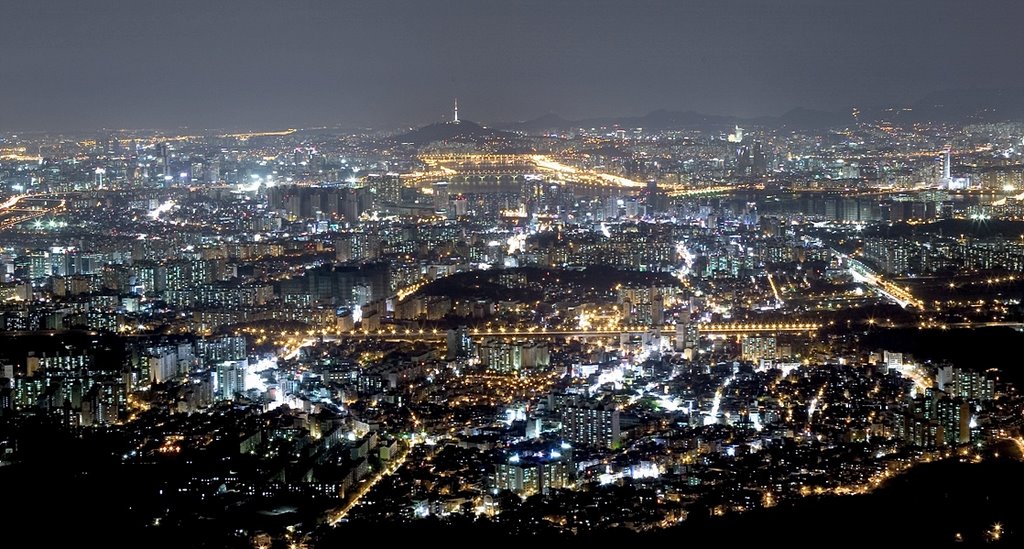
For they last few weeks I have been doing a movie theater review of all of the film places here in Daejeon, Korea. I have listed a video about the insanity of Dokto that shows that nationalism and the pure stupidity of the commercials that I have seen here at the Korean Theaters. Well Thanks to youtube, Here it is.
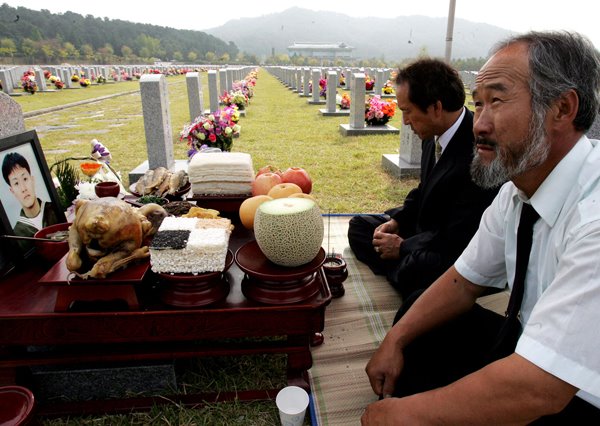
A Sad photo
Park Nam-jun, right, visits the grave of his son, Sergeant Park Dong-hyeok, who died in a June 2002 naval skirmish with North Korean forces, at the National Cemetery in Daejeon on the eve of Chuseok.
Happy Chuseok
Chuseok (Tip to GI Korea)
Chuseok is supposed to be a happy time of year for Korean families but for some families it is a time painful rememberance.
For background information click here.
Buy a T-shirt.
I saw this in Itaewon and just could not believe it. Be very very quiet, I'm hunting Americans. (Tip of the hat to Elmer Fudd)
Alleyway T-shirt vendors in the Itaewon district have a new competitor. The new must-have shirts read “I’m not migook” on the front, and on the back in Korean, “I am not an American.” Since the shirts first turned up at a shop in front of the neighborhood Starbucks in the middle of last month, more than 100 of the shirts have been sold every five days. The man who brought the thoughtful product into the world is a 31-year-old named Michael Kenny who would like to make it clear that he is Canadian.
Kenny hatched the idea of starting up his own business only two months ago. “When I started out, it was just to help make money for a trip my girlfriend and I were taking to South America and Australia,” he recalls. He found an untapped niche market: non-American Caucasians in Korea, with their fears of being thrown in the same pot with U.S. citizens. Kenny’s idea paid off. The going price of W15,000 is a little steep for a T-shirt, but that hasn’t stopped droves of European tourists and Canadian and Australian English instructors -- fed up with the “everything white is an American” attitude -- from snapping up every last one of the shirts. He has already recouped his investment, and from here on out, it’s pure profit for the entrepreneur. His Korean girlfriend says, “We’ve seen for ourselves just how many non-American Caucasians there really are in Korea.”
Michael spends his Fridays and Saturdays out on the Itaewoon sidewalk hawking his goods. A spinoff of his original best-seller -- “I’m waygook” on one side and “Foreigner” on the back -- also sells well. “I’ve been to Korea six times now, and there are always Koreans who assume that I’m an American and come up speaking only English to me,” said one German traveler who bought a shirt the moment he saw it. “What I’ve always wanted to say is written right there.” There are even Americans who see the fun in the shirt and purchase one for themselves. Kenny is only waiting for his first Korean customer.
But though things are going well, he still has two things to fret about. First, he is concerned about knockoffs. The flood of cheap copies inundating outlets in Itaewon is one of the things it is best known for, so Kenny decided to apply for a patent for his T-shirt design with the Korean Intellectual Property Office. But the complicated procedures involved are giving him a headache. Worry no. 2 is that people tend to associate the shirts with anti-Americanism. He says quite a few people have challenged him about the message. But his response is: “Oh, there’s nothing to it. It’s all just good fun. American whites are Caucasians, but that doesn’t mean all Caucasians are Americans. Now, wouldn’t it be nice if Koreans knew that too?”
I have alot of friends from Canada here in Korea so this is not directed at them ,but, as Robert said, "I’m in the market for a “I’m Not a Low-Quality Canadian English Teacher (who hates America and feels sad because they are great and we hate them)" jeogori if anyone’s got ‘em.
Foreign actors in "The Host" deported
Payback (From the Marmot)
The Dong-A Ilbo reports that immigration authorities have handed down deportation orders for actors David Anselmo and Clinton Morgan, both of whom appeared in Bong Joon-ho’s blockbuster “The Host,” for violating Article 20 of Korea’s immigration law, namely, that you must get government permission before engaging in activities other than the ones specified in your sojourn status.
Morgan, an Australian, was on a English teaching visa and employed at a university in Suwon, while Anselmo, a Canadian, was on a 90-day tourist visa.
Good news for the both, however. If they pay a 1 million won fine and leave Korea, they can return anytime they like. If they fail to pay the fine, however, they would be forcefully deported and barred from reentering the Land of the Morning Calm for 3-5 years. Which would suck.
Mr. Morgan, however, was still pretty pissed. He told the Dong-A (warning: retranslating from Korean here), “Restricting activities besides those marked on your visa is a narrow-minded policy… I don’t want to come back to Korea.”
Actually, I feel bad for the guys. I can see how they might have to pay a fine, but a deportation order? For appearing in, what, the highest grossing film in Korean cinema history? You’d figure just for their contributions to Korea’s film industry the authorities would go easy. Guess not. Hope they get some good legal help.
Someone elses remaks...
My favorite part of the sneering disdain many Koreans have for those foreigners who, for whatever reasons, decide to come to Korea instead of some other place, is the self-hatred behind the idea that such people have “nowhere to go but Korea”, or that only “low-quality” expatriates would choose this place.
Anyway, for the two actors, or for Mrs. Vershbow, all of the trouble could have been avoided simply by asking for permission to engage in some activity outside the scope of the original visa. In all cases, provided the foreigner has permission from his/her “owner” (think of yourselves as indentured servants or chattel slaves, and you’ll get the idea of the immigration department’s attitude toward foreigners resident in Korea, and whose rights they ought to be protecting), the immigration department is usually pretty generous about granting additional permission for work.
Free legal advice for the day: If you’re here in Korea on a visa, of whatever kind, ask yourself whether the economic activity you intend is permitted by the visa you currently hold (the answer is usually “no“), then go about getting the additional permission — in the form of an endorsement to your current visa — necessary to do it without getting deported.
THIS JEM ALSO.....
Back in the eighties, when Chun Doo Hwan was having the film industry crank out cautionary tales about dalliances with Itaewon’s foreign devils, there were always some white ninnies willing to play villains in the films. Two Europeans that I know of fell victim to the xenophobia they had helped whip up: immigration deported them. I agree with Hans: poetic justice.
But my guess is the Immigration turned a blind eye to Morgan and Anselmo for a couple years, then decided to boot them out before they turn into bona fide “talents”.
Thursday, September 28, 2006
We are going to the PIFF!
Ok, now what is the PIFF?
11TH Pusan International Film Festival
On October 14th at 1130 and 1430 me and my former co-worker will be watching 2 movies the first one will be 12:08 East of Bucharest this one will start at 1130 and will be playing at the CGV Jangsan 6, it is a film about the fall of Nicolae Ceausescu of Romania and it's a Critic's Choice selection at the Festival.
The second one is Soul Kicking this one will start at 1430 and will be playing at the CGV Jangsan 6, it is a film from Greece/Cyprus and it's in the World Cinema selection. I could not get any tickets and the times just never would work for the one that I really wanted to see. The film is called Days of Glory , I know , another French War film. (The last 2 French films I really went crazy over werethe re-release of Battaglia di Algeri, La in 2004 and Joyeux Noel, the latter I gave the #1 selection on Socious best film of the year.)
I have allready seen some of the films that wil be shown here, The 9th Company, The Host and a few others. I have 2 PIFF books and tickets in hand. What really suprised me was the price of the tickets, they were 5,000 Won ($5.50) each.
It looks like a KTX ride to Pusan and then we will have to take the subway to Jangsan Station. I am so looking forward to this.
Happy Birthday, Claudia
Saturday was my daughters 10th birthday. It was a sad day for me, I still do not have any idea where She and my son, Sean , live at in California. They probably think that I have forgoten about them but I have not and my ex will not let me talk to them. Its just a sad story, that sadly, will continue.
I hope that you had a very nice birthday.
Thursday, September 14, 2006
Am I Famous Here In Korea
Am I famous here in Korea? At times I sure do not understand it. Today I was in Costco, looking at Ipods, when I see this group of High School girls. I bow and say, hello ladies, The girls all start to giggle at me and take my photo with their cell cameras. Later I was eating pizza and I was thinking about what had just happened .
I recalled Bob "The Beast Sapp, talking about how everytime he traveled in Japan, the girls would gigle and always have his picture taken. It sure sounded familiar today.
Now I am not A k-1 fighter, the only think I have going is that I am 6'4. maybe I am the first tall white guy that they have talked do, to be honest I do not understand it but it sure does happen alot.
Tuesday, September 12, 2006







Sunday, September 10, 2006
2996
2,996 is a tribute to the victims of 9/11.
On September 11, 2006, 2,996 volunteer bloggers
will join together for a tribute to the victims of 9/11.
Each person will pay tribute to a single victim.
We will honor them by remembering their lives,
and not by remembering their murderers.
I saw this link and I knew that I had to join this. I really can not tell anybody why. It just seemed like the right thing to do, and that I had to do it.
So When I joined I was sent an Email and I was given a name
The name was Francis X. Deming
What I found out was that he was 47 years old when he died, he worked at the WTC for Oracle and that he loved God and that he loved his family. I can think of no better words than those to honor this man.
Francis X. Deming

Solid Man, Quiet Hero
Francis Xavier Deming was not a peacock. He was not ostentatious, flashy or loud. He was a solid man who bowed to God. "He was the quiet hero," said his sister Rose Deming-Phalon. "He worked hard and he worked a lot. He loved his family and he is missed."
By his sister's account, Mr. Deming, 47, was one of the workaday Americans who is never celebrated. He went to his job as an accountant at the Oracle Corporation and came directly home to Franklin Lakes, N.J. He taught his five children to swim. He was active in his church, Most Blessed Sacrament. He built furniture. He was a man who did not lean on others, but whom others leaned on.
His last day on earth is a good example. There is a record of it in a message he left for his wife on their answering machine. He and a group were fleeing the 99th floor of 1 World Trade Center. "Get down low so you can breathe better," he told the group. And then: "What happened to the people who were behind us?"
Profile published in THE NEW YORK TIMES on November 2, 2001.
Francis X. Deming age 47, of Franklin Lakes, missing from World Trade Center since Sept. 11, 2001. Beloved husband of Brooke (nee Flynn). Devoted and adored father of Brian, Craig and Christopher, and step-father of Jeffrey and Brooke. Loving son of Ann Deming of Pequannock and the late Thomas J. Deming. Frank will be sorely missed by brothers Thomas of Towaco, Patrick of Mine Hill, Michael of Auburn. N.Y, and Robert of Monroe, NY.: and sister Rose Phalon of Pequannock. He also leaves behind many nephews and nieces, aunts and uncles, in-laws, cousins and friends. Frank was a member of Most Blessed Sacrament R.C. Church in Franklin Lakes.
He was employed by Oracle Corp as a practice director, working in the offices of Marsh McClennan on the 99th floor of Tower One of the World Trade Center. Prior to that he was employed as consultant by Exxon, TRW, Price Waterhouse, Coopers & Lybrand and Anderson consulting. He was a 1968 graduate of Holy Spirit Elementary School in Pequnnock and a 1972 graduate of Pequannock Township High School.
He graduated William Patterson College in 1976, and completed his Master's at Business Adminstration degree at Fairleigh Dickinson University in 1979. A strong believer in honest hard work. Frank held a number Jobs, including those of a cook in W.T. Grants' in Pompton Plains and member of the National Ski Patrol, to pay for his education. These will be among the many qualities he will pass along to his family. Frank was an avid sportsman, whose activities always included his family. He was a accomplished skier and boater.
Many of his happiest days were spent aboard his boat, the Good Times, water skiing on Lake Hopatcong or just enjoying a quiet sunset on the water. Although Frank's professional background was in accounting and computer software systems, he was also very good with this hands. Whether plumbing, electric or carpentry, there was rarely a project, repair or improvement in his home he could not handle. And he could always be counted to lend a hand to a family member or friend. When he found time to relax Frank and Brooke could often be found dining at Aldo's in Wyckoff,
Frank's friends and family are invited to Join in celebration of life Saturday, September 29 at 9:45 a.m. at Most Blessed Sacrament Church, 787 Franklin Lakes Road, Franklin Lakes, N.J. 07417. In lieu of flowers contributions in Franks' name may be made to The American Red Cross and The American cancer' Society.
Paid Notice published in THE BOSTON GLOBE on September 27, 2001.
Francis X. Deming, 47, an avid boater
Francis X. Deming of Franklin Lakes named his motorboat Good Times, and not without reason.
"Most of his time was spent on Lake Hopatcong boating with his wife, Brooke, his children and friends," said Robert Vreeland, a longtime friend who shared Mr. Deming's enthusiasm for water sports.
"Frank was an avid sportsman, whose activities always included his family," Vreeland recalled. "He was an accomplished skier and boater. Many of his happiest days were spent aboard his boat, water skiing or just enjoying a quiet sunset on the water."
Mr. Deming, 47, also enjoyed his job as a practice director for the California-headquartered Oracle Corp., a data-based software developer. At the time of the terrorist attack on the World Trade Center, Mr. Deming was at work as an Oracle consultant in the offices of Marsh McClennon on the 99th floor of the North Tower.
Although his professional background was in accounting and computer software systems, he was described as very good with his hands. Whether it was plumbing, electrical work or carpentry, there was rarely a repair or improvement project in his home that he could not handle. Family and friends could always count on him for his skills.
Mr. Deming was a 1968 graduate of Holy Spirit Elementary School in Pequannock and a 1972 graduate of Pequannock High School. He graduated from William Paterson College in 1976 and completed his master's of business administration degree at Fairleigh Dickinson University in 1979.
In addition to his wife, Mr. Deming is survived by his mother, Ann Deming of Pequannock; his children, Brian, Craig and Christopher, and stepchildren, Jeffrey and Brooke; four brothers, Thomas of Towaco, Patrick of Mine Hill, Michael of Auburn, N.Y., and Robert of Monroe, N.Y., and a sister, Rose Phalon of Pequannock.
A celebration of life ceremony will be held at 9:45 a.m. Saturday at the Most Blessed Sacrament Church, 787 Franklin Lakes Road, Franklin Lakes.
In lieu of flowers, contributions in Mr. Deming's name may be made to the American Red Cross and the American Cancer Society.
Profile by William Gordon published in THE STAR-LEDGER.
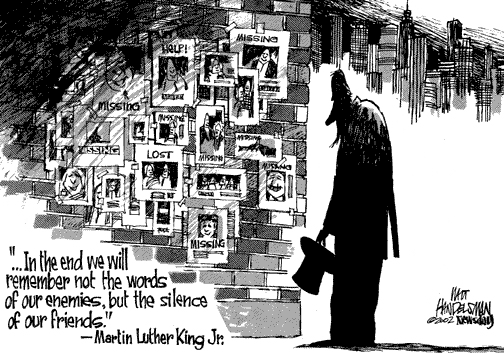
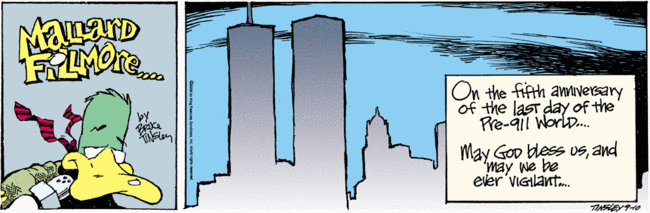
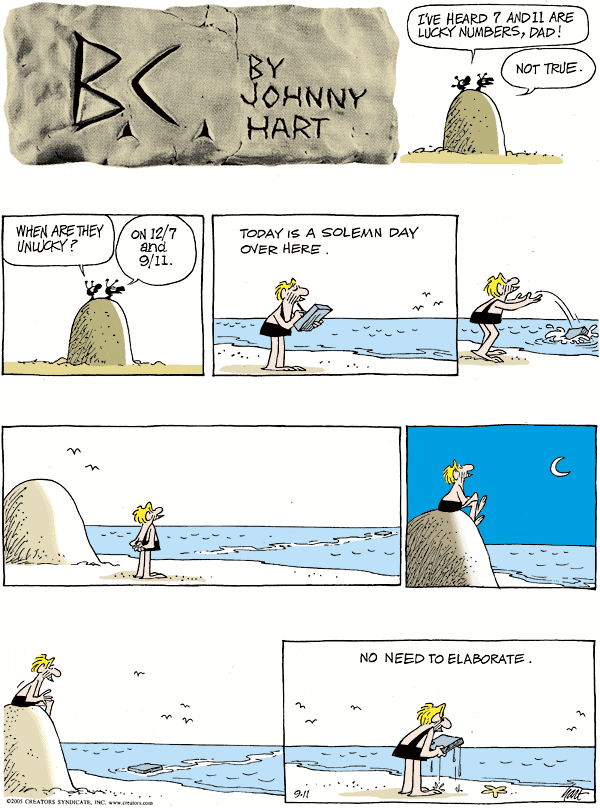
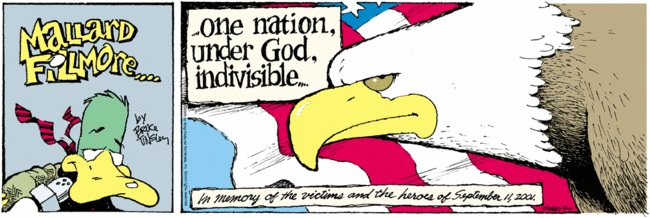
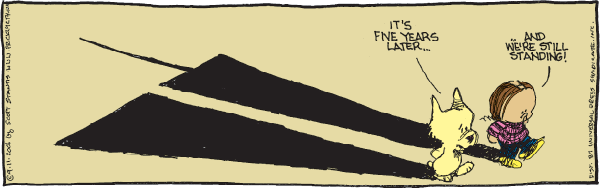
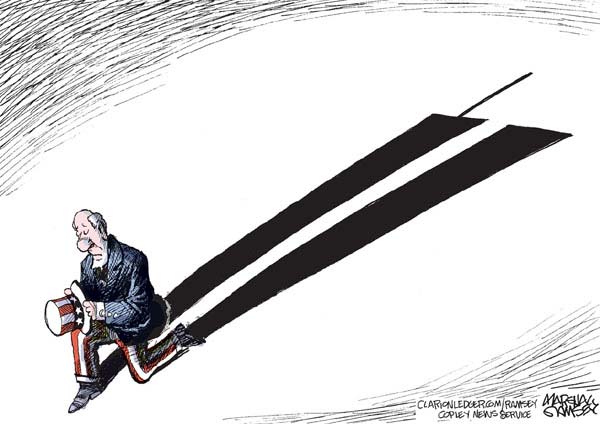
I have learned something over the years that I was a police officer, "You can tell alot about a man when he has a huge crisis and you see how he reacts to it."
I noticed that on the phone call to his wife, he was heard telling his people to get low to the ground and wondering where the people were that were just behind in his group as they were trying to escape the WTC.
This tells me what kind of a man he was, he was worried about his fellow man. He loved God, His Family, and his fellow man. We should all try and follow this example.
Friday, September 08, 2006
My former co-worker wrote this and I thought that it needed to be stated here in my blog.
I really did not see what was going on until I saw Stephanie say no, then I moved the guy away from Steph in about 2 seconds. I still can not believe that these Korean men try and buy Stephanie like she is a piece of meat. I have always wondered what would happen if I tried to buy a girl at that club, like the Korean men were trying to buy Stephanie. Is was very pathetic to see the guy cry because I removed him from Stephanie but damn it was just sad. I kept my eye on him for the rest of the night. I was in taxi one so I did not see the cab 2 incident, but I would have removed him again if I had been in cab 2.
Here is the rest of the story from her own words.....
For those of you who aren’t foreigners in Korea or familiar with our situation, because I have blonde hair and blue eyes, in Korea it is assumed that I am Russian. The first few times I heard this, I wasn’t surprised or offended by this because I passed for a Russian in Russia both times I went there. Later, I came to understand that by being asked if I am Russian, a Korean man is actually asking me if I am a prostitute (if they just ask where I’m from as an opened ended question, there’s nothing implied). The strange thing about it is that it has nothing to do with what I’m wearing or how I’m behaving, and everything to do with the way that I look naturally. I shrugged the incident off since it happens often enough not to be anything of scandal. After mentioning the event while getting the group together and walking to the North Korean bar, it became a running gag for the night.
Later, I was at a nightclub downtown called "Boobi boobi" which is always a good time. At one point, a young Korean man wanted to dance with me, so I humored him for a minute and then broke away to go dance with my little circle of friends who were nearby on the dance floor. A little while later, he came back and started asking my friend Trey about me. Trey gave me a confused/incredulous look and told the guy “no.” The guy kept asking questions and pointing to me, and Trey kept shaking his head saying “no” and crossing his arms across his chest in the Korean “no” fashion.
The guy wouldn’t let up and decided to talk to me directly. I couldn’t understand a word he was saying until the words “how much” came out of his mouth. I looked at Trey, and he said “I kept telling him that we’re American and that we’re not Russian but he keeps asking.” I was disgusted at this man’s persistence in pursuing me as a product to be bought and sold and told him in Korean to go away. The guy wouldn’t listen to me and continued trying to talk to me, but I wasn’t having it. Luckily, big Mike, my bouncer, saw me yelling at this guy and forcibly removed him from my presence. Good job, Mike! Heather said the guy almost cried when Mike tossed him away.
I was really irritated at being propositioned twice in one night, and especially at the creepy persistence of the second interested party. I needed to step away for a moment and calm down because I could feel my anger rising. I left the dance floor and stood by the lockers, drinking my drink. After about two minutes, another Korean guy came up to me, tried to put his arm around me, and asked me if I was Russian. I angrily replied that I was American, and decided that enough was enough. Three propositions in one night is three strikes and I’m out.
I rounded up my friends that hadn’t gone home already, and we decided to continue the party at my place. I took off in the first taxi with a few people, and the rest packed into the second taxi to follow us. After my taxi had pulled away, the second taxi was preparing for departure when the creepy Korean guy who wanted to buy me tried to hop in the front seat of the second taxi. Its occupants made it very clear that he was not welcome, but he refused to get out of the cab. One of the guys in taxi got out and again, had to physically removed him from the group.
This kind of situation bothers me not only because it’s insulting to be thought of as something that can be bought and sold, but I find it to be especially insulting to all the Russian women that I know (since I’m American, not Russian), most of whom are completely respectable individuals. I know that there are certain individuals and realities that give some Russian women that kind of reputation in Korea, but first of all, I guarantee you there are more Korean prostitutes than any other kind in Korea.
That does not mean that all Korean women are prostitutes, although it kills me how a regular Korean girl can walk around in high heels and a skirt so short you can see her ass cheeks and everything’s cool, but if I am completely covered I must be selling myself since I'm blonde and white. Following that train of thought, I find it appalling that some Korean people assume that all yellow haired females must be for sale. It’s total racism. I’m not comparing this in an exact way to the racism that occurred in America in the earlier part of the twentieth century, but to a certain extent, it is. I’ve had cab drivers pull up, take a look at me and say “Russia no!” before driving off without me. I’ve been approached by businessmen and propositioned in broad daylight while trying to get my groceries in a cab. I guess he thought I’d be quick enough to finish him off and get home before the ice cream melted.
Korea spends a good amount of energy trying to protect what they see as their traditional culture and values, but with that come closed-mindedness, xenophobia, and intolerance. Korea sees a lot of its cultural problems as the influence of outside (read western) culture and foreigners corrupting their food, their clothes, their language, and their general way of life. It’s all well and good to maintain one’s cultural identity, but that does not entitle any culture to hate, avoid, or look down upon another group or ethnicity simply because it is not one’s own. It makes even less sense for a country trying to become more important on the world stage to make generalizations about the people that currently reside in or visit the country.
At the same time, Koreans treat westerners (read English speakers) as something desirable and essential to what they see as their gateway to the rest of the world. I think it’s amazingly ironic that I can get a job anywhere here, and get a job instead of someone more qualified because I’m young, white, and blonde, but if I step out into the street to run some errands, some people will assume that I’m a prostitute.
I find it insulting, especially as someone who prides herself on being a person of substance, to be treated as something that can be bought or sold. It’s not the first time that it’s happened here, it won’t be the last time, I’m sure, but that doesn’t make it right. It’s embarrassing, it’s degrading, and I refuse to put up with it.
I really did not see what was going on until I saw Stephanie say no, then I moved the guy away from Steph in about 2 seconds. I still can not believe that these Korean men try and buy Stephanie like she is a piece of meat. I have always wondered what would happen if I tried to buy a girl at that club, like the Korean men were trying to buy Stephanie. Is was very pathetic to see the guy cry because I removed him from Stephanie but damn it was just sad. I kept my eye on him for the rest of the night. I was in taxi one so I did not see the cab 2 incident, but I would have removed him again if I had been in cab 2.
Here is the rest of the story from her own words.....
For those of you who aren’t foreigners in Korea or familiar with our situation, because I have blonde hair and blue eyes, in Korea it is assumed that I am Russian. The first few times I heard this, I wasn’t surprised or offended by this because I passed for a Russian in Russia both times I went there. Later, I came to understand that by being asked if I am Russian, a Korean man is actually asking me if I am a prostitute (if they just ask where I’m from as an opened ended question, there’s nothing implied). The strange thing about it is that it has nothing to do with what I’m wearing or how I’m behaving, and everything to do with the way that I look naturally. I shrugged the incident off since it happens often enough not to be anything of scandal. After mentioning the event while getting the group together and walking to the North Korean bar, it became a running gag for the night.
Later, I was at a nightclub downtown called "Boobi boobi" which is always a good time. At one point, a young Korean man wanted to dance with me, so I humored him for a minute and then broke away to go dance with my little circle of friends who were nearby on the dance floor. A little while later, he came back and started asking my friend Trey about me. Trey gave me a confused/incredulous look and told the guy “no.” The guy kept asking questions and pointing to me, and Trey kept shaking his head saying “no” and crossing his arms across his chest in the Korean “no” fashion.
The guy wouldn’t let up and decided to talk to me directly. I couldn’t understand a word he was saying until the words “how much” came out of his mouth. I looked at Trey, and he said “I kept telling him that we’re American and that we’re not Russian but he keeps asking.” I was disgusted at this man’s persistence in pursuing me as a product to be bought and sold and told him in Korean to go away. The guy wouldn’t listen to me and continued trying to talk to me, but I wasn’t having it. Luckily, big Mike, my bouncer, saw me yelling at this guy and forcibly removed him from my presence. Good job, Mike! Heather said the guy almost cried when Mike tossed him away.
I was really irritated at being propositioned twice in one night, and especially at the creepy persistence of the second interested party. I needed to step away for a moment and calm down because I could feel my anger rising. I left the dance floor and stood by the lockers, drinking my drink. After about two minutes, another Korean guy came up to me, tried to put his arm around me, and asked me if I was Russian. I angrily replied that I was American, and decided that enough was enough. Three propositions in one night is three strikes and I’m out.
I rounded up my friends that hadn’t gone home already, and we decided to continue the party at my place. I took off in the first taxi with a few people, and the rest packed into the second taxi to follow us. After my taxi had pulled away, the second taxi was preparing for departure when the creepy Korean guy who wanted to buy me tried to hop in the front seat of the second taxi. Its occupants made it very clear that he was not welcome, but he refused to get out of the cab. One of the guys in taxi got out and again, had to physically removed him from the group.
This kind of situation bothers me not only because it’s insulting to be thought of as something that can be bought and sold, but I find it to be especially insulting to all the Russian women that I know (since I’m American, not Russian), most of whom are completely respectable individuals. I know that there are certain individuals and realities that give some Russian women that kind of reputation in Korea, but first of all, I guarantee you there are more Korean prostitutes than any other kind in Korea.
That does not mean that all Korean women are prostitutes, although it kills me how a regular Korean girl can walk around in high heels and a skirt so short you can see her ass cheeks and everything’s cool, but if I am completely covered I must be selling myself since I'm blonde and white. Following that train of thought, I find it appalling that some Korean people assume that all yellow haired females must be for sale. It’s total racism. I’m not comparing this in an exact way to the racism that occurred in America in the earlier part of the twentieth century, but to a certain extent, it is. I’ve had cab drivers pull up, take a look at me and say “Russia no!” before driving off without me. I’ve been approached by businessmen and propositioned in broad daylight while trying to get my groceries in a cab. I guess he thought I’d be quick enough to finish him off and get home before the ice cream melted.
Korea spends a good amount of energy trying to protect what they see as their traditional culture and values, but with that come closed-mindedness, xenophobia, and intolerance. Korea sees a lot of its cultural problems as the influence of outside (read western) culture and foreigners corrupting their food, their clothes, their language, and their general way of life. It’s all well and good to maintain one’s cultural identity, but that does not entitle any culture to hate, avoid, or look down upon another group or ethnicity simply because it is not one’s own. It makes even less sense for a country trying to become more important on the world stage to make generalizations about the people that currently reside in or visit the country.
At the same time, Koreans treat westerners (read English speakers) as something desirable and essential to what they see as their gateway to the rest of the world. I think it’s amazingly ironic that I can get a job anywhere here, and get a job instead of someone more qualified because I’m young, white, and blonde, but if I step out into the street to run some errands, some people will assume that I’m a prostitute.
I find it insulting, especially as someone who prides herself on being a person of substance, to be treated as something that can be bought or sold. It’s not the first time that it’s happened here, it won’t be the last time, I’m sure, but that doesn’t make it right. It’s embarrassing, it’s degrading, and I refuse to put up with it.
Thursday, September 07, 2006
My Socious review for United 93 and World Trade Center
http://www.imdb.com/title/tt0475276/ imdb link United 93
http://www.imdb.com/title/tt0469641/ imdb link for World Trade Center
Release dates in Korea. United 93 9-7-06. World Trade Center Unknown
How I saw both films. Cam VCD
Plot For United 93. On September 11, 2001, America witnessed three terrorist attacks when three planes were hijacked and destroyed the pentagon and the two world trade centers. However, one plane in the mist of the hijacking never reached its target. Instead the passengers fought back to save thousands of lives even if it meant they too, would die. This is their story. The story of United Flight 93.
Plot for World Trade Center. In the aftermath of the World Trade Center disaster, hope is still alive. Refusing to bow down to terrorism, rescuers and family of the victims press forward. Their mission of rescue and recovery is driven by the faith that under each piece of rubble, a co-worker, a friend a family member may be found. This is the true story of John McLoughlin and William J. Jimeno, two of the last survivors extracted from Ground Zero and the rescuers who never gave up. It's a story of the true heroes of that fateful time in the history of the United States when buildings would fall and heroes would rise, literally from the ashes to inspire the entire human race.
Opening Weekend.
United 93 $11,478,360 (USA) (30 April 2006) (1,795 Screens)
World Trade Center $18,730,762 (USA) (13 August 2006)
When I agreed to do the movie reviews, I promised to tell the truth and to call it straight. To be very honest I did not want to see these 2 movies, I knew how I would react to them. I made a promise to always see the good films along with the bad films, so I went into these 2 with a very heavy heart. I have decided to do these 2 reviews together because the both talk about a very sad day that will not be forgotten for a very long time.
When I saw the 2006 film release schedule back in January, I soon realized these 2 films and next years Adam Sandler tackle on the aftermath of this day . I just sighed and dreaded the day that I would have to do these reviews. I was lucky I did not loose anybody that I knew that day, some of my friends were not so luck, they lost loved ones that day.
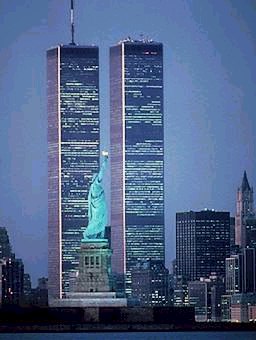
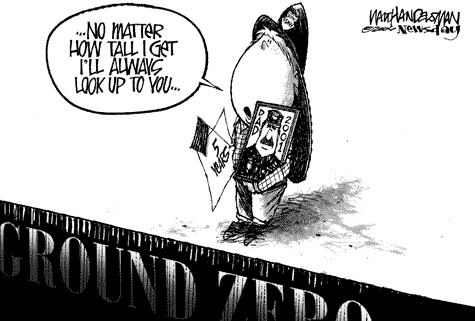
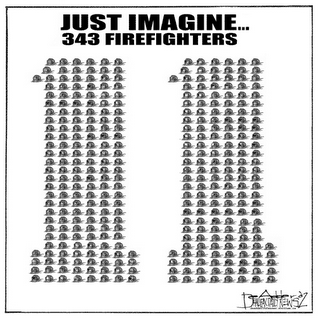
I have selected 2 cartoons to, in a very simple way, to show what was lost that day.
 alt="" />

You can see what was lost that day, 343 firefighter and many innocent people.
The first review will be for the film “United 93” it will be released on 7 September 2006, here in south Korea.
I have always had a question about my life in the US Army and as a police officer, what would you do when you have to face real evil and its wants you dead. I was lucky, I was always able to skate around this without ever having to answer this decision. The people on flight United 93 has the same decision to make and the film deal with their reaction to insanity.
You can see what was lost that day, 343 firefighter and many innocent people.
The first review will be for the film “United 93” it will be released on 7 September 2006, here in south Korea.
I have always had a question about my life in the US Army and as a police officer, what would you do when you have to face real evil and its wants you dead. I was lucky, I was always able to skate around this without ever having to answer this decision. The people on flight United 93 has the same decision to make and the film deal with their reaction to insanity.
This will not be an easy film to watch, if you know anybody who lost anybody on this sad day then please do not see the movie, it will be to painful to remember. If you want to see a very good movie then I highly recommend this film. There are no big name stars in this film and some of the actually US Military and FAA people involved in the decision making of that day play themselves in the film. Near the end of the film, when you know what is going to happen, and the passengers and crew call to say goodbye to their loved ones, It will make you very angry and very sad at the same time.
Grade (A+)
Next movie review will be Oliver Stone’s World Trade Center
When I saw Stones name attached to this I was thinking, “Great another JFK film” with his waked out conspiracies and theories.
I was so glad that I was wrong! This is a good film by Stone but it is not a great one like United 93.
I also had another pre-judgment error about this film, I thought that the film would be about Nicolas Cage’s character, Sgt. John McLoughlin. He plays the leader of his small band of brothers but the film really belongs to 2 actors who take you by the hand and shows you what hell was like on that day. Michael Pena plays the role of Officer William Jimeno, who was trapped under the rubble of the WTC. The other stars name is Michael Shannon, who plated Dave Karnes, a former Marine, who put back on his uniform and went to Ground Zero to save lives and to find it.
I was really impressed with the role that Shannon played in the film, he plays a man who knows that he has to do something and in the end he is the one who finds the trapped officers in the WTC rubble. During the films credits you find out that Karnes’ later re-enlisted in the Marine Corps and served two tours of duty in Iraq.
Michael Pena takes the next step, from becoming a part player, as he was in the film “Crash” to actually being able to carry a movie, When you are shown his back story while he is trying to stay alive under the WTC, you see that he pulls it off and you believe it. When his daughter ask when is daddy coming home, it will really strike at you very hard.
I thought the film would cover more of the WTC, but it just covers the collapse, A police officer that feels guilty and makes a very sad decision and their rescue. It just seemed that something was missing, it was the small parts that make a good film into great one.
The film will make you feel very sad about that day and when the dispatcher makes the comment, “A lot more people went to help at the WTC than are coming back, where are they at?” It just left me very sad because a lot of them never did make it back.
Overall, this film had a nice idea but just never seemed to be able to reach it. It’s a good film and needs to be seen but its not a great film and from Oliver Stone I was expecting more than what I received.
Grade B+
Please see both films when you can.
http://www.imdb.com/title/tt0475276/ imdb link United 93
http://www.imdb.com/title/tt0469641/ imdb link for World Trade Center
Release dates in Korea. United 93 9-7-06. World Trade Center Unknown
How I saw both films. Cam VCD
Plot For United 93. On September 11, 2001, America witnessed three terrorist attacks when three planes were hijacked and destroyed the pentagon and the two world trade centers. However, one plane in the mist of the hijacking never reached its target. Instead the passengers fought back to save thousands of lives even if it meant they too, would die. This is their story. The story of United Flight 93.
Plot for World Trade Center. In the aftermath of the World Trade Center disaster, hope is still alive. Refusing to bow down to terrorism, rescuers and family of the victims press forward. Their mission of rescue and recovery is driven by the faith that under each piece of rubble, a co-worker, a friend a family member may be found. This is the true story of John McLoughlin and William J. Jimeno, two of the last survivors extracted from Ground Zero and the rescuers who never gave up. It's a story of the true heroes of that fateful time in the history of the United States when buildings would fall and heroes would rise, literally from the ashes to inspire the entire human race.
Opening Weekend.
United 93 $11,478,360 (USA) (30 April 2006) (1,795 Screens)
World Trade Center $18,730,762 (USA) (13 August 2006)
When I agreed to do the movie reviews, I promised to tell the truth and to call it straight. To be very honest I did not want to see these 2 movies, I knew how I would react to them. I made a promise to always see the good films along with the bad films, so I went into these 2 with a very heavy heart. I have decided to do these 2 reviews together because the both talk about a very sad day that will not be forgotten for a very long time.
When I saw the 2006 film release schedule back in January, I soon realized these 2 films and next years Adam Sandler tackle on the aftermath of this day . I just sighed and dreaded the day that I would have to do these reviews. I was lucky I did not loose anybody that I knew that day, some of my friends were not so luck, they lost loved ones that day.
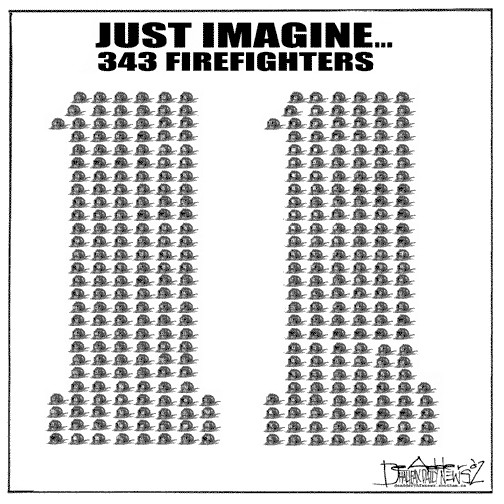
I have selected 2 cartoons to, in a very simple way, to show what was lost that day.
 alt="" />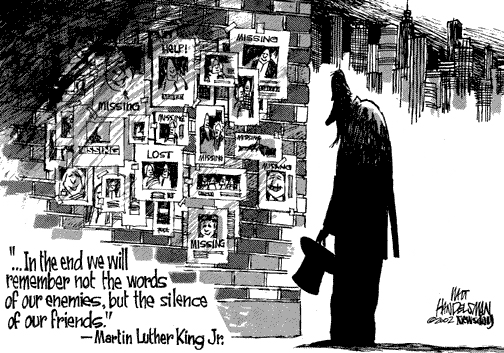
You can see what was lost that day, 343 firefighter and many innocent people.
The first review will be for the film “United 93” it will be released on 7 September 2006, here in south Korea.
I have always had a question about my life in the US Army and as a police officer, what would you do when you have to face real evil and its wants you dead. I was lucky, I was always able to skate around this without ever having to answer this decision. The people on flight United 93 has the same decision to make and the film deal with their reaction to insanity.
You can see what was lost that day, 343 firefighter and many innocent people.
The first review will be for the film “United 93” it will be released on 7 September 2006, here in south Korea.
I have always had a question about my life in the US Army and as a police officer, what would you do when you have to face real evil and its wants you dead. I was lucky, I was always able to skate around this without ever having to answer this decision. The people on flight United 93 has the same decision to make and the film deal with their reaction to insanity.
This will not be an easy film to watch, if you know anybody who lost anybody on this sad day then please do not see the movie, it will be to painful to remember. If you want to see a very good movie then I highly recommend this film. There are no big name stars in this film and some of the actually US Military and FAA people involved in the decision making of that day play themselves in the film. Near the end of the film, when you know what is going to happen, and the passengers and crew call to say goodbye to their loved ones, It will make you very angry and very sad at the same time.
Grade (A+)
Next movie review will be Oliver Stone’s World Trade Center
When I saw Stones name attached to this I was thinking, “Great another JFK film” with his waked out conspiracies and theories.
I was so glad that I was wrong! This is a good film by Stone but it is not a great one like United 93.
I also had another pre-judgment error about this film, I thought that the film would be about Nicolas Cage’s character, Sgt. John McLoughlin. He plays the leader of his small band of brothers but the film really belongs to 2 actors who take you by the hand and shows you what hell was like on that day. Michael Pena plays the role of Officer William Jimeno, who was trapped under the rubble of the WTC. The other stars name is Michael Shannon, who plated Dave Karnes, a former Marine, who put back on his uniform and went to Ground Zero to save lives and to find it.
I was really impressed with the role that Shannon played in the film, he plays a man who knows that he has to do something and in the end he is the one who finds the trapped officers in the WTC rubble. During the films credits you find out that Karnes’ later re-enlisted in the Marine Corps and served two tours of duty in Iraq.
Michael Pena takes the next step, from becoming a part player, as he was in the film “Crash” to actually being able to carry a movie, When you are shown his back story while he is trying to stay alive under the WTC, you see that he pulls it off and you believe it. When his daughter ask when is daddy coming home, it will really strike at you very hard.
I thought the film would cover more of the WTC, but it just covers the collapse, A police officer that feels guilty and makes a very sad decision and their rescue. It just seemed that something was missing, it was the small parts that make a good film into great one.
The film will make you feel very sad about that day and when the dispatcher makes the comment, “A lot more people went to help at the WTC than are coming back, where are they at?” It just left me very sad because a lot of them never did make it back.
Overall, this film had a nice idea but just never seemed to be able to reach it. It’s a good film and needs to be seen but its not a great film and from Oliver Stone I was expecting more than what I received.
Grade B+
Please see both films when you can.
Sunday, September 03, 2006
well a real intresting look at our problem child of the North and he does not pull any punches, its a long read but a good one. thanks to the koreanliberator.org for this one
Chuck Downs is an author, independent consultant, and former Pentagon official who frequently appears on television news programs to discuss North Korea policy. He has held a number of important positions in government during his career, including Deputy Director for Regional Affairs and Congressional Relations in the Pentagon’s East Asia office and Assistant Director of the Office of Foreign Military Rights Affairs, where he was deeply involved in the planning and negotiation of key overseas basing agreements with foreign governments. He later served as Senior Defense and Foreign Policy Advisor to the House Policy Committee of the U.S. House of Representatives. He retired from government service in 2000.
Since his retirement, Mr. Downs has served as a Senior Fellow at the National Institute for Public Policy, where he chaired the North Korea Working Group, as a fellow at the Institute for Corean-American Studies, and the former Associate Director of the Asian Studies Program at the American Enterprise Institute. He currently serves on the board of the U.S. Committee for Human Rights in North Korea and the North Korean Freedom Coalition. He co-wrote Crisis in the Taiwan Strait with Former U.S. Ambassador to Korea and China, James Lilley. He is best known as the author of Over the Line: North Korea’s Negotiating Strategy, which has also been published in Korean and Japanese. This quotation should give you a general idea of how Mr. Downs views his subject:
“North Korea does not enter into negotiations because it seeks agreements. Its objective is to gain concessions and benefits merely as a result of consenting to talk.” He believes not only that the deliberate policies of the Pyongyang government have claimed more than 500,000 lives each year since 1995 [the article was published in 2000], but that in many ways the regime is better off today than it has been at almost any time in the past. “It has obtained political recognition, security assurances and significant economic assistance -even from its former enemies. Through its negotiating strategy, the North Korean leadership has avoided political and economic collapse time and again during the past five decades.” [….] “Contrary to the hopes of the administration, North Korea has used these years to develop a more threatening military posture, not less.”
Our thanks to Mr. Downs for agreeing to this interview. He has also agreed to answer readers’ questions in the comments below. As always, I reserve the right to moderate comments.
============================
Q: There have been some rumors among Korea bloggers that in October, after the next talks on the future of the alliance, that an accelerated downsizing or even a full U.S. withdrawal from Korea could be announced. Have you heard those rumors? Do you think there’s anything to them?
A: I wouldn’t call them rumors. For a long time, there have been discussions between both countries on troop deployments. South Korea has resisted a fast timetable of reductions, but Secretary Rumsfeld wants these things to happen on a faster timetable. That’s what he has always said. I think Rumsfeld and his people still want to proceed on that accelerated path. So this is not a new push by Rumsfeld. Perhaps the reductions have recently become even more desirable from the point of view of the Pentagon.
It’s clear that the SK government wants to give lip service to the alliance, but its point of view is at odds with the basic rationale for the alliance. You can’t have an alliance when one side tries to portray the other as an oppressive presence. When this develops, as it did in the Philippines, there is no alternative but to accelerate the reduction in the American presence. The government in South Korea is now limiting us in ways that reduce our capabilities and change our obligations in a legal sense. In such situations, the U.S. tends to respond extremely quickly. When the host government isn’t stridently calling for us to stay and address a common threat, it’s hard for us to justify continuing the troop presence. No one ever thought we’d leave the Philippines, either, but our presence is always based on how the host country views our forces. If the host country starts doing things like changing the basic command structure, it’s a fundamental shift in the way the alliance works. You will hear the U.S. side say that it will move quickly to do what the host government wants. You can’t do something good for the host government that the host doesn’t recognize as a good thing. We are not the Soviets and this isn’t the Warsaw Pact. We are not a colonial power. If the host country doesn’t want us there, we won’t stay.
Now, I don’t think this means a pull-out from Korea completely, but if we hear the South Korean government say that we are there to work for our own interests, but not theirs, then we can be out in a number of months.
When you are in a foreign country, that country is in charge. We never stay in a foreign country against that country’s will — ever. The Korean pro-U.S. right thinks we should be pushing against the Roh government, for arrangements that favor the U.S. That’s all fine, but it doesn’t work that way. We do what the government in place wants done. It’s the task of the Pro-Americans in South Korea to get their government to promote a strong alliance and arrangements that favor one. We won’t do something against their government’s objectives.
Q: How do you think the North Korean missile tests affected the Administration’s view of the North Korean regime?
A: I think they made the administration realize that – some of this was surprising – how far South Korea’s view had diverged from our view of how to deal with the North Korean threat.
The other thing that happened was it proved how cooperative the Chinese can be in undertaking stringent measures against North Korea when they’re persuaded that it’s in their interests to do so. In spite of some troubling rhetoric from China, they voted for a strong condemnation of North Korea’s program in the the U.N. resolution, and they took strong action to limit North Korean access to the Bank of China. The South Korean view was that pressure and the resolution were not helpful.
The third interesting development from the missile tests was the strong expression of anti-Japanese sentiment by the South Korean government. The U.S. government worked out a clever way to encourage Japan to carry the diplomatic burden at the UN. Although North Korea threatens South Korea more directly, Japan voiced the strongest protest against North Korea. This protected South Korea from having to lead the charge against North Korea. Japan was willing to do that in the interest of protecting itself. Normally, in the past, South Korea would have been in the position of leading the charge. At the time, we welcomed having Japan take the leading role, because we knew that South Korea wanted, on some level, to have relatively cordial relations with North Korea. We tend to assume that in reality, South Korea recognizes the threat from North Korea, and wanted Japan to play a leading role in formulating a strong international response. But the Roh Moo Hyun government turned on Japan, instead of criticizing North Korea. That was a completely unfortunate turn of events.
Q: Do you think the Sunshine Policy is dead?
A: Roh Moo Hyun and his followers are going to continue trying to carry out the Sunshine Policy every chance they have. But I think the South Korean public is beginning to be very tired of funding a country that still wants to annihilate or absorb South Korea. Its followers are still in power and still running the executive branch in South Korea, so the Sunshine Policy is not dead
yet. But it has less popular support, and eventually, I think it will die because of a lack of popular support.
Q: We’ve heard various reports that China has cut off fuel to the North, or reduced aid or trade. How much do you believe those reports?
A: I don’t have any independent way of confirming that. Sometimes, people talk about things that happened ages ago as if they were happening today. In March of 2003, we know that China shut off North Korea’s supply of fuel, supposedly for technical reasons. I don’t know if that has happened again. But a very effective measure taken by China was to deny North Korea access to the Bank of China.
Q: Do you think China’s view of the North Korean regime has changed since the missile tests?
A: The missile tests per se didn’t change their views, but they strengthened the arguments of people who take a more pragmatist view. Various Chinese officials have already staked out their positions on North Korea. You have an older group, sentimentalists, who tend to see “fraternal” North Korea from the perspective of the Korean War and China’s support for North Korea then. Then you have younger technocrats, pragmatists, who realize that what North Korea is doing is dangerous to China’s own interests.
The missile tests strengthened people on the pragmatist side. Chinese attempts to moderate North Korea’s positions, which failed miserably, hardened Chinese Chinese views about North Korea’s actions.
Q: We’ve discussed all of these effects from the missile tests in July. So what would motivate Kim Jong Il to do something that’s damaged his interests so much?
A: He probably thinks it has not damaged his interests. Part of the answer may involve domestic North Korean matters we don’t know anything about. It may have been necessary for Kim Jong Il to provide his military with a type of exercise — something to challenge their loyalty, to keep them busy. He knows that his military cultivates contacts with Chinese military officers. Kim Jong Il was asking his military to do something in open defiance of Chinese interests. They failed on the Taepodong test, and that was an embarrassment. The SCUD and No-Dong launches, on the other hand, were a demonstration of how effectively those missile forces work. They were an impressive show of handling of mid-range missiles from mobile launchers in different parts of country. The entire emphasis was on loyalty of the military to Kim Jong Il. I suspect that this may be followed by executions of some whose loyalty was in doubt. It may also be followed by more tests.
Q: We’re all speculating about whether Kim Jong Il will test a nuclear weapon. Would you care to venture your own guess?
A: It seems as though a nuclear test would be the capstone of a strategy of ratcheting up pressure against the United States. The setback was that the Taepodong was a major failure. Kim Jong Il might hold off to prove that he has good long-range Taepodong capabilities first. Another thing you have to consider, in the context of that embarrassing failure, is what would it be like to suffer the embarrassment of a bad nuclear test? Kim Jong-il has to be considerably concerned about the failure that may result from his bravado.
In terms of traditional strategy, I expect North Korea to go through what appear to be preparations for a nuclear test. I’d expect them to go through the motions of preparing to conduct a nuclear test without actually doing it, perhaps for as long as two years. If he goes through with it within the next few weeks, that might be an indicator that he has something worse in mind down the road. The traditional way for North Korea to serve its interests is to threaten to test without actually testing, so it creates an atmosphere of concern and fear and leverage about the potential test. There can be a lot of back-and-forth discussion about whether they have a right to conduct a test, how they want to join the nuclear powers like India and Pakistan, and about their need for deterrent forces. We’ll also hear their rationalization that this is justified by a fairly small U.S. and ROK military exercise called Ulchi Focus Lens [see Richardson’s link here — Joshua]. They can get lots of play out of the threat of a nuclear test. They can make this go on for many months, maybe a year.
Q: Recently, the South Korean Foreign Minister met with his Chinese counterpart, and the two jointly called on North Korea not to test a nuclear weapon. Would you agree that the South Korean and Chinese positions on North Korea are considerably closer than those of South Korea and the United States?
A: It’s possible, and the South Koreans may see it that way, but I’m not sure the Chinese see it that way. It’s easy to call on North Korea not to test a nuclear weapon. I wouldn’t apply a great deal of significance to that, certainly not as much as South Korean officials do.
Q: To what extent is it really accurate to call South Korea an ally today?
A: Although the current trend seems to be moving very quickly toward a diminishment of the alliance, it has been such a strong alliance over the years that there’s still a significant amount left to it, even despite the approach Roh Moo-Hyun has taken. Roh is certainly aware of other benefits of the alliance, other than deterrence of North Korea, such as regional and global security, and South Korean participation in the Middle East, which is very important. Aspects of that could continue even without the threat from North Korea, even if one party in the alliance thought there was no North Korean threat. Something will be left of this alliance even if the North Korean factor is taken out of the equation.
Q: How much chance do you think there is of us agreeing to CVID with North Korea before this Administration ends?
A: Very close to zero.
Q: Does the Bush Administration, through diplomacy or otherwise, still have time to accomplish anything?
A: Something is accomplished by merely trying to pursue an objective in this kind of international policy. I’m not sure that I’d consider an agreement with North Korea a good accomplishment. A better accomplishment would be cutting all of North Korea’s means of support from outside governments and its banking operations. There is a lot that can be accomplished, even though I think an agreement with North Korea is unlikely.
Q: Do you think there are elements in the Administration so desperate for a deal that they would take one that fails to attain our objectives?
A: Whatever those elements may be, they’re not in the White House. I don’t think this White House would conclude a bad deal with North Korea.
Q: From where I sit, Kim Jong Il is just continuing to build bombs and refuse to negotiate in good faith. One possible explanation for this is that we lack the power to deter him: South Korea won’t go along with us, our Army is fighting two ground wars, and China – at least as I see it – won’t cut off his supplies. Realistically, what military options at our disposal can deter Kim Jong Il from dragging things out forever?
A: I think we are deterring him now from many things. He’d be in Seoul now, with a government much more like his, if we were not already deterring him. We are already succeeding at deterrence. It’s worth remembering that. I wouldn’t give up on the possibility that we will continue to deter with much of the same force we’ve been using for last 60 years. The Bush Administration has constrained his options more on illicit activities and banking—that’s an achievement.
It’s true that we’re deterred from taking certain military actions, but I’m not sure we’d want to take the kind of military action we’ve been kept from taking. After all, we didn’t attack North Korea when South Korean governments wanted a more hostile policy toward North Korea. It’s true that South Korea now tends to stay our hand, but I’m not sure we’d want to pursue hostile action anyway. Iraq also restrains our options, but from doing something we’d prefer not to do anyway.
Q: What, then, should we be doing to influence events in North Korea? I speak here not just of the regime itself and its decisions.
A: We should be trying to influence the regime and its decisions, trying to embarrass the regime with the truth every time we get a change. We should be trying to learn as much as we can about connections between the North Korean military and the Chinese military. We should encourage China to build contacts on a personal or local level to try to influence better behavior by the government in Pyongyang. Success lies in influencing China through the U.S.-China relationship, toward loosening its bonds with the North Korean regime.
Q: To what extend should we be trying to reach out to the North Korean people?
A: I think they listen to our radio broadcasts. Through word of mouth, they probably know more than we suspect. We forget that, throughout history, huge mass movements have happened in countries without loudspeakers or telephones. It’s possible to have mass movements form based on what people hear from their neighbors. We could see a situation develop in North Korea where the people begin to move toward the border, and begin to challenge the military. At that point, the military would have to decide whether it wanted to maintain its loyalty to the people of North Korea, or to Kim Jong Il. This is the scenario that Kim Jong Il finds the most frightening.
=========================
A few notes on how this interview was conducted. I interviewed Mr. Downs telephonically, typed notes of the conversation, and later reworked those notes into grammatical sentences that were as faithful as possible to Mr. Downs’s own words. I then forwarded that text to Mr. Downs for his approval and adoption, at which time he had the opportunity to edit his responses for accuracy. Newspapers don’t ordinarily do this, but having had the experience of being misquoted by newspapers, and given the reluctance of most people to allow themselves to be recorded, this is the format both the interviewees and I tend to prefer. In this case, Mr. Downs’s edits did not significantly change the meanings of his responses and were primarily edits for clarity and flow.
Chuck Downs is an author, independent consultant, and former Pentagon official who frequently appears on television news programs to discuss North Korea policy. He has held a number of important positions in government during his career, including Deputy Director for Regional Affairs and Congressional Relations in the Pentagon’s East Asia office and Assistant Director of the Office of Foreign Military Rights Affairs, where he was deeply involved in the planning and negotiation of key overseas basing agreements with foreign governments. He later served as Senior Defense and Foreign Policy Advisor to the House Policy Committee of the U.S. House of Representatives. He retired from government service in 2000.
Since his retirement, Mr. Downs has served as a Senior Fellow at the National Institute for Public Policy, where he chaired the North Korea Working Group, as a fellow at the Institute for Corean-American Studies, and the former Associate Director of the Asian Studies Program at the American Enterprise Institute. He currently serves on the board of the U.S. Committee for Human Rights in North Korea and the North Korean Freedom Coalition. He co-wrote Crisis in the Taiwan Strait with Former U.S. Ambassador to Korea and China, James Lilley. He is best known as the author of Over the Line: North Korea’s Negotiating Strategy, which has also been published in Korean and Japanese. This quotation should give you a general idea of how Mr. Downs views his subject:
“North Korea does not enter into negotiations because it seeks agreements. Its objective is to gain concessions and benefits merely as a result of consenting to talk.” He believes not only that the deliberate policies of the Pyongyang government have claimed more than 500,000 lives each year since 1995 [the article was published in 2000], but that in many ways the regime is better off today than it has been at almost any time in the past. “It has obtained political recognition, security assurances and significant economic assistance -even from its former enemies. Through its negotiating strategy, the North Korean leadership has avoided political and economic collapse time and again during the past five decades.” [….] “Contrary to the hopes of the administration, North Korea has used these years to develop a more threatening military posture, not less.”
Our thanks to Mr. Downs for agreeing to this interview. He has also agreed to answer readers’ questions in the comments below. As always, I reserve the right to moderate comments.
============================
Q: There have been some rumors among Korea bloggers that in October, after the next talks on the future of the alliance, that an accelerated downsizing or even a full U.S. withdrawal from Korea could be announced. Have you heard those rumors? Do you think there’s anything to them?
A: I wouldn’t call them rumors. For a long time, there have been discussions between both countries on troop deployments. South Korea has resisted a fast timetable of reductions, but Secretary Rumsfeld wants these things to happen on a faster timetable. That’s what he has always said. I think Rumsfeld and his people still want to proceed on that accelerated path. So this is not a new push by Rumsfeld. Perhaps the reductions have recently become even more desirable from the point of view of the Pentagon.
It’s clear that the SK government wants to give lip service to the alliance, but its point of view is at odds with the basic rationale for the alliance. You can’t have an alliance when one side tries to portray the other as an oppressive presence. When this develops, as it did in the Philippines, there is no alternative but to accelerate the reduction in the American presence. The government in South Korea is now limiting us in ways that reduce our capabilities and change our obligations in a legal sense. In such situations, the U.S. tends to respond extremely quickly. When the host government isn’t stridently calling for us to stay and address a common threat, it’s hard for us to justify continuing the troop presence. No one ever thought we’d leave the Philippines, either, but our presence is always based on how the host country views our forces. If the host country starts doing things like changing the basic command structure, it’s a fundamental shift in the way the alliance works. You will hear the U.S. side say that it will move quickly to do what the host government wants. You can’t do something good for the host government that the host doesn’t recognize as a good thing. We are not the Soviets and this isn’t the Warsaw Pact. We are not a colonial power. If the host country doesn’t want us there, we won’t stay.
Now, I don’t think this means a pull-out from Korea completely, but if we hear the South Korean government say that we are there to work for our own interests, but not theirs, then we can be out in a number of months.
When you are in a foreign country, that country is in charge. We never stay in a foreign country against that country’s will — ever. The Korean pro-U.S. right thinks we should be pushing against the Roh government, for arrangements that favor the U.S. That’s all fine, but it doesn’t work that way. We do what the government in place wants done. It’s the task of the Pro-Americans in South Korea to get their government to promote a strong alliance and arrangements that favor one. We won’t do something against their government’s objectives.
Q: How do you think the North Korean missile tests affected the Administration’s view of the North Korean regime?
A: I think they made the administration realize that – some of this was surprising – how far South Korea’s view had diverged from our view of how to deal with the North Korean threat.
The other thing that happened was it proved how cooperative the Chinese can be in undertaking stringent measures against North Korea when they’re persuaded that it’s in their interests to do so. In spite of some troubling rhetoric from China, they voted for a strong condemnation of North Korea’s program in the the U.N. resolution, and they took strong action to limit North Korean access to the Bank of China. The South Korean view was that pressure and the resolution were not helpful.
The third interesting development from the missile tests was the strong expression of anti-Japanese sentiment by the South Korean government. The U.S. government worked out a clever way to encourage Japan to carry the diplomatic burden at the UN. Although North Korea threatens South Korea more directly, Japan voiced the strongest protest against North Korea. This protected South Korea from having to lead the charge against North Korea. Japan was willing to do that in the interest of protecting itself. Normally, in the past, South Korea would have been in the position of leading the charge. At the time, we welcomed having Japan take the leading role, because we knew that South Korea wanted, on some level, to have relatively cordial relations with North Korea. We tend to assume that in reality, South Korea recognizes the threat from North Korea, and wanted Japan to play a leading role in formulating a strong international response. But the Roh Moo Hyun government turned on Japan, instead of criticizing North Korea. That was a completely unfortunate turn of events.
Q: Do you think the Sunshine Policy is dead?
A: Roh Moo Hyun and his followers are going to continue trying to carry out the Sunshine Policy every chance they have. But I think the South Korean public is beginning to be very tired of funding a country that still wants to annihilate or absorb South Korea. Its followers are still in power and still running the executive branch in South Korea, so the Sunshine Policy is not dead
yet. But it has less popular support, and eventually, I think it will die because of a lack of popular support.
Q: We’ve heard various reports that China has cut off fuel to the North, or reduced aid or trade. How much do you believe those reports?
A: I don’t have any independent way of confirming that. Sometimes, people talk about things that happened ages ago as if they were happening today. In March of 2003, we know that China shut off North Korea’s supply of fuel, supposedly for technical reasons. I don’t know if that has happened again. But a very effective measure taken by China was to deny North Korea access to the Bank of China.
Q: Do you think China’s view of the North Korean regime has changed since the missile tests?
A: The missile tests per se didn’t change their views, but they strengthened the arguments of people who take a more pragmatist view. Various Chinese officials have already staked out their positions on North Korea. You have an older group, sentimentalists, who tend to see “fraternal” North Korea from the perspective of the Korean War and China’s support for North Korea then. Then you have younger technocrats, pragmatists, who realize that what North Korea is doing is dangerous to China’s own interests.
The missile tests strengthened people on the pragmatist side. Chinese attempts to moderate North Korea’s positions, which failed miserably, hardened Chinese Chinese views about North Korea’s actions.
Q: We’ve discussed all of these effects from the missile tests in July. So what would motivate Kim Jong Il to do something that’s damaged his interests so much?
A: He probably thinks it has not damaged his interests. Part of the answer may involve domestic North Korean matters we don’t know anything about. It may have been necessary for Kim Jong Il to provide his military with a type of exercise — something to challenge their loyalty, to keep them busy. He knows that his military cultivates contacts with Chinese military officers. Kim Jong Il was asking his military to do something in open defiance of Chinese interests. They failed on the Taepodong test, and that was an embarrassment. The SCUD and No-Dong launches, on the other hand, were a demonstration of how effectively those missile forces work. They were an impressive show of handling of mid-range missiles from mobile launchers in different parts of country. The entire emphasis was on loyalty of the military to Kim Jong Il. I suspect that this may be followed by executions of some whose loyalty was in doubt. It may also be followed by more tests.
Q: We’re all speculating about whether Kim Jong Il will test a nuclear weapon. Would you care to venture your own guess?
A: It seems as though a nuclear test would be the capstone of a strategy of ratcheting up pressure against the United States. The setback was that the Taepodong was a major failure. Kim Jong Il might hold off to prove that he has good long-range Taepodong capabilities first. Another thing you have to consider, in the context of that embarrassing failure, is what would it be like to suffer the embarrassment of a bad nuclear test? Kim Jong-il has to be considerably concerned about the failure that may result from his bravado.
In terms of traditional strategy, I expect North Korea to go through what appear to be preparations for a nuclear test. I’d expect them to go through the motions of preparing to conduct a nuclear test without actually doing it, perhaps for as long as two years. If he goes through with it within the next few weeks, that might be an indicator that he has something worse in mind down the road. The traditional way for North Korea to serve its interests is to threaten to test without actually testing, so it creates an atmosphere of concern and fear and leverage about the potential test. There can be a lot of back-and-forth discussion about whether they have a right to conduct a test, how they want to join the nuclear powers like India and Pakistan, and about their need for deterrent forces. We’ll also hear their rationalization that this is justified by a fairly small U.S. and ROK military exercise called Ulchi Focus Lens [see Richardson’s link here — Joshua]. They can get lots of play out of the threat of a nuclear test. They can make this go on for many months, maybe a year.
Q: Recently, the South Korean Foreign Minister met with his Chinese counterpart, and the two jointly called on North Korea not to test a nuclear weapon. Would you agree that the South Korean and Chinese positions on North Korea are considerably closer than those of South Korea and the United States?
A: It’s possible, and the South Koreans may see it that way, but I’m not sure the Chinese see it that way. It’s easy to call on North Korea not to test a nuclear weapon. I wouldn’t apply a great deal of significance to that, certainly not as much as South Korean officials do.
Q: To what extent is it really accurate to call South Korea an ally today?
A: Although the current trend seems to be moving very quickly toward a diminishment of the alliance, it has been such a strong alliance over the years that there’s still a significant amount left to it, even despite the approach Roh Moo-Hyun has taken. Roh is certainly aware of other benefits of the alliance, other than deterrence of North Korea, such as regional and global security, and South Korean participation in the Middle East, which is very important. Aspects of that could continue even without the threat from North Korea, even if one party in the alliance thought there was no North Korean threat. Something will be left of this alliance even if the North Korean factor is taken out of the equation.
Q: How much chance do you think there is of us agreeing to CVID with North Korea before this Administration ends?
A: Very close to zero.
Q: Does the Bush Administration, through diplomacy or otherwise, still have time to accomplish anything?
A: Something is accomplished by merely trying to pursue an objective in this kind of international policy. I’m not sure that I’d consider an agreement with North Korea a good accomplishment. A better accomplishment would be cutting all of North Korea’s means of support from outside governments and its banking operations. There is a lot that can be accomplished, even though I think an agreement with North Korea is unlikely.
Q: Do you think there are elements in the Administration so desperate for a deal that they would take one that fails to attain our objectives?
A: Whatever those elements may be, they’re not in the White House. I don’t think this White House would conclude a bad deal with North Korea.
Q: From where I sit, Kim Jong Il is just continuing to build bombs and refuse to negotiate in good faith. One possible explanation for this is that we lack the power to deter him: South Korea won’t go along with us, our Army is fighting two ground wars, and China – at least as I see it – won’t cut off his supplies. Realistically, what military options at our disposal can deter Kim Jong Il from dragging things out forever?
A: I think we are deterring him now from many things. He’d be in Seoul now, with a government much more like his, if we were not already deterring him. We are already succeeding at deterrence. It’s worth remembering that. I wouldn’t give up on the possibility that we will continue to deter with much of the same force we’ve been using for last 60 years. The Bush Administration has constrained his options more on illicit activities and banking—that’s an achievement.
It’s true that we’re deterred from taking certain military actions, but I’m not sure we’d want to take the kind of military action we’ve been kept from taking. After all, we didn’t attack North Korea when South Korean governments wanted a more hostile policy toward North Korea. It’s true that South Korea now tends to stay our hand, but I’m not sure we’d want to pursue hostile action anyway. Iraq also restrains our options, but from doing something we’d prefer not to do anyway.
Q: What, then, should we be doing to influence events in North Korea? I speak here not just of the regime itself and its decisions.
A: We should be trying to influence the regime and its decisions, trying to embarrass the regime with the truth every time we get a change. We should be trying to learn as much as we can about connections between the North Korean military and the Chinese military. We should encourage China to build contacts on a personal or local level to try to influence better behavior by the government in Pyongyang. Success lies in influencing China through the U.S.-China relationship, toward loosening its bonds with the North Korean regime.
Q: To what extend should we be trying to reach out to the North Korean people?
A: I think they listen to our radio broadcasts. Through word of mouth, they probably know more than we suspect. We forget that, throughout history, huge mass movements have happened in countries without loudspeakers or telephones. It’s possible to have mass movements form based on what people hear from their neighbors. We could see a situation develop in North Korea where the people begin to move toward the border, and begin to challenge the military. At that point, the military would have to decide whether it wanted to maintain its loyalty to the people of North Korea, or to Kim Jong Il. This is the scenario that Kim Jong Il finds the most frightening.
=========================
A few notes on how this interview was conducted. I interviewed Mr. Downs telephonically, typed notes of the conversation, and later reworked those notes into grammatical sentences that were as faithful as possible to Mr. Downs’s own words. I then forwarded that text to Mr. Downs for his approval and adoption, at which time he had the opportunity to edit his responses for accuracy. Newspapers don’t ordinarily do this, but having had the experience of being misquoted by newspapers, and given the reluctance of most people to allow themselves to be recorded, this is the format both the interviewees and I tend to prefer. In this case, Mr. Downs’s edits did not significantly change the meanings of his responses and were primarily edits for clarity and flow.
Monday, August 28, 2006
There is an old saying that states that "There are more tears shed over answered prayers than unanswered ones." Well I sure did not see this one comming.
On Saturday, I was talking to some of the retired US Air Force men outside of Osan Air Base and we were talking about what will happen in a few years if the USFK collapses. We all arrived at the same conclusion that this will be a very different Korea. It looks like we will see a very different Korea in a few years and I wonder what will become of this land that I live in now? I am so Happy that President Bush has called President Roth's bluff.
Do they actualy realize how much all of this will cost and do they have the will to do it. I wonder what our friends from the north are thinking about this and I wonder if JAPAN CAN NOT BELIEVE HER GOOD LUCK. It becomes very simple, if the USFK collapses, USFJ will become a hell of alot stronger and bigger.
What i have cut and pasted is GI Korea, Marmot and Brendon Carr's postings on this issue, once again this is another major issue that we will have to face.
BE VERY CAREFUL WHAT YOU WISH YOU, YOU MIGHT JUST GET IT!
http://www.gikorea.net/BLOG/index.blog?from=20060828
Don't look for the White House or the Defense Department to do South Korean President Roh Moo-hyun in favors and Mr. Rumsfeld has just confirmed what was speculated President Bush had already approved; the early transfer of war time command to South Korea:
U.S. Defense Secretary of Donald Rumsfeld recently told Seoul the U.S. wants to hand over wartime operational control of Korea's armed forces in 2009, it emerged Sunday. That signals tough negotiations ahead since Korea¿s proposed date is 2012.
Rumsfeld wrote to his Korean counterpart Yoon Kwang-ung on Aug. 17 saying Washington plans to hand over wartime operational control to South Korea in 2009, a government official said. It was the first time the U.S. defense chief has officially confirmed the open secret.
This confirms my earlier speculation that the Bush administration wants to make sure that President Roh reaps what he sows on his watch as President of Korea. The Korean government has been pushing for a 2012 date for the hand over which would mean that President Roh wouldn't be in office when the aftermath of his anti-US policies would really be felt. However, with the 2009 handover that means that probably next year further troop cuts and transformation of the US-ROK alliance would begin. That would mean that any effects a US draw down or complete pull out would have on the economy would begin on Roh's watch. Without a doubt it appears that Roh will go down as the most incompetent President in the history of the Republic of Korea. That's no small accomplishment because South Korea hasn't really hasn't been blessed with to many enlightened leaders since the founding of the Republic after World War II.
What I like even more is that the US government is even rubbing salt into President Roh's political wounds by demanding a more equitable defense cost sharing of the alliance:
In the letter, Rumsfeld also proposed that two allies divide the upkeep cost of the USFK at an "equitable" rate, which pundits say means 50:50. Korea currently shoulders slightly less than 40 percent of the cost. He also pressed for a new bombing range for the USFK to replace a facility in Maehyang-ri that was shut down, and expressed hope that the two sides can sort out their differences over who should pay for the environmental cleanup at bases the USFK is vacating.
It is going to be interesting to see what excuse the Roh's government is going to come up with, about why they can't share the cost of the alliance equitably when they have war time operational control, not the US. Roh has been talking about having a more equal alliance with the US since he took over as President in 2002, well guess what, let's see if his money is where his mouth is.
Just think of the cost this news is going to have on the South Korean tax payer. There is going to have to be a number of system that have to bough immediately to meet the hand over timeline plus if Korea is forced to pay 50% of the alliance costs that is just even more money the South Korean tax payer is going to have come up with. Is it any wonder why the Korean government rather sell apartments on the handed over Yongsan Garrison land instead of turning it all into a park?
Not only is the economic security of the peninsula being compromised by Roh's incompetence, but also the national security as well because even if the government purchases the needed systems in time there is no way they will have trained soldiers and leaders to operate and command those system in time for the turn over. The US government takes it's security commitments very seriously and initially were trying to approach the war time command issue in a rational manner to not compromise the security of the peninsula and still meet the US military's transformation plans, but with Roh and his minions politicizing the issue there is going to be serious national security issues on the peninsula, which will allow the North Koreans to really extort money from South Korea because his military threat to South Korea will be greatly enhanced by a US pull out or reduction.
That is what the lone big question is that is remaining for the US, will it be a complete US pull out or just a reduction? I don't even think the White House knows yet, but I do think they wouldn't be shy about pulling the trigger on a complete US pull out if they don't get what they want like equitable cost sharing, the speed up of the camp relocation issue, and a bombing range for the Air Force.
What about President Roh? Well look for him to try and cover his ass by continuing to make grand proclamations that the ROK Army is ready now for the hand over even though they aren't and he knows it, while the ROK Army turns to their retired brass and veterans to spearhead a drive to delay the hand over.
I think it would be best for the ROK military to cut their loses and do what they can to just keep whatever US presence on the peninsula that they can, but it is quite clear now that the hand over is going to be 2009 and it is no sure thing that a robust US presence is going to remain on the peninsula at all. To make things even worse there is so far no guarantee that the Yankee cavalry will come save South Korea with a massive deployment of forces in case of hostilities:
But abandoning OPLAN 5027, which guarantees automatic U.S. reinforcements, and replacing it with a piece of paper that will require congressional approval, however, is like swapping cash for a dubious promissory note. What's more, we will have to pour W620 trillion into our self-defense by 2020 to exercise sole operational control of our forces.
President Roh wanted an "independent" Korea, well it looks like he got it.
http://www.rjkoehler.com/2006/08/28/rummy-tells-seoul-to-get-ready-for-2009-oh-and-pay-up/
According to media reports today, U.S. Defense Secretary Donald Rumsfeld sent a letter to his South Korean counterpart earlier this month expressing the U.S. desire to transfer wartime operational command by 2009:
“Rumsfeld said in his letter to Yoon in mid-August that it is reasonable to hand over the operational control to South Korea in 2009 considering the timing of moving the USFK Seoul base to Pyeongtaek and the proposed dissolution of the command of U.S.-South Korea Combined Forces,” a Korean government source said on condition of anonymity.
It is first time that the U.S. secretary has suggested 2009 as the target year for the transfer of the wartime operational control.
Seoul is proposing a 2012 handover. The Chosun Ilbo, quoting a Korean source, reported early this month that the U.S. date might reflect Washington’s irritation with what it believes to be politically motivated demands for operational command.
Some Koreans, however, apparently believe the sooner the better, albeit they’d turn it right over to the North Koreans if they got the chance.
Even more interesting is that Rummy appears to have asked Seoul to put up 50 percent of the bill for keeping USFK around:
Rumsfeld called on Seoul to share an “equitable” amount of defense costs in keeping with South Korea’s growing economy, which is the 10th largest in the world, as well as the Korean military’s greater role in national defense, a diplomatic source said.
Read: Let’s see if you put your money where your “pride” is. Korea currently pays about 40 percent of the bill, and Korean experts believe “equitable,” in this case, means 50 percent.
Some, however, believe Rummy’s letter was a way of putting pressure on Seoul so that negotiations regarding a number of pending military issues—including cost sharing, cleaning up polluted former U.S. bases and the search for a new bombing range—go Washington’s way. In particular, one expert working for a government-funded institute said the United States was well aware of the debate within Korea about the transfer of operational command, and Washington may be trying to use those tensions to its advantage.
Anyway, with the Korea-U.S. summit coming up in September and military talks in October, some believe Korea urgently needs to work on its negotiating strategy. From the U.S. position, they say, the transfer of operational command could be very advantageous, as it would fit into the Global Posture Review, allow Washington to reduce costs to defend South Korea and boost arms sales as Seoul obtains what it needs to assume greater defense responsibility.
From Brendon Carr
This is the Rumsfeld Corollary to the Korean insistence on including Kaesong in the Korea-United States FTA discussions: Inclusion of a known non-starter as a baseline demand in order to undermine the success of the talks while looking “sincere.” How ready are the Koreans to accept a major increase in cost-sharing? Well, in last year’s talks Korea wangled a 9% reduction in its cost-sharing contribution.
That reduction took Korea’s share to less than a third of the notional “stationing cost”, but in actual fact Korea is only contributing about 0.2% or less of the actual total cost of 1/10 America’s total combat arms, which is what Korea has committed to its defense right now in the form of the 2d Infantry Division, 7th Air Force, and Marine and Navy components tied up here or on call to come rushing over from Japan, Okinawa, and Guam to throw their chests in front of North Korean artillery shells bought and paid for with South Korean Shoeshine Policy money. True equity would be at least a hundredfold increase, something so difficult as to be impossible. Yet these Korean clowns live in a Reality Distortion Field so powerful Steve Jobs would sell his very soul to control, so we can expect teeth-gnashing about how unfair the American demand for a few hundred million dollars is.
This year Korea is begrudingly offering to chip in W680 billion (US$708 million); skinflint Japan, by the way, throws in more than US$5 billion. Is it fair to call the Republic of Korea a “free rider” or even a “bloodsucking parasite“? Seven hundred million dollars is 0.16% of the Pentagon’s $416 billion budget request for 2006 (which admittedly is swollen by the costs of the Iraq war), but as noted, about 10% of total United States combat power is tied up in the defense of the Republic of Korea from its impoverished, starving neighbor. For this selfless, thankless (and then some) commitment the Yankee is generally reviled and identified as thief of national sovereignty — even, in some surveys, as Korea’s most likely future enemy. The Republic of Korea is one of the world’s largest economies and a rich country with a $20,000 per capita GDP (a fact they only stop crowing about when the Yankee raises the spectre of an end to the free ride); why can’t they pay for their own defense? America wants out of troop presence here (and has wanted out since 1972!), and we may expect a ratcheting up of demands for basic equity until things break down. Don’t think Yongsan will be vacated by 2008? Don’t bet on that. It happened in the Philippines tout suite. Pyongtaek land speculators ought to be anxious as well.
As I noted in comments to an earlier Marmot’s Hole thread, if there were any justice in the world (alas, there usually isn’t) mid-September’s visit to the White House should be an interesting experience for Roh Moo Hyun. Roh should have to cool his heels in the waiting room for a while as Dubya attends to more important business, like figuring out if he and Koizumi will wear matching shirts to the next G8 world leaders’ meeting. Then, after being ushered across a vast room to have a seat in a chair which has had its legs shortened in the fashion of Chaplin’s “The Great Dictator” to match Roh’s dwarvish stature, bringing his eye level to Dubya’s elbows (watch that you don’t get that guy’s mascara on your sleeve, Mr. President!), the Malcolm Reynolds Make-a-Wish Foundation would announce to the world the independence of the Republic of Korea. Pay for it yerself, Mr. Monchhichi. Now git!
America gets nothing from the “alliance”. America used to have a strategic interest in opposing Communism. It was an existential crisis for the United States, one which made logic go out the window. Bear any burden, pay any price, and all that. That one-time strategic interest is now gone, worldwide Communism having been defeated (ironically, the Republic of Korea is now the only industrialized state in the world at risk of getting more Communist).
The Soviet Union is dead, Eastern Europe is free and prospering, China now works for Wal-Mart, and all that Communism has brought to its periphery is hardship and even starvation. So whereas in 1950 standing “shoulder-to-shoulder” to prevent a poor and wretched land from being gobbled up by worldwide Communism made sense, in 2006 when the erstwhile poor and wretched land is rich, fat, and lazy (just like us!) it doesn’t. In 2006 we have the luxury to look at the math.
On Saturday, I was talking to some of the retired US Air Force men outside of Osan Air Base and we were talking about what will happen in a few years if the USFK collapses. We all arrived at the same conclusion that this will be a very different Korea. It looks like we will see a very different Korea in a few years and I wonder what will become of this land that I live in now? I am so Happy that President Bush has called President Roth's bluff.
Do they actualy realize how much all of this will cost and do they have the will to do it. I wonder what our friends from the north are thinking about this and I wonder if JAPAN CAN NOT BELIEVE HER GOOD LUCK. It becomes very simple, if the USFK collapses, USFJ will become a hell of alot stronger and bigger.
What i have cut and pasted is GI Korea, Marmot and Brendon Carr's postings on this issue, once again this is another major issue that we will have to face.
BE VERY CAREFUL WHAT YOU WISH YOU, YOU MIGHT JUST GET IT!
http://www.gikorea.net/BLOG/index.blog?from=20060828
Don't look for the White House or the Defense Department to do South Korean President Roh Moo-hyun in favors and Mr. Rumsfeld has just confirmed what was speculated President Bush had already approved; the early transfer of war time command to South Korea:
U.S. Defense Secretary of Donald Rumsfeld recently told Seoul the U.S. wants to hand over wartime operational control of Korea's armed forces in 2009, it emerged Sunday. That signals tough negotiations ahead since Korea¿s proposed date is 2012.
Rumsfeld wrote to his Korean counterpart Yoon Kwang-ung on Aug. 17 saying Washington plans to hand over wartime operational control to South Korea in 2009, a government official said. It was the first time the U.S. defense chief has officially confirmed the open secret.
This confirms my earlier speculation that the Bush administration wants to make sure that President Roh reaps what he sows on his watch as President of Korea. The Korean government has been pushing for a 2012 date for the hand over which would mean that President Roh wouldn't be in office when the aftermath of his anti-US policies would really be felt. However, with the 2009 handover that means that probably next year further troop cuts and transformation of the US-ROK alliance would begin. That would mean that any effects a US draw down or complete pull out would have on the economy would begin on Roh's watch. Without a doubt it appears that Roh will go down as the most incompetent President in the history of the Republic of Korea. That's no small accomplishment because South Korea hasn't really hasn't been blessed with to many enlightened leaders since the founding of the Republic after World War II.
What I like even more is that the US government is even rubbing salt into President Roh's political wounds by demanding a more equitable defense cost sharing of the alliance:
In the letter, Rumsfeld also proposed that two allies divide the upkeep cost of the USFK at an "equitable" rate, which pundits say means 50:50. Korea currently shoulders slightly less than 40 percent of the cost. He also pressed for a new bombing range for the USFK to replace a facility in Maehyang-ri that was shut down, and expressed hope that the two sides can sort out their differences over who should pay for the environmental cleanup at bases the USFK is vacating.
It is going to be interesting to see what excuse the Roh's government is going to come up with, about why they can't share the cost of the alliance equitably when they have war time operational control, not the US. Roh has been talking about having a more equal alliance with the US since he took over as President in 2002, well guess what, let's see if his money is where his mouth is.
Just think of the cost this news is going to have on the South Korean tax payer. There is going to have to be a number of system that have to bough immediately to meet the hand over timeline plus if Korea is forced to pay 50% of the alliance costs that is just even more money the South Korean tax payer is going to have come up with. Is it any wonder why the Korean government rather sell apartments on the handed over Yongsan Garrison land instead of turning it all into a park?
Not only is the economic security of the peninsula being compromised by Roh's incompetence, but also the national security as well because even if the government purchases the needed systems in time there is no way they will have trained soldiers and leaders to operate and command those system in time for the turn over. The US government takes it's security commitments very seriously and initially were trying to approach the war time command issue in a rational manner to not compromise the security of the peninsula and still meet the US military's transformation plans, but with Roh and his minions politicizing the issue there is going to be serious national security issues on the peninsula, which will allow the North Koreans to really extort money from South Korea because his military threat to South Korea will be greatly enhanced by a US pull out or reduction.
That is what the lone big question is that is remaining for the US, will it be a complete US pull out or just a reduction? I don't even think the White House knows yet, but I do think they wouldn't be shy about pulling the trigger on a complete US pull out if they don't get what they want like equitable cost sharing, the speed up of the camp relocation issue, and a bombing range for the Air Force.
What about President Roh? Well look for him to try and cover his ass by continuing to make grand proclamations that the ROK Army is ready now for the hand over even though they aren't and he knows it, while the ROK Army turns to their retired brass and veterans to spearhead a drive to delay the hand over.
I think it would be best for the ROK military to cut their loses and do what they can to just keep whatever US presence on the peninsula that they can, but it is quite clear now that the hand over is going to be 2009 and it is no sure thing that a robust US presence is going to remain on the peninsula at all. To make things even worse there is so far no guarantee that the Yankee cavalry will come save South Korea with a massive deployment of forces in case of hostilities:
But abandoning OPLAN 5027, which guarantees automatic U.S. reinforcements, and replacing it with a piece of paper that will require congressional approval, however, is like swapping cash for a dubious promissory note. What's more, we will have to pour W620 trillion into our self-defense by 2020 to exercise sole operational control of our forces.
President Roh wanted an "independent" Korea, well it looks like he got it.
http://www.rjkoehler.com/2006/08/28/rummy-tells-seoul-to-get-ready-for-2009-oh-and-pay-up/
According to media reports today, U.S. Defense Secretary Donald Rumsfeld sent a letter to his South Korean counterpart earlier this month expressing the U.S. desire to transfer wartime operational command by 2009:
“Rumsfeld said in his letter to Yoon in mid-August that it is reasonable to hand over the operational control to South Korea in 2009 considering the timing of moving the USFK Seoul base to Pyeongtaek and the proposed dissolution of the command of U.S.-South Korea Combined Forces,” a Korean government source said on condition of anonymity.
It is first time that the U.S. secretary has suggested 2009 as the target year for the transfer of the wartime operational control.
Seoul is proposing a 2012 handover. The Chosun Ilbo, quoting a Korean source, reported early this month that the U.S. date might reflect Washington’s irritation with what it believes to be politically motivated demands for operational command.
Some Koreans, however, apparently believe the sooner the better, albeit they’d turn it right over to the North Koreans if they got the chance.
Even more interesting is that Rummy appears to have asked Seoul to put up 50 percent of the bill for keeping USFK around:
Rumsfeld called on Seoul to share an “equitable” amount of defense costs in keeping with South Korea’s growing economy, which is the 10th largest in the world, as well as the Korean military’s greater role in national defense, a diplomatic source said.
Read: Let’s see if you put your money where your “pride” is. Korea currently pays about 40 percent of the bill, and Korean experts believe “equitable,” in this case, means 50 percent.
Some, however, believe Rummy’s letter was a way of putting pressure on Seoul so that negotiations regarding a number of pending military issues—including cost sharing, cleaning up polluted former U.S. bases and the search for a new bombing range—go Washington’s way. In particular, one expert working for a government-funded institute said the United States was well aware of the debate within Korea about the transfer of operational command, and Washington may be trying to use those tensions to its advantage.
Anyway, with the Korea-U.S. summit coming up in September and military talks in October, some believe Korea urgently needs to work on its negotiating strategy. From the U.S. position, they say, the transfer of operational command could be very advantageous, as it would fit into the Global Posture Review, allow Washington to reduce costs to defend South Korea and boost arms sales as Seoul obtains what it needs to assume greater defense responsibility.
From Brendon Carr
This is the Rumsfeld Corollary to the Korean insistence on including Kaesong in the Korea-United States FTA discussions: Inclusion of a known non-starter as a baseline demand in order to undermine the success of the talks while looking “sincere.” How ready are the Koreans to accept a major increase in cost-sharing? Well, in last year’s talks Korea wangled a 9% reduction in its cost-sharing contribution.
That reduction took Korea’s share to less than a third of the notional “stationing cost”, but in actual fact Korea is only contributing about 0.2% or less of the actual total cost of 1/10 America’s total combat arms, which is what Korea has committed to its defense right now in the form of the 2d Infantry Division, 7th Air Force, and Marine and Navy components tied up here or on call to come rushing over from Japan, Okinawa, and Guam to throw their chests in front of North Korean artillery shells bought and paid for with South Korean Shoeshine Policy money. True equity would be at least a hundredfold increase, something so difficult as to be impossible. Yet these Korean clowns live in a Reality Distortion Field so powerful Steve Jobs would sell his very soul to control, so we can expect teeth-gnashing about how unfair the American demand for a few hundred million dollars is.
This year Korea is begrudingly offering to chip in W680 billion (US$708 million); skinflint Japan, by the way, throws in more than US$5 billion. Is it fair to call the Republic of Korea a “free rider” or even a “bloodsucking parasite“? Seven hundred million dollars is 0.16% of the Pentagon’s $416 billion budget request for 2006 (which admittedly is swollen by the costs of the Iraq war), but as noted, about 10% of total United States combat power is tied up in the defense of the Republic of Korea from its impoverished, starving neighbor. For this selfless, thankless (and then some) commitment the Yankee is generally reviled and identified as thief of national sovereignty — even, in some surveys, as Korea’s most likely future enemy. The Republic of Korea is one of the world’s largest economies and a rich country with a $20,000 per capita GDP (a fact they only stop crowing about when the Yankee raises the spectre of an end to the free ride); why can’t they pay for their own defense? America wants out of troop presence here (and has wanted out since 1972!), and we may expect a ratcheting up of demands for basic equity until things break down. Don’t think Yongsan will be vacated by 2008? Don’t bet on that. It happened in the Philippines tout suite. Pyongtaek land speculators ought to be anxious as well.
As I noted in comments to an earlier Marmot’s Hole thread, if there were any justice in the world (alas, there usually isn’t) mid-September’s visit to the White House should be an interesting experience for Roh Moo Hyun. Roh should have to cool his heels in the waiting room for a while as Dubya attends to more important business, like figuring out if he and Koizumi will wear matching shirts to the next G8 world leaders’ meeting. Then, after being ushered across a vast room to have a seat in a chair which has had its legs shortened in the fashion of Chaplin’s “The Great Dictator” to match Roh’s dwarvish stature, bringing his eye level to Dubya’s elbows (watch that you don’t get that guy’s mascara on your sleeve, Mr. President!), the Malcolm Reynolds Make-a-Wish Foundation would announce to the world the independence of the Republic of Korea. Pay for it yerself, Mr. Monchhichi. Now git!
America gets nothing from the “alliance”. America used to have a strategic interest in opposing Communism. It was an existential crisis for the United States, one which made logic go out the window. Bear any burden, pay any price, and all that. That one-time strategic interest is now gone, worldwide Communism having been defeated (ironically, the Republic of Korea is now the only industrialized state in the world at risk of getting more Communist).
The Soviet Union is dead, Eastern Europe is free and prospering, China now works for Wal-Mart, and all that Communism has brought to its periphery is hardship and even starvation. So whereas in 1950 standing “shoulder-to-shoulder” to prevent a poor and wretched land from being gobbled up by worldwide Communism made sense, in 2006 when the erstwhile poor and wretched land is rich, fat, and lazy (just like us!) it doesn’t. In 2006 we have the luxury to look at the math.
Sunday, August 27, 2006
The final cut
This one is a very long read but man was it worth it. He tell alot obout the Korean Education system from the inside and he pulls no punches.
I really do hate the hagwon system here in Korea, I have seen attempts of sexual harrasment done on my friends here and one boss knows that if he ever touches his foreign girls again, I will be visiting him. The lies and shit I saw stephanie and many others go through was and still is unreal and because we are foreigners, we seem to get the short end of the stick.
Please read this long one, I think you will like it.
http://metropolitician.blogs.com/scribblings_of_the_metrop/2006/08/the_phantom_men.html#comments
The Phantom Menace
This post started a long time ago as a diatribe against the unethical, dishonest, and hateful Korean Teachers' Union, and I had filed this post because I thought that things would blow over and die down. But the recent ridiculousness about "foreign English teachers" has reached some pretty unbelievable proportions and it's time to post, from the mouth of one who knows.
The problems we are talking about are really a function of the formal economy, as well as a sexual economy that is largely created by America's long and problematic influence on Korean culture. If you also look at Korea's "do it by any means necessary and do it now!" way of doing many things, the excessive, excessive, excessive emphasis placed in learning English at any cost, and the huuuuuuuuuuge economy that has grown and depends on – much like America's diet industry – the inherent inability to actually deliver the product promised (if low-fat foods and diets actually worked, or English education in Korea were actually any good at teaching English, there'd be far less demand, wouldn't there?), this whole thing makes a whole lot more sense.
But this problem of obssession with English, sycophantic cultural deference to the West and whiteness and the "magic" of the English native speaker (a newer form of daycare), a sense of perceived inferiority to that West (a really strong 열등감), the ineffective education system's looming meltdown and problematic relationship with teaching-for-the-test that the private sector is doing a far better job than the public schools (and the 교육열 that creates Korea's insane sense of competitiveness) – all come together in hagwon owners, Kangnam and Pyeongchang-dong ajummas, and even the Korean government's "throw money first, ask questions never" way of hiring.
And the blacklist? Please. If Korean society is so worried about the condition of its foreign instructors, then perhaps it should worry more about the legions and legions and legions of hagwons, schools, and other organizations breaking or even completely ignoring contracts, withholding or not paying salaries, not paying overtime hours or providing housing – and yes, sexually harassing female teachers because of that exact same assumption "foreigners are "easy" or "have no sexual morals."
If foreigners were to start a master "blacklist" of Korean schools and orgs that have cheated or abused foreigners (many lists exist, but the job is too big), it would literally have to be a 100-pyeong office space with a full-time staff of 10 just to list the complaints, keep the database fresh, along with a full-time legal department that would have to exist to stop all these organizations from suing them or the individual complainants who would be attacked using Korea's far-too-aggressive libel laws that protect one's reputation even if the accusation is demonstrably true.
This is why the recent statements of the Korean Teachers' Union, the creation of this ridiculous and practically useless (not to mention illegal) blacklist, and the new conversation forming around Jon-Benet's alleged killer having had lived in Korea – have all made me bloggin' mad.
If I were to list even ONE institution who had consciously and viciously lied to me and hired me under contract stipulations they had no intention of upholding, I'd be sued to high heaven. I wouldn't last a minute in the courtroom. And I'm sure just about every foreign teacher in this country has a similar story or three.
And given how concerned Koreans seem to be about their country's image, it's surprising to me that more people don't care about the many, many more people who have come to have quite negative feelings while living in Korea because of hiring practices here, versus the far fewer foreigners who came to Korea and gotten a "good impression" because of the 2002 World Cup. My hunch is that far more foreigners leave Korea with a very negative impression because of having been fucked over by a hagwon or a school than ever come in as a tourist and leave with glowing, warm feelings.
All I have to say is – thank God I'm not an English teacher. I'm not saying this because I think the job itself is bad. I'm just saying that Korean society – in the media, on the news, at the water cooler – seems to have a new badguy. I think I'd rather introduce myself these days as the old "bad guy" – the American GI – than say I'm "an English teacher from Canada." Now, that's saying a lot.
Let me tell you where I'm coming from. Some may find my listing of my set of qualifications excessive; but given how easily any foreigner criticizing Korea is attacked – and given the xenophobic nature of this particular issue – I feel it's important to put all my chips on the table. And I'm going to be as raw as possible without actually getting to the point of rude. Sorry in advance to whomever this might offend.
I'm part of one of the first groups of foreign teachers to actually enter the Korean education system. Before 1992, there was only foreign missionaries and the Peace Corps, whose primary work in Korea was teaching English until the mid-1980's (my memory has it until 1986), until the U.S. government declared Korea too developed to receive further Peace Corps assistance.
Feeling the loss, the Korean government, under the auspices of the Korean American Educational Commission, formed the Fulbright English Teaching Assistant (ETA) Fellowship, which brought mostly fresh college graduates to Korea from 1992 to live and work in middle and high schools in small towns all over the peninsula.
When I came in 1994, the Japanese Yen was strong and Korea did not yet occupy a major place in the hearts and minds of Westerners. There was no "Korean wave" then, fine wine was still that red Majuang that tasted like cough syrup, and the most common Western dish was "hamburger steak" that cost you 13,000 won, which was, back then, about $16.50. Cable TV wasn't but about a year old, people still, as a rule, ate dried squid and sugared popcorn in movie theaters, and most people outside of Seoul had never even seen a black person in real life (as a case-in-point, my chubby ass was likened to Denzel Washington's several times back in the years of Ace of Base's pop chart dominance).
And most foreigners in Korea were alternatively some sort of missionary, military, or somehow specially motivated men. Most of the foreigners here were pretty sketchy, as the big money was in Japan. Barring being able to get into Japan, or having a strange, special interest in Korea, if you were teaching English back in those glory days, you were probably in Seoul. If you didn't quite have what it took to find a job in Seoul, a given foreigner living in Cheonju, Jinju, or Cheju was either somehow or another divinely inspired...or pretty much a bailjumper.
And in 1994, there were 27 of us Fulbright ETA's spread up and down the peninsula. In 1995 – after the Korean government had approached and been denied by the Fulbright program its wild and ill-advised proposal to expand it to reach "2000 by 2000" (yes, that meant 2000 Fulbright ETA's in Korean schools by the year 2000, to compete with, of course, Japan's JET foreign teacher program), then decided to whip up its own program, then called KORETA, now called EPIK (English Program in Korea) – there were around 250 of the EPIK peeps in Korea. And that wasn't a good thing.
Now, before some of you present-day EPIK people, friends, and alumni decide to get all medieval on my ass, please understand that I'm not trying to bag on the present state of the program, about which I know very little. But I do know something about the early history of that program and the Ministry of Education/Korean Educational Development Institute's plans at that time. So bear with me for a minute.
If my memory serves, they had aimed at around 250 spots the first year. It came down to me – straight from a closely connected insider at that time – that they accepted all but two people from the first round. Effectively, everyone who applied got in. And let me tell you, Korea at that time was a little tough to take for the purely materially-interested; you had to be either touched by a vision – whether personal or pious – or you had to be hard up. Or down on your luck. Or up the creek. Or something wasn't quite right.
There were five Fulbrighters and five EPIK people that first year. Without getting too much into it, let me just tell you that the American dude down in Seogwipo established a sovereign, English-speaking nation-state within his school as a teaching tool; of course, he was the President. The other American dude, who followed my lead by moving into the same building as me, dropped in unannounced on his first visit to my humble abode to ask if I had any porno tapes for him to use on the three Korean girls he had brought to his room and wanted some "Korean girls sex tips;" the Canadian dude whom I tried to avoid cornered me after bumping into him on a Sunday afternoon and brought me into a coffee shop to help him sexually proposition a nice university co-ed who had been unlucky and unwise enough to offer him directions; he later, during an official function where we all had to share the same physical space, went on and on about how much he wanted to "fuck his girls" in the all-girls commercial high school he taught at; the two Aussie women were much less offensive, even if all they did was constantly complain at these school board meeting as to how "cheap" Koreans were and "when are we getting paid again?" It was ugly. I was scared. And the experience of other Fulbrights, with their EPIK counterparts in small towns all across Korea, was disturbingly similar.
I had already written a letter of protest to the Ministry's proposed plan before it had even been implemented. After it had, and after having seen the pretty rotten fruits of their ill-thought labor, I wrote another letter to the then-head of KEDI to talk about the dangers of sexual predators lurking in their schools. Think I got an answer?
The point here is that it was the no-holds-barred, anything-goes, balls-to-the-walls way that the Ministry was trying to get foreigners into Korean schools – by any means necessary and because hey, if Japan has them, we must, too! – that was responsible for these freaks and fugitives working in Korean schools in 1995. In a nutshell, this reflects the overall attitude of native speakers and belief in their magical powers even today. Things have gotten better, the pool of applicants has gotten bigger, Korea has gotten more...ahem, famouser. Even given the fact that any white person without a major speech impediment – and this includes non-native speakers of English - can teach or tutor English and make money on par with the top of the income bracket of normal Korean people, there isn't really any pattern of really bad or highly illegal things with minors being committed by what is often still an eclectic and strange group of people. Yeah, you might get some knuckleheads out there acting a fool or doing stuff that I wouldn't in the view of people's cameraphones, but generally these acts are committed with other consenting adults. To each, his or her own.
So I'm arguing here that even the few bad apples that keep popping up 'round here – you know, the ones with dummy diplomas or axes to grind on English Spectrum – generally get here because market demand for them is so high. With Korean mommas in Kangnam throwing down duckets at the rate of 50,000 an hour to anyone who shows up in white skin – what middle school graduate from Podunk, America who hears about this great opportunity isn't gonna come?
But I digress. Big time, I guess. I was supposed to break down my qualifications for my attack on the KTU and it's xenophobic, erroneous, and purposefully dishonest statements and characterizations, right?
So this is more for the Korean folks who might have a problem with what I say, based on perceived notions of my concrete qualifications for saying them. For those of you who might be like many of the Americans I know, you might find this part kind of inane, offensive, and even inane. You might think I'm an asshole; but I do this because I want my criticisms to stick, and not be dismissed as the rantings of just another irritated foreigner. I want Koreans who read this to know that, for a person my age, I am probably one of the people with the most direct experience in and around the different parts of the Korean education system than most other foreigners, past, present, and future.
I'll just say it.
My mom's Korean. I have "Korean blood" pumping through my veins. I went to one of the most prestigious boarding schools in America. I then went to an Ivy League school. I was like Hines Ward, but without the tough life. Then I lived and taught in a small city for two years as a Fulbright ETA, where I learned Korean from esentially scratch. From there, I went on to write papers about the Korean education system, and this subject is a part of my Ph.D. dissertation at one of the best graduate schools in my country. I came back to Korea as a Fulbright research grantee to do dissertation work and also a documentary on the education system that was to come from the same body of research. I then did some consulting work for the Korean Education Development Institute, and also taught photography (in Korean) in two schools within the Seoul Alternative Learning Network (namely, The Haja Center and 스스로넷). I taught for a semester at Ewha Women's University and have been a lecturer in American Culture and history at the Hanguk University of Foreign Studies for two years, and will be returning to teach a course in "Korean Social Problems" there for my 4th year at their Korean Studies summer program. I also taught for one-and-half years at Daewon Foreign Language High School before quitting last year to go to HUFS' new elite extension high school, the Hanguk Academy of Foreign Studies (HAFS) – yes, that's the one with the uniforms designed by André Kim. I also work part-time for UNESCO, yes, have done my share of illegal tutoring.
In sum, I have worked, as part of the most elite group of foreign teachers in Korea, in two middle schools in Korea's heartland, as well as some of Korea's top, cutting-edge alternative schools and what are considered 2 out of the top 3 high schools in Korea. I have also worked and presently work in some of this country's most prestigious institutions of higher learning, and have talked, taught, and given presentations in both English and Korean.
So I know a lot about Korean education, and I have seen things in a variety of institutions that even most Korean people have never seen. I have personally witnessed a boy being beaten and kicked until he was on the ground bleeding. Harsh beatings were common in the middle school in which I taught. I personally know of one of several unpublicized incidents – relayed to me by a Fulbright ETA who was working in that school – in which a teacher's corporal punishment of directly student resulted in the death of a student (for those who want the details, a male high school student taught by an ETA in a town I won't mention was forced to run around the building all day long in the summer heat while being deprived of food or water, and on his way home, this otherwise healthy 18-year-old died of massive heart failure; the teacher was simply moved into an administrative position and the family bullied into silence).
My Korean co-teacher told me stories of the male teacher who, during night study hall, would force the girls he liked to come to the front of the classroom so he could feel them up, in full view of all the girls. He knew full well that he would never be reported, and he never was. I have a friend who right this very minute is planning to quit her job at her high school because of tensions that have come up from her complaining about male teachers on a school field trip bringing their female high school students into their motel rooms to do soju shots with them. When she complained that this was highly inappropriate, she was met with the anger and indignation of many of the teachers, who said that she "just didn't understand Korean culture."
It's no wonder so many Korean horror films take place in the vast darkness of high schools. And it's also no wonder so many sex comedies are made with young girls in high school being the sexual objects of fully-grown males. Because they are.
Not only have I been inside almost every level of the Korean education system – actually, the hagwon is one place with which I am the least familiar, something unusual for a foreign teacher – but I have been connected to a network of similar people who have all been doing similar work. For example, Fulbright has been the eyes and ears of American teachers in cities and towns from Seoul to Suncheon, Sokcho to Cheju. No Korean critic, journalist, nor KTU member can really say that I don't have some qualification to make intelligent, informed comments about the Korean education system.
That being said, I find the statements of the KTU factually dishonest, irresponsible, xenophobic, and guilty of plain old race-baiting – in addition to being simply counterproductive to solving the very problems it purports to be complaining about.
And let me make something else clear: I'm a union man. I support worker and trade unions; I support strikes when they're necessary; I participated twice in full-on strikes of the teaching assistants' union while at Berkeley. I think workers have rights, and being a schoolteacher is one of the most under-appreciated, important jobs in any society. I'm a teacher, too.
However, I find the Korean Teachers' Union to be one of the most self-interested, dirtiest, dishonest, and most despicable examples of a "progressive" organization I have ever come across or even heard about in my adult life, whether in the US or Korea. I know for a fact that they engineered anti-American hate campaigns using the public schools as their base in late 2002 (they were not, as they claimed "discussions" or "debates" to get children thinking, as they claimed).
Is Korea really so concerned about teachers molesting children? Then my recommendations are thus:
1) Do something about the by-any-means-necessary habits of hiring that make demand for anyone who speaks English natively able to inexplicably earn more than doctors in society. Stop the racist finger-pointing at the symptom of the problem and deal with the cause. Hagwons and schools who hire anyone white and with a pulse are the problem; if you don't have standards, then lower quality is the result.
2) Stop the bullshit argument that the root of the problem is cultural and foreigners have no sexual mores. I don't know about other countries, but in the US, there is a far clearer line between teacher and student than in Korea. And don't tell me I don't know because I'm a foreigner. I've worked in more types of schools than most Korean teachers – from middle to high to alternative schools and have taught at the university undergraduate and graduate levels. I have taught English as a Fulbright, US history and culture as a graduate student, and photography in the alternative schools. I know for a fact that American teachers would look at the blurry line between teacher and student in Korea as dangerously unprofessional in many cases, and I have seen with my own eyes teachers stroking students of the opposite sex, have heard of internal sexual harassment scandals within schools that were covered up, and actually know of Korean teachers who have have had sexual relationships with their students. And don't even get me started on the several sexual scandals I have read in Korean newspapers over the years, such as the teachers who raped two middle school girls in a noraebang, or the sex ring run by teachers in a Korean university recently. If I were to use the same "cultural" argument and paint Korea with a single brush, who would find it easier to say has a more "immoral" school culture? Let's start by drawing clearer lines between teacher and student in general, which would make these lines harder to cross by anyone, whether Korean or not. The fact that it's OK for popular romantic comedies to portray teachers falling in love with students – no matter what the bullshit particulars are in a given plot – should set off alarm bells; when I watched about 10 minutes of 어린이 신부 in a TV store, I felt like throwing up, or at least throwing something at the screen. Insipid, immature, irritating stuff. Sorry, but I'll have to go out on a limb and say that, from my observations, many more Korean teachers and professors and hagwon instructors fuck their students than any foreigners. And I don't mean this in terms of raw numbers, but in proportion.
3) Delink the unrelated issues of A) teachers who have illegal sexual relations with underage students, B) teachers who have inappropriate (but legal) sexual relations with adult students, and C) adult foreigners who have sexual relations with adult Koreans who are not even their students (wild Hongdae parties or stupid foreigners who go on TV and say they slept with 2,000 women are just sensationalist and ridiculous stories). If you separate A, B, and C, you'll quickly realize that what the newspapers are talking about is mostly B and C, but are trying to make it SEEM like there is a lot of A going on, when in fact, I haven't heard of any cases of A involving foreign teachers at all.
4) Admit that there are little to no cases of A going on. And the unethical and unprofessional Korean teachers' union needs to retract its ridiculous and racist statement that foreigners (read "white" and "Western") teachers have lower sexual mores than Koreans. Or, since they're making a sweeping generalization from the case in the English Village, since the alleged sexual molesters actually turned out to be Korean nationals, I guess they have to change their argument to "Koreans have lower sexual morals than foreigners." Since they won't do that, I assume they'll just say that the reason these Korean instructors allegedly molested those students was because they spent time in America or something. "Yeah, Americans are really that way – I saw so in the movies!"
5) Calm down and realize that the problem is structural, not cultural. To use the words of Bill Clinton – "It's the economy, stupid!" If Koreans could make $50–100 an hour teaching Korean in Norway, don't you think tickets to Norway would be bought up by a whole bunch of Korean 20-somethings who came out of 4-year universities but couldn't get a job in Korea's tight job market? And if, say, in Norway, people (especially girls) found Korean guys extra attractive because of decades of seeing hunky Korean stars in movies and television dramas, don't you think Korean men would be hopping on the plane in droves to make easy money and sleep with lots of blonde, blue-eyed girls with big mazoombas? Yeah, there'd also be some people truly interested in Norwegian culture and language, but not too many. And since Norwegian girls would see these average-Joe Korean guys as "looking like the stars I saw on TV!" and the Korean guys would be looking at these average blonde, blue-eyed Norwegian girls as the culmination of every boyhood fantasy of banging the girls they saw in Playboy Magazine – it would be a perfect linking of cultural power, sexual fantasy, and the politics of supply and demand. Sound familiar?
Jesus. Stop killing the messenger and start dealing with the structural causes of the problem, 대한민국! It may feel good to blame everything that goes wrong with Korea on outside causes (foreign invasion, foreign forces splitting the peninsula, neo-colonialism, IMF, sexually immoral foreigners, the FTA) and everything good in Korea on internal factors (5,000 years of history, racial and cultural purity, selfless sacrifice, and "하면 된다" determination), but in the end, the only victim is Korea and Korea's education system.
Why? What's really going to happen here?
A few foreign teachers will be blamed, shamed, and deported, the problem won't be solved, and business will go on as usual, except that xenophobia and irrational scapegoating will have increased. This will actually make the problems worse, since the already mostly-unethical hagwon owners and school principals will just mistreat, anger, and insult foreigners even more, which will make foreigners even more hostile to Korea, unprofessional in their behavior, and take themselves, their jobs, and this country much less seriously.
English education in Korea will still generally continue to suck, the elite will benefit from being able to get the fewer good teachers because of the premium rates they are willing and able to pay, and the everyday Korean salaryman trying to advance in his non-English related job by getting a higher TOEIC score, or the college student without the means to study overseas who is trying to improve her conversation skills for a (ridiculous) job interview conducted in English – they will both grumble about and focus their frustration on the phantom menace of the "immoral" or "unqualified" English teacher without looking at the real root causes of the problem.
And what, dear Korean friends, do you think makes many foreigners think of Korea as a sexual playground, or a place to make easy money, or as a country that is unprofessional and is not to be taken seriously?
In all these cases, I'll simply use that beautiful and apt phrase, "It takes two to tango."
And for those of you who think I'm full of shit, consider my qualifications, my experience, my knowledge of the culture and the language, and my many years spent living here; consider those things with the fact that I would still find it difficult to even get a job in a hagwon here, because I "look Filipino" or "they're afraid you'd speak in a black accent."
In a country in which a man with real degrees from America's most elite schools, multiple recipients of prestigious grants and fellowships, and with more experience in a broad range of educational institutions than even most Korean professional educators have would have little chance of getting the jobs that sheisters without high school diplomas but fair skin would get no questions asked – is the present state of thing surprising? I'll ask the honest question – does Korea really deserve any better?
And I'm not putting myself in there because of mere personal anger over this issue. I have looooong ago come to terms with the reality that my brown skin creates for me in terms of job prospects. What I am doing is making a bigger point, using myself as an obvious fulcrum in illustrating the fact that most of this "problem" is one that Korea has created for itself.
If the media and the people who blindly follow it continue this pattern of racist, nationalist scapegoating – the only people who suffer, in the end, are Koreans, albeit in small strokes. In toto, however, the effects are enormous and part of a larger pattern of mediocrity, pettiness, and the inability to be truly self-critical that keeps Korean schools uniform, boring, and ineffective, while keeping Korean universities out of the top 100 in the world.
It's far easier to metonymically blame the phantom specter of the "unqualified English teacher" or the "ugly American GI" for a host of frustrations and problems in Korean society than to look inherent flaws in the social structure or even in Korean identity itself.
Or maybe it might be easier to end this with the famous quip, "Don't blame me, man. I just work here." Ooh, ain't that the truth?
Posted by Michael Hurt on August 25, 2006
Now for some comments that people have left on this article
While the complaint about a lack of self-criticism is certainly valid, it is important to remember a somewhat overlooked facet of this story, one that might be missed if we should slip into thinking in terms of "'Koreans' are X."
Koreans are a whole damn lot of things. One thing they are doing is leaving the nation in droves to escape the same shit Michael rightfully bitches about. Unfortunately, we don't often hear the bitching because nobody in power dares bitch like this, nor do most Koreans ever bitch like this to foreigners. But to speak in over-generalizing terms effaces the fact that plenty of Koreans can see this shit and are plenty pissed off too. Their bitches rarely get heard or have any power to change anything.
I have Korean cousins who want desperately to "escape Korea" (their own words) before their two young girls reach middle school, such that they don't have to be socialized/terrorized by the education system. Michael's complaints would be recognized by them immediately.
Granted such folks are a minority, but a minority that should never be forgotten. To do so only adds insult to the injuries they already suffer from being silenced in their own nation.
Posted by: matty | August 25, 2006 at 11:15 AM
Plus --a few more comments: With Korea's regional (and perhaps global) hallyu wave of popularity, there is a frightening smugness emerging from Korea's elite.
Several big denials that Korean society has: One, denying that there is a problem that needs immediate attention and is rotten to the core. Two, denying that it is their responsibility to fix systemic problems OR that they have the power/capability to fix their problems. Three, (the worst form of denial) when victimized, they deny it is the offender's fault but rather the fault of the victim for being victimized! Is it any wonder that Koreans have an inferiority complex?! IMHO, however you want to explain, this inability to address serious problems prevents Korea from getting out of its rut. (Note: As an ethnic Korean, I am talking about my own heritage.)
Frankly, it will take a miracle for that to change and problems to be fixed but I'm optimistic in that Koreans tend to surprise the world. (Who knew that Samsung and LG would become such economic powerhouses, that South Korea would recover from its '97 currency crisis, that Kim Daejung and Kim Jongil would meet, that there would be several rounds of reunions for separated families, that Hallyu would be such a regional success?)
(Wrt Asia blogs being run by conservative males, IMHO there should be a heavy emphasis on "most" and NOT "all." IMHO this posting is commenting on an issue that transcends partisan and gender differences. I've heard plenty of women mention their dislikes as well as their likes while living in Korea.)
Posted by: Phantom | August 26, 2006 at 01:00 PM
This one is a very long read but man was it worth it. He tell alot obout the Korean Education system from the inside and he pulls no punches.
I really do hate the hagwon system here in Korea, I have seen attempts of sexual harrasment done on my friends here and one boss knows that if he ever touches his foreign girls again, I will be visiting him. The lies and shit I saw stephanie and many others go through was and still is unreal and because we are foreigners, we seem to get the short end of the stick.
Please read this long one, I think you will like it.
http://metropolitician.blogs.com/scribblings_of_the_metrop/2006/08/the_phantom_men.html#comments
The Phantom Menace
This post started a long time ago as a diatribe against the unethical, dishonest, and hateful Korean Teachers' Union, and I had filed this post because I thought that things would blow over and die down. But the recent ridiculousness about "foreign English teachers" has reached some pretty unbelievable proportions and it's time to post, from the mouth of one who knows.
The problems we are talking about are really a function of the formal economy, as well as a sexual economy that is largely created by America's long and problematic influence on Korean culture. If you also look at Korea's "do it by any means necessary and do it now!" way of doing many things, the excessive, excessive, excessive emphasis placed in learning English at any cost, and the huuuuuuuuuuge economy that has grown and depends on – much like America's diet industry – the inherent inability to actually deliver the product promised (if low-fat foods and diets actually worked, or English education in Korea were actually any good at teaching English, there'd be far less demand, wouldn't there?), this whole thing makes a whole lot more sense.
But this problem of obssession with English, sycophantic cultural deference to the West and whiteness and the "magic" of the English native speaker (a newer form of daycare), a sense of perceived inferiority to that West (a really strong 열등감), the ineffective education system's looming meltdown and problematic relationship with teaching-for-the-test that the private sector is doing a far better job than the public schools (and the 교육열 that creates Korea's insane sense of competitiveness) – all come together in hagwon owners, Kangnam and Pyeongchang-dong ajummas, and even the Korean government's "throw money first, ask questions never" way of hiring.
And the blacklist? Please. If Korean society is so worried about the condition of its foreign instructors, then perhaps it should worry more about the legions and legions and legions of hagwons, schools, and other organizations breaking or even completely ignoring contracts, withholding or not paying salaries, not paying overtime hours or providing housing – and yes, sexually harassing female teachers because of that exact same assumption "foreigners are "easy" or "have no sexual morals."
If foreigners were to start a master "blacklist" of Korean schools and orgs that have cheated or abused foreigners (many lists exist, but the job is too big), it would literally have to be a 100-pyeong office space with a full-time staff of 10 just to list the complaints, keep the database fresh, along with a full-time legal department that would have to exist to stop all these organizations from suing them or the individual complainants who would be attacked using Korea's far-too-aggressive libel laws that protect one's reputation even if the accusation is demonstrably true.
This is why the recent statements of the Korean Teachers' Union, the creation of this ridiculous and practically useless (not to mention illegal) blacklist, and the new conversation forming around Jon-Benet's alleged killer having had lived in Korea – have all made me bloggin' mad.
If I were to list even ONE institution who had consciously and viciously lied to me and hired me under contract stipulations they had no intention of upholding, I'd be sued to high heaven. I wouldn't last a minute in the courtroom. And I'm sure just about every foreign teacher in this country has a similar story or three.
And given how concerned Koreans seem to be about their country's image, it's surprising to me that more people don't care about the many, many more people who have come to have quite negative feelings while living in Korea because of hiring practices here, versus the far fewer foreigners who came to Korea and gotten a "good impression" because of the 2002 World Cup. My hunch is that far more foreigners leave Korea with a very negative impression because of having been fucked over by a hagwon or a school than ever come in as a tourist and leave with glowing, warm feelings.
All I have to say is – thank God I'm not an English teacher. I'm not saying this because I think the job itself is bad. I'm just saying that Korean society – in the media, on the news, at the water cooler – seems to have a new badguy. I think I'd rather introduce myself these days as the old "bad guy" – the American GI – than say I'm "an English teacher from Canada." Now, that's saying a lot.
Let me tell you where I'm coming from. Some may find my listing of my set of qualifications excessive; but given how easily any foreigner criticizing Korea is attacked – and given the xenophobic nature of this particular issue – I feel it's important to put all my chips on the table. And I'm going to be as raw as possible without actually getting to the point of rude. Sorry in advance to whomever this might offend.
I'm part of one of the first groups of foreign teachers to actually enter the Korean education system. Before 1992, there was only foreign missionaries and the Peace Corps, whose primary work in Korea was teaching English until the mid-1980's (my memory has it until 1986), until the U.S. government declared Korea too developed to receive further Peace Corps assistance.
Feeling the loss, the Korean government, under the auspices of the Korean American Educational Commission, formed the Fulbright English Teaching Assistant (ETA) Fellowship, which brought mostly fresh college graduates to Korea from 1992 to live and work in middle and high schools in small towns all over the peninsula.
When I came in 1994, the Japanese Yen was strong and Korea did not yet occupy a major place in the hearts and minds of Westerners. There was no "Korean wave" then, fine wine was still that red Majuang that tasted like cough syrup, and the most common Western dish was "hamburger steak" that cost you 13,000 won, which was, back then, about $16.50. Cable TV wasn't but about a year old, people still, as a rule, ate dried squid and sugared popcorn in movie theaters, and most people outside of Seoul had never even seen a black person in real life (as a case-in-point, my chubby ass was likened to Denzel Washington's several times back in the years of Ace of Base's pop chart dominance).
And most foreigners in Korea were alternatively some sort of missionary, military, or somehow specially motivated men. Most of the foreigners here were pretty sketchy, as the big money was in Japan. Barring being able to get into Japan, or having a strange, special interest in Korea, if you were teaching English back in those glory days, you were probably in Seoul. If you didn't quite have what it took to find a job in Seoul, a given foreigner living in Cheonju, Jinju, or Cheju was either somehow or another divinely inspired...or pretty much a bailjumper.
And in 1994, there were 27 of us Fulbright ETA's spread up and down the peninsula. In 1995 – after the Korean government had approached and been denied by the Fulbright program its wild and ill-advised proposal to expand it to reach "2000 by 2000" (yes, that meant 2000 Fulbright ETA's in Korean schools by the year 2000, to compete with, of course, Japan's JET foreign teacher program), then decided to whip up its own program, then called KORETA, now called EPIK (English Program in Korea) – there were around 250 of the EPIK peeps in Korea. And that wasn't a good thing.
Now, before some of you present-day EPIK people, friends, and alumni decide to get all medieval on my ass, please understand that I'm not trying to bag on the present state of the program, about which I know very little. But I do know something about the early history of that program and the Ministry of Education/Korean Educational Development Institute's plans at that time. So bear with me for a minute.
If my memory serves, they had aimed at around 250 spots the first year. It came down to me – straight from a closely connected insider at that time – that they accepted all but two people from the first round. Effectively, everyone who applied got in. And let me tell you, Korea at that time was a little tough to take for the purely materially-interested; you had to be either touched by a vision – whether personal or pious – or you had to be hard up. Or down on your luck. Or up the creek. Or something wasn't quite right.
There were five Fulbrighters and five EPIK people that first year. Without getting too much into it, let me just tell you that the American dude down in Seogwipo established a sovereign, English-speaking nation-state within his school as a teaching tool; of course, he was the President. The other American dude, who followed my lead by moving into the same building as me, dropped in unannounced on his first visit to my humble abode to ask if I had any porno tapes for him to use on the three Korean girls he had brought to his room and wanted some "Korean girls sex tips;" the Canadian dude whom I tried to avoid cornered me after bumping into him on a Sunday afternoon and brought me into a coffee shop to help him sexually proposition a nice university co-ed who had been unlucky and unwise enough to offer him directions; he later, during an official function where we all had to share the same physical space, went on and on about how much he wanted to "fuck his girls" in the all-girls commercial high school he taught at; the two Aussie women were much less offensive, even if all they did was constantly complain at these school board meeting as to how "cheap" Koreans were and "when are we getting paid again?" It was ugly. I was scared. And the experience of other Fulbrights, with their EPIK counterparts in small towns all across Korea, was disturbingly similar.
I had already written a letter of protest to the Ministry's proposed plan before it had even been implemented. After it had, and after having seen the pretty rotten fruits of their ill-thought labor, I wrote another letter to the then-head of KEDI to talk about the dangers of sexual predators lurking in their schools. Think I got an answer?
The point here is that it was the no-holds-barred, anything-goes, balls-to-the-walls way that the Ministry was trying to get foreigners into Korean schools – by any means necessary and because hey, if Japan has them, we must, too! – that was responsible for these freaks and fugitives working in Korean schools in 1995. In a nutshell, this reflects the overall attitude of native speakers and belief in their magical powers even today. Things have gotten better, the pool of applicants has gotten bigger, Korea has gotten more...ahem, famouser. Even given the fact that any white person without a major speech impediment – and this includes non-native speakers of English - can teach or tutor English and make money on par with the top of the income bracket of normal Korean people, there isn't really any pattern of really bad or highly illegal things with minors being committed by what is often still an eclectic and strange group of people. Yeah, you might get some knuckleheads out there acting a fool or doing stuff that I wouldn't in the view of people's cameraphones, but generally these acts are committed with other consenting adults. To each, his or her own.
So I'm arguing here that even the few bad apples that keep popping up 'round here – you know, the ones with dummy diplomas or axes to grind on English Spectrum – generally get here because market demand for them is so high. With Korean mommas in Kangnam throwing down duckets at the rate of 50,000 an hour to anyone who shows up in white skin – what middle school graduate from Podunk, America who hears about this great opportunity isn't gonna come?
But I digress. Big time, I guess. I was supposed to break down my qualifications for my attack on the KTU and it's xenophobic, erroneous, and purposefully dishonest statements and characterizations, right?
So this is more for the Korean folks who might have a problem with what I say, based on perceived notions of my concrete qualifications for saying them. For those of you who might be like many of the Americans I know, you might find this part kind of inane, offensive, and even inane. You might think I'm an asshole; but I do this because I want my criticisms to stick, and not be dismissed as the rantings of just another irritated foreigner. I want Koreans who read this to know that, for a person my age, I am probably one of the people with the most direct experience in and around the different parts of the Korean education system than most other foreigners, past, present, and future.
I'll just say it.
My mom's Korean. I have "Korean blood" pumping through my veins. I went to one of the most prestigious boarding schools in America. I then went to an Ivy League school. I was like Hines Ward, but without the tough life. Then I lived and taught in a small city for two years as a Fulbright ETA, where I learned Korean from esentially scratch. From there, I went on to write papers about the Korean education system, and this subject is a part of my Ph.D. dissertation at one of the best graduate schools in my country. I came back to Korea as a Fulbright research grantee to do dissertation work and also a documentary on the education system that was to come from the same body of research. I then did some consulting work for the Korean Education Development Institute, and also taught photography (in Korean) in two schools within the Seoul Alternative Learning Network (namely, The Haja Center and 스스로넷). I taught for a semester at Ewha Women's University and have been a lecturer in American Culture and history at the Hanguk University of Foreign Studies for two years, and will be returning to teach a course in "Korean Social Problems" there for my 4th year at their Korean Studies summer program. I also taught for one-and-half years at Daewon Foreign Language High School before quitting last year to go to HUFS' new elite extension high school, the Hanguk Academy of Foreign Studies (HAFS) – yes, that's the one with the uniforms designed by André Kim. I also work part-time for UNESCO, yes, have done my share of illegal tutoring.
In sum, I have worked, as part of the most elite group of foreign teachers in Korea, in two middle schools in Korea's heartland, as well as some of Korea's top, cutting-edge alternative schools and what are considered 2 out of the top 3 high schools in Korea. I have also worked and presently work in some of this country's most prestigious institutions of higher learning, and have talked, taught, and given presentations in both English and Korean.
So I know a lot about Korean education, and I have seen things in a variety of institutions that even most Korean people have never seen. I have personally witnessed a boy being beaten and kicked until he was on the ground bleeding. Harsh beatings were common in the middle school in which I taught. I personally know of one of several unpublicized incidents – relayed to me by a Fulbright ETA who was working in that school – in which a teacher's corporal punishment of directly student resulted in the death of a student (for those who want the details, a male high school student taught by an ETA in a town I won't mention was forced to run around the building all day long in the summer heat while being deprived of food or water, and on his way home, this otherwise healthy 18-year-old died of massive heart failure; the teacher was simply moved into an administrative position and the family bullied into silence).
My Korean co-teacher told me stories of the male teacher who, during night study hall, would force the girls he liked to come to the front of the classroom so he could feel them up, in full view of all the girls. He knew full well that he would never be reported, and he never was. I have a friend who right this very minute is planning to quit her job at her high school because of tensions that have come up from her complaining about male teachers on a school field trip bringing their female high school students into their motel rooms to do soju shots with them. When she complained that this was highly inappropriate, she was met with the anger and indignation of many of the teachers, who said that she "just didn't understand Korean culture."
It's no wonder so many Korean horror films take place in the vast darkness of high schools. And it's also no wonder so many sex comedies are made with young girls in high school being the sexual objects of fully-grown males. Because they are.
Not only have I been inside almost every level of the Korean education system – actually, the hagwon is one place with which I am the least familiar, something unusual for a foreign teacher – but I have been connected to a network of similar people who have all been doing similar work. For example, Fulbright has been the eyes and ears of American teachers in cities and towns from Seoul to Suncheon, Sokcho to Cheju. No Korean critic, journalist, nor KTU member can really say that I don't have some qualification to make intelligent, informed comments about the Korean education system.
That being said, I find the statements of the KTU factually dishonest, irresponsible, xenophobic, and guilty of plain old race-baiting – in addition to being simply counterproductive to solving the very problems it purports to be complaining about.
And let me make something else clear: I'm a union man. I support worker and trade unions; I support strikes when they're necessary; I participated twice in full-on strikes of the teaching assistants' union while at Berkeley. I think workers have rights, and being a schoolteacher is one of the most under-appreciated, important jobs in any society. I'm a teacher, too.
However, I find the Korean Teachers' Union to be one of the most self-interested, dirtiest, dishonest, and most despicable examples of a "progressive" organization I have ever come across or even heard about in my adult life, whether in the US or Korea. I know for a fact that they engineered anti-American hate campaigns using the public schools as their base in late 2002 (they were not, as they claimed "discussions" or "debates" to get children thinking, as they claimed).
Is Korea really so concerned about teachers molesting children? Then my recommendations are thus:
1) Do something about the by-any-means-necessary habits of hiring that make demand for anyone who speaks English natively able to inexplicably earn more than doctors in society. Stop the racist finger-pointing at the symptom of the problem and deal with the cause. Hagwons and schools who hire anyone white and with a pulse are the problem; if you don't have standards, then lower quality is the result.
2) Stop the bullshit argument that the root of the problem is cultural and foreigners have no sexual mores. I don't know about other countries, but in the US, there is a far clearer line between teacher and student than in Korea. And don't tell me I don't know because I'm a foreigner. I've worked in more types of schools than most Korean teachers – from middle to high to alternative schools and have taught at the university undergraduate and graduate levels. I have taught English as a Fulbright, US history and culture as a graduate student, and photography in the alternative schools. I know for a fact that American teachers would look at the blurry line between teacher and student in Korea as dangerously unprofessional in many cases, and I have seen with my own eyes teachers stroking students of the opposite sex, have heard of internal sexual harassment scandals within schools that were covered up, and actually know of Korean teachers who have have had sexual relationships with their students. And don't even get me started on the several sexual scandals I have read in Korean newspapers over the years, such as the teachers who raped two middle school girls in a noraebang, or the sex ring run by teachers in a Korean university recently. If I were to use the same "cultural" argument and paint Korea with a single brush, who would find it easier to say has a more "immoral" school culture? Let's start by drawing clearer lines between teacher and student in general, which would make these lines harder to cross by anyone, whether Korean or not. The fact that it's OK for popular romantic comedies to portray teachers falling in love with students – no matter what the bullshit particulars are in a given plot – should set off alarm bells; when I watched about 10 minutes of 어린이 신부 in a TV store, I felt like throwing up, or at least throwing something at the screen. Insipid, immature, irritating stuff. Sorry, but I'll have to go out on a limb and say that, from my observations, many more Korean teachers and professors and hagwon instructors fuck their students than any foreigners. And I don't mean this in terms of raw numbers, but in proportion.
3) Delink the unrelated issues of A) teachers who have illegal sexual relations with underage students, B) teachers who have inappropriate (but legal) sexual relations with adult students, and C) adult foreigners who have sexual relations with adult Koreans who are not even their students (wild Hongdae parties or stupid foreigners who go on TV and say they slept with 2,000 women are just sensationalist and ridiculous stories). If you separate A, B, and C, you'll quickly realize that what the newspapers are talking about is mostly B and C, but are trying to make it SEEM like there is a lot of A going on, when in fact, I haven't heard of any cases of A involving foreign teachers at all.
4) Admit that there are little to no cases of A going on. And the unethical and unprofessional Korean teachers' union needs to retract its ridiculous and racist statement that foreigners (read "white" and "Western") teachers have lower sexual mores than Koreans. Or, since they're making a sweeping generalization from the case in the English Village, since the alleged sexual molesters actually turned out to be Korean nationals, I guess they have to change their argument to "Koreans have lower sexual morals than foreigners." Since they won't do that, I assume they'll just say that the reason these Korean instructors allegedly molested those students was because they spent time in America or something. "Yeah, Americans are really that way – I saw so in the movies!"
5) Calm down and realize that the problem is structural, not cultural. To use the words of Bill Clinton – "It's the economy, stupid!" If Koreans could make $50–100 an hour teaching Korean in Norway, don't you think tickets to Norway would be bought up by a whole bunch of Korean 20-somethings who came out of 4-year universities but couldn't get a job in Korea's tight job market? And if, say, in Norway, people (especially girls) found Korean guys extra attractive because of decades of seeing hunky Korean stars in movies and television dramas, don't you think Korean men would be hopping on the plane in droves to make easy money and sleep with lots of blonde, blue-eyed girls with big mazoombas? Yeah, there'd also be some people truly interested in Norwegian culture and language, but not too many. And since Norwegian girls would see these average-Joe Korean guys as "looking like the stars I saw on TV!" and the Korean guys would be looking at these average blonde, blue-eyed Norwegian girls as the culmination of every boyhood fantasy of banging the girls they saw in Playboy Magazine – it would be a perfect linking of cultural power, sexual fantasy, and the politics of supply and demand. Sound familiar?
Jesus. Stop killing the messenger and start dealing with the structural causes of the problem, 대한민국! It may feel good to blame everything that goes wrong with Korea on outside causes (foreign invasion, foreign forces splitting the peninsula, neo-colonialism, IMF, sexually immoral foreigners, the FTA) and everything good in Korea on internal factors (5,000 years of history, racial and cultural purity, selfless sacrifice, and "하면 된다" determination), but in the end, the only victim is Korea and Korea's education system.
Why? What's really going to happen here?
A few foreign teachers will be blamed, shamed, and deported, the problem won't be solved, and business will go on as usual, except that xenophobia and irrational scapegoating will have increased. This will actually make the problems worse, since the already mostly-unethical hagwon owners and school principals will just mistreat, anger, and insult foreigners even more, which will make foreigners even more hostile to Korea, unprofessional in their behavior, and take themselves, their jobs, and this country much less seriously.
English education in Korea will still generally continue to suck, the elite will benefit from being able to get the fewer good teachers because of the premium rates they are willing and able to pay, and the everyday Korean salaryman trying to advance in his non-English related job by getting a higher TOEIC score, or the college student without the means to study overseas who is trying to improve her conversation skills for a (ridiculous) job interview conducted in English – they will both grumble about and focus their frustration on the phantom menace of the "immoral" or "unqualified" English teacher without looking at the real root causes of the problem.
And what, dear Korean friends, do you think makes many foreigners think of Korea as a sexual playground, or a place to make easy money, or as a country that is unprofessional and is not to be taken seriously?
In all these cases, I'll simply use that beautiful and apt phrase, "It takes two to tango."
And for those of you who think I'm full of shit, consider my qualifications, my experience, my knowledge of the culture and the language, and my many years spent living here; consider those things with the fact that I would still find it difficult to even get a job in a hagwon here, because I "look Filipino" or "they're afraid you'd speak in a black accent."
In a country in which a man with real degrees from America's most elite schools, multiple recipients of prestigious grants and fellowships, and with more experience in a broad range of educational institutions than even most Korean professional educators have would have little chance of getting the jobs that sheisters without high school diplomas but fair skin would get no questions asked – is the present state of thing surprising? I'll ask the honest question – does Korea really deserve any better?
And I'm not putting myself in there because of mere personal anger over this issue. I have looooong ago come to terms with the reality that my brown skin creates for me in terms of job prospects. What I am doing is making a bigger point, using myself as an obvious fulcrum in illustrating the fact that most of this "problem" is one that Korea has created for itself.
If the media and the people who blindly follow it continue this pattern of racist, nationalist scapegoating – the only people who suffer, in the end, are Koreans, albeit in small strokes. In toto, however, the effects are enormous and part of a larger pattern of mediocrity, pettiness, and the inability to be truly self-critical that keeps Korean schools uniform, boring, and ineffective, while keeping Korean universities out of the top 100 in the world.
It's far easier to metonymically blame the phantom specter of the "unqualified English teacher" or the "ugly American GI" for a host of frustrations and problems in Korean society than to look inherent flaws in the social structure or even in Korean identity itself.
Or maybe it might be easier to end this with the famous quip, "Don't blame me, man. I just work here." Ooh, ain't that the truth?
Posted by Michael Hurt on August 25, 2006
Now for some comments that people have left on this article
While the complaint about a lack of self-criticism is certainly valid, it is important to remember a somewhat overlooked facet of this story, one that might be missed if we should slip into thinking in terms of "'Koreans' are X."
Koreans are a whole damn lot of things. One thing they are doing is leaving the nation in droves to escape the same shit Michael rightfully bitches about. Unfortunately, we don't often hear the bitching because nobody in power dares bitch like this, nor do most Koreans ever bitch like this to foreigners. But to speak in over-generalizing terms effaces the fact that plenty of Koreans can see this shit and are plenty pissed off too. Their bitches rarely get heard or have any power to change anything.
I have Korean cousins who want desperately to "escape Korea" (their own words) before their two young girls reach middle school, such that they don't have to be socialized/terrorized by the education system. Michael's complaints would be recognized by them immediately.
Granted such folks are a minority, but a minority that should never be forgotten. To do so only adds insult to the injuries they already suffer from being silenced in their own nation.
Posted by: matty | August 25, 2006 at 11:15 AM
Plus --a few more comments: With Korea's regional (and perhaps global) hallyu wave of popularity, there is a frightening smugness emerging from Korea's elite.
Several big denials that Korean society has: One, denying that there is a problem that needs immediate attention and is rotten to the core. Two, denying that it is their responsibility to fix systemic problems OR that they have the power/capability to fix their problems. Three, (the worst form of denial) when victimized, they deny it is the offender's fault but rather the fault of the victim for being victimized! Is it any wonder that Koreans have an inferiority complex?! IMHO, however you want to explain, this inability to address serious problems prevents Korea from getting out of its rut. (Note: As an ethnic Korean, I am talking about my own heritage.)
Frankly, it will take a miracle for that to change and problems to be fixed but I'm optimistic in that Koreans tend to surprise the world. (Who knew that Samsung and LG would become such economic powerhouses, that South Korea would recover from its '97 currency crisis, that Kim Daejung and Kim Jongil would meet, that there would be several rounds of reunions for separated families, that Hallyu would be such a regional success?)
(Wrt Asia blogs being run by conservative males, IMHO there should be a heavy emphasis on "most" and NOT "all." IMHO this posting is commenting on an issue that transcends partisan and gender differences. I've heard plenty of women mention their dislikes as well as their likes while living in Korea.)
Posted by: Phantom | August 26, 2006 at 01:00 PM
Subscribe to:
Posts (Atom)