Game Recap -- Sherman at Denison by Jason Della Rosa
So it's good that we settled all that last week right? After a season-long battle between local warring factions, Denison and Sherman finally played each other to determine who had the better team. The Jackets came away with the 43-28 victory and maintained their recent stranglehold on the Ax -- I point this out as mere coincidence but I have covered seven Battles of the Ax and Denison has won six. Just saying. -- and captured the District 9-4A title in the process, the program's second straight district title and fifth in the last seven years. The regular season is over. Bring on the playoffs.
It was over when -- Denison scored with 10 seconds left before half-time. After the Jackets scored with 1:44 left in the second quarter, the Denison defense forced a three-and-out by Sherman and, using its time-outs, got the ball back at its 31 with 51 seconds left. Jordan Taylor finished off the drive with a five-yard run to make it 29-7 at the half and deflate a lot of Bearcats' spirits. Without that late touchdown, Sherman was going to get the ball at the start of the third quarter with a chance to make it an eight-point game.
It was really over when -- Taylor scored his final touchdown of the night, a 25-yard run where he followed a kickout block to the left and burned everyone to the end zone with 2:26 left in the third quarter for a 36-14 lead. Taylor capped the nine-play drive to answer Sherman's opening possession of the second-half that was a touchdown. The key play came when he hit Jimmay Mundine for 25 yards on third and seven at the Sherman 40.
Player of the Game -- Another outstanding performance for Taylor. As I wrote in my story this week, the senior QB burst onto the scene in the Battle of the Ax two years ago when he led a stirring comeback victory as a sophomore. He didn't do a lot of the heavy lifting last year but was the main man in his last home game. Taylor ran for 175 yards and three touchdowns on 20 carries and completed 13-of-15 passes for 159 yards and a touchdown. From a statistical standpoint, he is the best quarterback in school history -- holding the six records for touchdowns and yards in a game, season and career. His rushing numbers are pretty good too. He's 3-0 against Sherman and the only thing Erick Harper has on him is a state title. Six weeks from now, that might not be the case.
Play of the Game -- Hayden Chapman recovered a Sherman fumble at the Denison eight-yard line. Holding a 7-0 lead, Denison was on its heels as the Bearcats were putting together their best drive to that point. On third-and-two from the Jacket 11, Madison Carter got past the line of scrimmage to the right and probably had the first down. But as he was getting hit he tried to pitch the ball to Zac Whitfield. The ball was right at Whitfield's feet and Chapman dove on it. Instead of tying the game, Sherman was still behind. And even though Denison had to punt three plays later, the eventual exchange in field position allowed Denison to go up by two scores and maintain a lead for all but the first 4:14 of the game. (Honorable mention goes to a play that won't get its due because a third of it was wiped out by a penalty. Kyle Galyon had one of the best catch-and-runs you will see for what would have been a 69-yard touchdown on the drive right before half-time. A penalty called it back to make it only a 44-yard gain but the moves he made downfield are worthy of a mention.)
The good -- Another strong first half offensively. The Jackets scored on four of six drives and had 304 yards in the opening two quarters. The balance between the pass and run is almost 50-50. Late in the game Taylor had thrown for 147 yards and ran for 146, numbers like that make it tough to game-plan against one facet of the game or the other. Reeves had a 78-yard punt, albeit helped by the wind and a good bounce, but he essentially kicked from his own end zone and Sherman started the drive at its own two. The defensive pressure on Carter was very, very good. Sherman's senior signal-caller was never able to really get comfortable and 132 of his 188 yards came in the fourth quarter as the Bearcats tried to play catch-up down 43-14. He was sacked three times and had 22 yards on 13 carries. From a running standpoint, Denison allowed 70 yards on three carries by Whitfield and then 82 on the other 29. Knowing that Sherman had to onside kick after its first fourth-quarter score, Denison faced its first true onside attempt against them this year and Jared Mitchell came away with the ball.
The bad -- Well there was the 44-yard kickoff return by Nathan James to set up Sherman's first touchdown. And then there was the 12 penalties for 140 yards. But I mention those only briefly because they end up in this section every week. Outside of that duo you can't be upset when you hold a four-touchdown lead on your rival with eight minutes left in the game.
District dish -- The 111th Battle of the Ax and the 9-4A title went Denison, which meant that Sherman took second place. McKinney picked up a 35-14 victory over Frisco Liberty, which put the Lions into the playoffs even though Frisco Wakeland defeated McKinney North 43-25. McKinney, Liberty and Wakeland all tied for third but Wakeland lost out on the tie-breaker. The other game in district play was Frisco Centennial's 70-47 victory over Frisco. Playoff-wise, Denison is the top seed in Division II and faces Richardson Pearce at 7:30 p.m. on Friday at Pizza Hut Park in Frisco. Liberty is the second seed in Division II and will face Rockwall-Heath. Sherman is the top seed in Division I and plays Carrollton Newman Smith at 7:30 p.m. on Friday at Clark Stadium in Plano. McKinney is the second seed in Division I and faces Highland Park. Starting next week this space will become a Division II Region II breakdown.
Stinging stats of the week -- It was the 10th straight win at Munson Stadium...The victory was the third straight for Denison in the Battle of the Ax, tying for the second-longest streak by the Jackets in the series, which has been done six times. The best streak is four from 1945-48...The 121 points in the three wins is the best point production against in a three-game stretch vs. Sherman, as is the 165 over the past four Ax games...Denison has won six of the last seven against Sherman, which ties for the best stretch in school history, matching a run from 1942-1948...It was Denison's 15th straight district victory, which is the second-longest streak in school history behind only a 17-game stretch from 1994-98...The Jackets now have 21 wins over the last two seasons, the sixth time that has happened in school history. The others are 1984-85, 1995-96 and 1996-97 (29), 1994-95 (25), 1997-98 (21)...Denison had its streak of rushing for 300 yards in a game snapped at five after finishing with 272...Mundine has caught at least three passes in every game this season. He is two touchdown catches from setting the single-season mark, Warren Dade had 13 in 1990. The 12 touchdowns are tied for second in a career. His 767 yards this season is the third-best season total, his 40 catches this year ties for second-most in a season...The 109 yards gave Jones more than 1,500 yards this season, making him the third Jacket with a pair of 1,500-yard years along with Chris and Corey Robertson...Jones now has 4,764 yards, which is 455 yards from surpassing Corey Robertson for the top spot...It was Jones' 23nd 100-yard game, which is four from passing Corey Robertson's school mark...Reeves needs 14 catches to pass Dade as the school's all-time leader in receptions. His 27-yard TD catch made him the third Yellow Jacket with 1,000 career receiving yards...The touchdown pass to Reeves gave Taylor the school record for passing yards in a season. He now has 1,505, breaking the old mark of 1,370 held by Eric Chavez set in 2007...Denison has gone three games -- 153 plays -- without a turnover...It was Cody White's 25th victory at Denison (and overall), making him the seventh Jacket head coach to do so...Aaron Morrison had 12 tackles (six solo)...Ty Carter had eight tackles (five solo)...Mundine added two sacks...Reeves made six solo tackles.
Tuesday, November 10, 2009


Sunday, November 08, 2009


Thursday, November 05, 2009
Fans throughout NYC celebrate Yankees’ title

NEW YORK (AP)—Hundreds of Yankees fans poured into the streets of New York early Thursday to celebrate the team’s 27th World Series championship, a party that extended uptown and began building hours earlier when the crowd at Yankee Stadium danced and sang to the music even before the first pitch.
Fans in Yankees jerseys and hats who watched the 7-3 victory over Philadelphia at sports bar Stout spilled out onto 33rd Street between Sixth and Seventh avenues early Thursday in Manhattan. Greeted by an NYPD van, several patrol cars with lights flashing and officers standing on street corners, they remained well-behaved.
New York City police said there were no early reports of disturbances related to the Yankees victory.
A ticker-tape parade and ceremony to honor the team has been scheduled for Friday, the mayor’s office said.

Outside the team’s $1.5 billion ballpark in the Bronx, 16-year-old Ryan Wessel of Somers, N.Y., bought two Yankees hat right after the game. He reveled in the team’s win, underscored by Hideki Matsui’s record-tying six RBIs. Matsui was named World Series MVP.
“He definitely should have gotten it,” Wessel said. “He’s my favorite player.”
The Yankees “have a great attitude, a lot of hard work, really superb performances by clutch players at the right time,” said fan Bob Matsuok of New York, who wore a Matsui jersey as he watched the game in northern Manhattan.
Fans at Stout yelled, “MVP! MVP! MVP!” every time Matsui came to bat.
The three-level bar was packed most of Wednesday evening with fans from as far away as San Diego hanging on every pitch as they watched Game 6 on flat-screen televisions.
“It’s phenomenal,” said Robert Christiansen, 41, of Malverne, N.Y. “It’s all you can ask for.”
When Yankees left-hander Damaso Marte struck out Phillies second baseman Chase Utley on three pitches with two runners on to end the top of the seventh inning, a sense of relief overcame the packed house at Stout.
The crowd responded to the strikeout by chanting: “Yankees! Yankees! Yankees!”
Gabriel Ortega, 28, a credit card executive from San Diego, called it “an extraordinary game; it’s keeping us on our toes.”
“We love Matsui,” said Ortega.
In Manhattan’s Chelsea neighborhood, a whoop went out from bars and restaurants every time the Yankees recorded an out in the late innings.
Fans high-fived each other at the Westside Tavern on 23rd Street when the game ended.
“Matsui should be the MVP,” said Tom Murphy, an investor.
Cynthia Lang finished work on a party cruise boat and watched the last two innings at a Mexican restaurant next door.
“The season started off kind of slow,” she said, adding that the Yankees performed best when it counted—in the playoffs.
Fans had waited nine years since the team’s last World Series win, a Subway Series against their crosstown rivals, the Mets, in 2000.
Some were quick to note that before the series began, Phillies shortstop Jimmy Rollins had predicted a Philadelphia victory in five games.
But it was a quiet night on Broad Street in Philadelphia, where thousands of fans partied when the Phillies won the National League championship.
There were no postgame troubles in the city early Thursday, Philadelphia police spokesman Officer Stephen Malen said.
At Yankee Stadium, the stands trembled after each key hit.
A television blimp circled above the stadium during the entire game, and at one point the electronic lettering on the side beamed “Lisa, will you marry me? Love John.”
The blimp circled the stadium again, and on the next round it brought the answer: She said “yes.”

Score and situation: Yankees 7, Phillies 3 Yankees win Series 4-2
Leading lads: Stone-faced Hideki Matsui went 3-for-4 with a homer and six RBIs to almost single-handledly (or double-handedly, since we're talking swinging) make the Yankees offense go in Game 6. He made the most of his limited plate appearances, clubbing three homers and driving in eight runs in just 13 at-bats to win Series MVP. He also might have played in his final game with the Yankees; he will be a free agent.
Mariano Rivera was the Yankees' rock at the end of the game as usual, going the final 1 2/3 innings to close it out for a save — in spirit.
 Head hangers: The Phillies went 0-for-6 with runners in scoring position and most of it hangs around the neck of Pedro Feliz(notes), who left five runners stranded.
Key play: The Phillies' best threat of the night came with them down four runs in the seventh, but left-hander Damaso Marte(notes) struck out Chase Utley(notes) with two men aboard to sink the rally. Marte had an awful, injury plagued regular season, but he was unscored-upon in eight playoff appearances.
Key stat: Pedro Martinez threw 77 pitches but 31 were outside of the strike zone. His inability to command, plus a lack of zip made it amazing the Yankees didn't score more.
What they're talking about: The Yankees won their first title since 2000, which seems like a couple of lifetimes for the Bronx Bombers.
What they're saying: "You never know where you're going to get back here." — Jorge Posada
What's next: A parade for the Yankees. Then spring training in about 3 1/2 months.
NEW YORK – The ghosts may have been abandoned across the street, where the House that Ruth Built is awaiting the imminent arrival of the wrecker’s ball. But from old to new, the New York Yankees left no doubt in the House that George Built that their championship tradition runs as straight and true as a pinstripe. 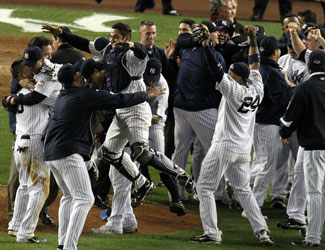
Catcher Jorge Posada #20 of the New York Yankees celebrates with his teammates after their 7-3 win against the Philadelphia Phillies in Game Six of the 2009 MLB World Series.
The Yankees won their 27th World Series title and first in the new Yankee Stadium by beating the Philadelphia Phillies 7-3 Wednesday night to take the 105th World Series in six games.
They christened their new $1.5 billion home in the same style as the original back in 1923, when the heroes were a left-handed slugger named Babe Ruth and a left-handed pitcher named Herb Pennock. Ruth hit three home runs, including one in the World Series clincher, and Pennock won twice, including the finale.
Eighty-six years later, only the names changed. Left-handed slugger Hideki Matsui(notes), in possibly his last game in a Yankee uniform, tied a Series record by driving in six runs and hit his third home run of the Series, a two-run blast in the second that was the Yankees’ first shot across the bow against Phillies starter Pedro Martinez.
Matsui, whose aching knees limited him to a pinch-hitting role in the three games in Philadelphia, had hit a tie-breaking home run off Martinez in the Yankees’ Game 2 win and demonstrated anew that if Martinez wanted to discuss his ancestry, his Yankee “daddy” was the venerable Japanese star.
Matsui hit a two-run single in the third off Martinez, then doubled in two more against Phillies’ rookie J.A. Happ(notes) in the fifth to earn Series MVP honors.
Left-handed pitcher Andy Pettitte(notes), pitching on three days’ rest, won the duel of old goats, as it was called by Martinez, holding the Phillies to a single run while the Yankees built a 7-1 lead against the 38-year-old Martinez and relievers Chad Durbin(notes) and Happ.
Pettitte, a sellout crowd of 50,315 creating chills independent of the 47-degree temperatures by thunderously chanting his name, came out in the sixth after giving up a two-run home run to Ryan Howard(notes), the strikeout-ridden Phillies slugger, and a two-out double to Raul Ibanez(notes).
Despite walking five batters, a number he has exceeded just once in 40 postseason starts, the 37-year-old Pettitte won for the second time in the Series and joined Boston’s Derek Lowe(notes) (2004) and Chicago’s Freddy Garcia(notes) (2005) as the only pitchers to win the clinching game in all three rounds of the playoffs: the division series, the LCS and the World Series.
Pettitte has won 18 postseason games, the most of any pitcher in history, including four this season. He also was the winner in a clinching game for the sixth time in his career, the most of any pitcher.
The last 10 outs were recorded by the Yankees bullpen, the final five by Mariano Rivera(notes), who with Pettitte, catcher Jorge Posada(notes) and shortstop Derek Jeter(notes) are the only players left from the last Yankees team to win it all, in 2000. Joe Girardi, in his second season as Yankees manager, was with the team as a reserve catcher for World Series titles in 1996, 1998 and 1999 but left as a free agent before the 2000 season.
With their bookend Series titles, the Yankees now can make a compelling case that they are the team of the decade, having won more regular-season games (965) and playoff series (10) than any other team, and joining the Boston Red Sox as the only teams to win two Series titles.
The Yankees had four 100-win seasons in the decade, including 103 in 2009 after new owner Hal Steinbrenner, taking over for his ailing father, George, gave general manager Brian Cashman the green light to spend over $243 million on three players – starting pitchers CC Sabathia(notes) and A.J. Burnett(notes) and first baseman Mark Teixeira(notes).
Sabathia and Burnett each won a game in the Series while Teixeira, who came into Wednesday night batting just .105 in the World Series and .172 in the postseason, singled home a run in the Yankees’ three-run fifth.
And, of course, the Yankees are the most successful franchise of all time. Their 27 titles are 17 more than that of the St. Louis Cardinals, who have won the second-most in baseball.
The Phillies fell short in their quest to become the first National League team since the 1975-76 Cincinnati Reds to win back-to-back Series titles.
Martinez, the self-styled “old goat” who didn’t join the Phillies until August, had counted upon “experience and survival” and his “frog’s blood” to carry him in a quest to add a triumphant coda to his rich history against the Yankees.
But Martinez lasted just four innings, succumbing to the master strokes of Matsui.
Thursday, October 22, 2009

Movie Review. Inglourious Basterds. (2009)
I remember that, back in 1994, I was told that there was a film that I just had to see. It was directed by someone named Quentin Tarantino and the film was calledPulp Fiction. After seeing the film, I knew that I wanted to see more film by this director. After seeing his last film, Inglourious Basterds, I am not sure that I want to see anymore films directed by him.
The film, set in German-occupied France, tells the story of two plots to assassinate the Nazi political leadership, one planned by a young French Jewish cinema proprietress, the other by a team of American soldiers called the "Basterds". The team is led by 1st Lieutenant Aldo Raine (Brad Pitt)
While I was watching the film, I kept thinking, "What if this film would have been set in the present day and instead of the Nazi's we are given Al-Qaeda or the Taliban?" This would be a very bold move. Instead we are given the same, tired plot, given that the Nazis were the bogeyman back in 1944. Does Hollywood only consider the past evil men and pretend that the present day evil doesn't exist?
To me this was the main reason why this film failed for me. Since "Pulp Fiction", I have asked Tarantino to always give me another great film. I do not mind the reusing of old ideas into something new but with this film, we are given a lot of recycled material, but nothing new and instead of a new classic film, I see a 2+ hour adult anti-Nazi cartoon.
When you see the film in Korea please remember that the film is in English, French
German and Italian. I do not know if there will be English Subtitles or only Korean ones.
Please pass on this film when it opens in South Korea on 29 October 2009.
Grade: D+
Lt. Aldo Raine: You probably heard we ain't in the prisoner-takin' business; we in the killin' Nazi business. And cousin, Business is a-boomin'.
Sunday, October 11, 2009
Soju, my dog, Died on October 11th, 2009 of an apparent heart attack.

I really didn't notice anything wrong with her earlier in the day. We both went for our morning walk and we had a nice time. She came back home and rested. I took her out for a small walk that she enjoyed and then we came back in and a few moments later she threw up a few more times.
I knew that Sol Pet vet was open on Sunday, so we walked their, she pooped and vomited some more. The vet saw her and did a test for any toxic stuff that Soju might have eaten. The Vet told me that Soju was going to get some anti vomit medicine and no food for the next 24 hours.
Soju, then laid down next to me and I told her, "Looks like I take care of you one more time." I petted her and then 2 seconds later, She turned over on her back, started shaking and whimpering. I Then yelled for the vet asap and when he saw he, he ran and started to pump her heart.
She was going very stiff and the vet for the next 20+ minutes kept pumping her heart. I kept my eye on her during the entire time. I was crying a lot during that time. I kept Looking at my dog, kept hopping but it just wasn't meant to be. Soju died.
I just started to cry and cry for awhile. I went and paid the vet bill. I went back to say goodbye to Soju.
I told her that thank you for coming into my life and that I guess that God got a child that needed a big puppy and he came to take you home. I hope that when I get to heaven that you're there waiting for me.
Me and the vet talked for a few minutes and I thanked him for trying his best and I am sorry that this happened today. (I saw this man give me his best and I saw the pain in his eyes)I told him, I didn't know Soju's past but for the last 5+months Soju had someone that loved her and that spoiled her a lot.
I told him that a lot of the girls just loved Soju. I Called her a SAP (Spoiled Ass Princess)I told him about when I had to go back to the office on day 2 of me owning her and that she was so happy to see me. I looked back at Soju and said "Good-bye my puppy-wuppy and left.
The vet thinks that one of the young heart worms got into Soju's heart and that it killed her. What was very unusual that all of the other dogs at the vet all sat down. It was like they knew that a dog had died.
As I was typing this blog post Annie, who helped me get her from the Asan Animal shelter, texted me. I called her and we both cried over losing Soju today.
This place seems so empty without her here, but I know that she isn't in anymore pain.

Goodbye Soju, I loved you and you loved me. We both took care of each other.

I really didn't notice anything wrong with her earlier in the day. We both went for our morning walk and we had a nice time. She came back home and rested. I took her out for a small walk that she enjoyed and then we came back in and a few moments later she threw up a few more times.
I knew that Sol Pet vet was open on Sunday, so we walked their, she pooped and vomited some more. The vet saw her and did a test for any toxic stuff that Soju might have eaten. The Vet told me that Soju was going to get some anti vomit medicine and no food for the next 24 hours.
Soju, then laid down next to me and I told her, "Looks like I take care of you one more time." I petted her and then 2 seconds later, She turned over on her back, started shaking and whimpering. I Then yelled for the vet asap and when he saw he, he ran and started to pump her heart.
She was going very stiff and the vet for the next 20+ minutes kept pumping her heart. I kept my eye on her during the entire time. I was crying a lot during that time. I kept Looking at my dog, kept hopping but it just wasn't meant to be. Soju died.
I just started to cry and cry for awhile. I went and paid the vet bill. I went back to say goodbye to Soju.
I told her that thank you for coming into my life and that I guess that God got a child that needed a big puppy and he came to take you home. I hope that when I get to heaven that you're there waiting for me.
Me and the vet talked for a few minutes and I thanked him for trying his best and I am sorry that this happened today. (I saw this man give me his best and I saw the pain in his eyes)I told him, I didn't know Soju's past but for the last 5+months Soju had someone that loved her and that spoiled her a lot.
I told him that a lot of the girls just loved Soju. I Called her a SAP (Spoiled Ass Princess)I told him about when I had to go back to the office on day 2 of me owning her and that she was so happy to see me. I looked back at Soju and said "Good-bye my puppy-wuppy and left.
The vet thinks that one of the young heart worms got into Soju's heart and that it killed her. What was very unusual that all of the other dogs at the vet all sat down. It was like they knew that a dog had died.
As I was typing this blog post Annie, who helped me get her from the Asan Animal shelter, texted me. I called her and we both cried over losing Soju today.
This place seems so empty without her here, but I know that she isn't in anymore pain.

Goodbye Soju, I loved you and you loved me. We both took care of each other.
Wednesday, September 23, 2009
Eagles’ pitcher bows out tonight after 21-year career
September 23, 2009
The Hanwha Eagles will bid their veteran pitcher Song Jin-woo farewell at tonight’s game against the LG Twins. The 43-year-old pitcher will get the start and is expected to pitch an inning or two. Hanwha will use a special ball inscribed with the text, “Song Jin-woo’s retirement game.”Song has played his entire 21-year career with the Eagles dating back to the days when the Eagles were under the sponsorship of Binggrae. The club’s officials have decided to honor Song’s contribution to the team by retiring his number, 21. Song becomes only the third player in Eagles history to have his number retired.
(I Will be at the game tonight!)
By GI Korea on September 21st, 2009 at at 5:56 am
First Time Published Image of the Daejon (Taejon) Massacre
Via the ROK Drop Forums comes this image from the Korean War with the inscription on the back of, “South Koreans killed at Tae Jon by North Koreans”:

The son of the veteran who took this photograph is looking for any information to confirm the location of the picture. The way the Tae Jon is spelled on the photo leads me to believe that this was in fact taken at the modern day Daejon because the spelling of “Tae Jon” was common during the Korean War. The hills in the background do not immediately jump out at me though and maybe some ROK Drop readers living in Daejon can better identify them.
The biggest question to answer though is whether this execution was a North Korean execution as depicted on the back of the photo or ROK Army execution. Below is a number of photos from executions carried out around Daejon by the South Korean governmental authorities:


For more on these photographs I highly recommend reading:
- Rehashing Korean War Era Executions
- Rehashing Korean War Era Executions, Again
- Rehashing Koreean War Era Executions, Again and Again
Notice in these pictures none of the bodies executed by the ROK authorities wer lined in up in neat lines like the picture in question. Now here are pictures of executions in Daejon carried out by the North Koreans:


In all the pictures I have seen of executions carried out in Daejon none of them show bodies neatly organized like in the picture in question. Additionally what I find interesting about the picture is how big the trench is compared to other execution sites. It makes me wonder if this is actually some kind of irrigaton canal for example that the bodies were left in?
Saturday, September 19, 2009
By GI Korea on September 18th, 2009 at at 5:19 pm
Marine Widow Hotaru Ferschke Faces Deportation
This story has long been followed here on the ROK Drop and though I’m not surprised, incredibly the immigration department has yet to fix her immigration status:

Hotaru Ferschke just wants to raise her 8-month-old son in his grandparents’ Tennessee home, surrounded by photos and memories of the father he’ll never meet: a Marine who died in combat a month after marrying her from thousands of miles away.
Sgt. Michael Ferschke was killed in Iraq in 2008, leaving his widow and infant son, both Japanese citizens, in immigration limbo: A 1950s legal standard meant to curb marriage fraud means U.S. authorities do not recognize the marriage, even though the military does.
Ferschke and his bride had been together in Japan for more than a year, and she was pregnant when he deployed. They married by signing their names on separate continents and did not have a chance to meet again in person after the wedding, which a 57-year-old immigration law requires for the union to be considered consummated.
“She is being denied because they are saying her marriage is not valid because it was not consummated — despite the fact that they have a child together,” said Brent Renison, an immigration lawyer in Oregon who has advised the family.
Hotaru Ferschke and the baby, Michael “Mikey” Ferschke III, are staying for now on a temporary visa at the home of her parents-in-law, in the Smoky Mountains town of Maryville. Robin and Michael Ferschke Sr., who are fighting for their daughter-in-law to stay, have emblazoned their son’s picture on everything from a blanket draped on the back of the couch to a waving banner on the fence outside. [Associated Press]
I can tell you from personal experience that the US Citizenship & Immigration Services doesn’t give a damn if you are in the military or not. They will treat you like crap like they do everyone else. It took me five years of nonsense with these people for various reasons mainly due to my continuous military re-locations, to get my wife her permanent residency card. In that whole time I interacted with USCIS only one guy in that entire bureaucracy was really helpful to us and did a lot to finally solve the immigration nonsense. If it wasn’t for that guy who just happened to be a retired Air Force E-8 my wife and I would have been separated due to my PCS back to the US.
So I can definitely understand the frustration that Hotaru is going through with these people. Hopefully the continuous publicity to this case will get these people to do something to help her out.
Further Reading:
Wednesday, August 26, 2009
Mother loses court case over son`s death..
The mother of Michael White, 14, who drowned in a Sauna in May 2008, has lost her court battle to win compensation for her sons death.
Stephannie White sought damages from the sauna, one of the hospitals where her son was taken, and the national and provincial governments, claiming that they had contributed to her sons death.
"I have instructed (my lawyer) Mr. Hwang to completely investigate all possibilities for appeal, Ms. White said."
"I will stay in Korea as long as necessary. While I am in Korea I will work within the system to seek justice and restitution. Once I am no longer in Korea, I will no longer have to respect Koreas sensibilities on the delicacy of this issue."
Details of the courts decision were unavailable at the time of writing.
The case lasted more than a year, with sessions being dissolved and the court taking the unusual step of visiting the sauna to examine the scene of Michael Whites death.
Police had said about 15 people were in the mens area of the sauna at the time. However, none of them had come forward with information, and a sauna employee had seen White floating face down, but had not acted, assuming that he was conscious.
The circumstances surrounding the death of White, an American, attracted attention from the expat community because of the unusual nature of the event, and because of the court case that followed.
The case was unusual because investigations into deaths of expats are usually closed when the body is taken out of the country, meaning that cases involving expat deaths are not often brought to court.
(paulkerry@heraldm.com)
The mother of Michael White, 14, who drowned in a Sauna in May 2008, has lost her court battle to win compensation for her sons death.
Stephannie White sought damages from the sauna, one of the hospitals where her son was taken, and the national and provincial governments, claiming that they had contributed to her sons death.
"I have instructed (my lawyer) Mr. Hwang to completely investigate all possibilities for appeal, Ms. White said."
"I will stay in Korea as long as necessary. While I am in Korea I will work within the system to seek justice and restitution. Once I am no longer in Korea, I will no longer have to respect Koreas sensibilities on the delicacy of this issue."
Details of the courts decision were unavailable at the time of writing.
The case lasted more than a year, with sessions being dissolved and the court taking the unusual step of visiting the sauna to examine the scene of Michael Whites death.
Police had said about 15 people were in the mens area of the sauna at the time. However, none of them had come forward with information, and a sauna employee had seen White floating face down, but had not acted, assuming that he was conscious.
The circumstances surrounding the death of White, an American, attracted attention from the expat community because of the unusual nature of the event, and because of the court case that followed.
The case was unusual because investigations into deaths of expats are usually closed when the body is taken out of the country, meaning that cases involving expat deaths are not often brought to court.
(paulkerry@heraldm.com)
Thursday, August 20, 2009
Greetings Mightie Mike fans
I'd like to first thank everyone for being so patient with me as I get over the jetlag and emotional baggage that comes with the court case.
Sitting in court, we held photos/keepsake ash memorial of Mike as the Judges & court waited nearly an hour for the Sauna's lawyer to appear. After he finally did arrive, court was called back into session and we heard the testimony of an ex- sauna employee, the floor manager of the men's floor. He was working the night Mike was murdered. This is the sauna employee we've been waiting on to come to court since Feb 12, 2009.
While the court carefully tip toed around the "how & why" Mike was unconscious to begin with, he was questioned about events after Mike was unconscious. The ex-employee admitted (as finally revealed to me by Mr. Hwang after much pestering for details) that the sauna staff was fully aware that Mike was unconscious in the shallow pool for at least 30 minutes before taking any action on his behalf. The ex-employee would not look at me directly nor let me look into his eyes, leaving quickly after court so there would be no opportunity.
We might remember at this point that the Good Samaritan law wasn't passed by congress until May 23, 2008, barely two weeks after Mike's murder. Even without the protection of a Good Samaritan law, there is no penalty for calling 119/112.
The lawyer for the Provence (representing the EMT & local public safety inspection office) had previously requested that he be able to call the EMT workers to the stand. These are the very same EMT who told Mr. Hwang they planned to lie on the stand. (we might note there are no laws/penalities for perjury in Korea)
After hearing the testimony of the ex-sauna employee, the head Judge closed the case without hearing the silver tongued testimony from the EMT. The verdict will be submitted to the court system on August 25 at 10am. We do not appear in court for the "reading" of the verdict. Sometime that afternoon, Mr. Hwang & the other lawyers will receive an email giving the basics of the verdict. Two weeks later they will all receive a paper copy of the verdict with full details from the three Judges. (Similar to the American Supreme Court verdict process)
The opposition lawyers/Mr. Hwang will have 30 days from August 25th to appeal the verdict. (Which is actually just two weeks, as they would need the detailed paper verdict to complete the appeal paperwork). Mr. Hwang feels confident that the Judges will side in my favor and the likelihood of appeal is small.
According to Mr. Hwang, it seems "my grief has pushed me to go too far" and I've pushed to the limit 'making Korea look bad". An appeal would prolong my time in Korea and give me more opportunity to gather what supporting evidence I can as well as continue to have the police files translated at a cheaper rate than I would get in the US. even if one of the opposition lawyers files an appeal, the Head Judge can deny it. We would have the same Judges again should that happen.
While, avoiding "counting my chicks before they hatch" decisions do need to be made on whether a foundation/charity or advocacy group will emerge from this. I've been contacted by Bill Kapoun's mother and hope to continue contacting more families of victims so that we (fams of the murdered) and the expat community can work toward doable goals and raising awareness. Somethings (like foundation/charity) can not be done without the support/volunteerism of the expat community. Your opinion is welcome and you are encouraged to express yourself.
Thank you again for your help, support, words of kindness and el mucho grande vibes sent out for Mike's sake. For that, I'm forever in your debt.
In humble thanks
Mightie Mike's Mom
Steph
I'd like to first thank everyone for being so patient with me as I get over the jetlag and emotional baggage that comes with the court case.
Sitting in court, we held photos/keepsake ash memorial of Mike as the Judges & court waited nearly an hour for the Sauna's lawyer to appear. After he finally did arrive, court was called back into session and we heard the testimony of an ex- sauna employee, the floor manager of the men's floor. He was working the night Mike was murdered. This is the sauna employee we've been waiting on to come to court since Feb 12, 2009.
While the court carefully tip toed around the "how & why" Mike was unconscious to begin with, he was questioned about events after Mike was unconscious. The ex-employee admitted (as finally revealed to me by Mr. Hwang after much pestering for details) that the sauna staff was fully aware that Mike was unconscious in the shallow pool for at least 30 minutes before taking any action on his behalf. The ex-employee would not look at me directly nor let me look into his eyes, leaving quickly after court so there would be no opportunity.
We might remember at this point that the Good Samaritan law wasn't passed by congress until May 23, 2008, barely two weeks after Mike's murder. Even without the protection of a Good Samaritan law, there is no penalty for calling 119/112.
The lawyer for the Provence (representing the EMT & local public safety inspection office) had previously requested that he be able to call the EMT workers to the stand. These are the very same EMT who told Mr. Hwang they planned to lie on the stand. (we might note there are no laws/penalities for perjury in Korea)
After hearing the testimony of the ex-sauna employee, the head Judge closed the case without hearing the silver tongued testimony from the EMT. The verdict will be submitted to the court system on August 25 at 10am. We do not appear in court for the "reading" of the verdict. Sometime that afternoon, Mr. Hwang & the other lawyers will receive an email giving the basics of the verdict. Two weeks later they will all receive a paper copy of the verdict with full details from the three Judges. (Similar to the American Supreme Court verdict process)
The opposition lawyers/Mr. Hwang will have 30 days from August 25th to appeal the verdict. (Which is actually just two weeks, as they would need the detailed paper verdict to complete the appeal paperwork). Mr. Hwang feels confident that the Judges will side in my favor and the likelihood of appeal is small.
According to Mr. Hwang, it seems "my grief has pushed me to go too far" and I've pushed to the limit 'making Korea look bad". An appeal would prolong my time in Korea and give me more opportunity to gather what supporting evidence I can as well as continue to have the police files translated at a cheaper rate than I would get in the US. even if one of the opposition lawyers files an appeal, the Head Judge can deny it. We would have the same Judges again should that happen.
While, avoiding "counting my chicks before they hatch" decisions do need to be made on whether a foundation/charity or advocacy group will emerge from this. I've been contacted by Bill Kapoun's mother and hope to continue contacting more families of victims so that we (fams of the murdered) and the expat community can work toward doable goals and raising awareness. Somethings (like foundation/charity) can not be done without the support/volunteerism of the expat community. Your opinion is welcome and you are encouraged to express yourself.
Thank you again for your help, support, words of kindness and el mucho grande vibes sent out for Mike's sake. For that, I'm forever in your debt.
In humble thanks
Mightie Mike's Mom
Steph
Monday, August 10, 2009
Sincerely, John Hughes

I was babysitting for my mom's friend Kathleen's daughter the night I wrote that first fan letter to John Hughes. I can literally remember the yellow grid paper, the blue ball point pen and sitting alone in the dim light in the living room, the baby having gone to bed.
I poured my heart out to John, told him about how much the movie mattered to me, how it made me feel like he got what it was like to be a teenager and to feel misunderstood.
(I felt misunderstood.)
I sent the letter and a month or so later I received a package in the mail with a form letter welcoming me as an "official" member of The Breakfast Club, my reward a strip of stickers with the cast in the now famous pose.
 I was irate.
I wrote back to John, explaining in no uncertain terms that, excuse me, I just poured my fucking heart out to you and YOU SENT ME A FORM LETTER.
That was just not going to fly.
He wrote back.
"This is not a form letter. The other one was. Sorry. Lots of requests. You know what I mean. I did sign it."
He wrote back and told me that he was sorry, that he liked my letter and that it meant a great deal to him. He loved knowing that his words and images resonated with me and people my age. He told me he would say hi to everyone on my behalf.
"No, I really will. Judd will be pleased you think he's sexy. I don't."
I asked him if he would be my pen pal.
He said yes.
"I'd be honored to be your pen pal. You must understand at times I won't be able to get back to you as quickly as I might want to. If you'll agree to be patient, I'll be your pen pal."

For two years (1985-1987), John Hughes and I wrote letters back and forth. He told me - in long hand black felt tip pen on yellow legal paper - about life on a film set and about his family. I told him about boys, my relationship with my parents and things that happened to me in school. He laughed at my teenage slang and shared the 129 question Breakfast Club trivia test I wrote (with the help of my sister) with the cast, Ned Tanen (the film's producer) and DeDe Allen (the editor). He cheered me on when I found a way around the school administration's refusal to publish a "controversial" article I wrote for the school paper. And he consoled me when I complained that Mrs. Garstka didn't appreciate my writing.
"As for your English teacher…Do you like the way you write? Please yourself. I'm rather fond of writing. I actually regard it as fun. Do it frequently and see if you can't find the fun in it that I do."
He made me feel like what I said mattered.
"I can't tell you how much I like your comments about my movies. Nor can I tell you how helpful they are to me for future projects. I listen. Not to Hollywood. I listen to you. I make these movies for you. Really. No lie. There's a difference I think you understand."

"It's been a month of boring business stuff. Grown up, adult, big people meetings. Dull but necessary. But a letter from Alison always makes the mail a happening thing."

"I may be writing about young marriage. Or babies. Or Breakfast Club II or a woman's story. I have a million ideas and can't decide what's next. I guess I'll just have to dive into something. Maybe a play."
"You've already received more letters from me than any living relative of mine has received to date. Truly, hope all is well with you and high school isn't as painful as I portray it. Believe in yourself. Think about the future once a day and keep doing what you're doing. Because I'm impressed. My regards to the family. Don't let a day pass without a kind thought about them."

There were a few months in 1987 when I didn't hear from John. I missed his letters and the strength and power and confidence they gave me and so I sent a letter to Ned Tanen who, by that time, was the President of Paramount Pictures (he died earlier this year). In my letter I asked Mr. Tanen if he knew what was up with John, why he hadn't been writing and if he could perhaps give him a poke on my behalf.
He did.
I came home from school soon after to find an enormous box on my front porch filled with t-shirts and tapes and posters and scripts and my very own Ferris Bueller's Day Off watch.
And a note.
"I missed you too. Don't get me in trouble with my boss any more. Sincerely, John Hughes."
Fast forward.
1997. I was working in North Carolina on a diversity education project that partnered with colleges and universities around the country to implement a curriculum that used video production as an experiential education tool. On a whim, I sent John a video about the work we were doing. I was proud of it and, all these years later, I wanted him to be proud too.
Late one night I was in the office, scheduled to do an interview with a job candidate. Ten minutes or so into the call it was clear that he wasn't the right guy, but I planned to suffer through.
Then the phone rang.
1…2…3…4…a scream came from the other room and 1…2…3…my boss Tony was standing in my doorway yelling, "John Hughes is on the phone!!"
I politely got off the phone with the job candidate who was no longer a candidate and
Hit. Line. Two.
"Hi, John."
"Hi, Alison."
We talked for an hour. It was the most wonderful phone call. It was the saddest phone call. It was a phone call I will never forget.
John told me about why he left Hollywood just a few years earlier. He was terrified of the impact it was having on his sons; he was scared it was going to cause them to lose perspective on what was important and what happiness meant. And he told me a sad story about how, a big reason behind his decision to give it all up was that "they" (Hollywood) had "killed" his friend, John Candy, by greedily working him too hard.
He also told me he was glad I had gotten in touch and that he was proud of me for what I was doing with my life. He told me, again, how important my letters had been to him all those years ago, how he often used the argument "I'm doing this for Alison" to justify decisions in meetings.
Tonight, when I heard the news that John had died, I cried. I cried hard. (And I'm crying again.) I cried for a man who loved his friends, who loved his family, who loved to write and for a man who took the time to make a little girl believe that, if she had something to say, someone would listen.
Thank you, John Hughes. I love you for what you did to make me who I am.
Sincerely, Alison Byrne Fields.
Sunday, July 12, 2009
Mike McStay
Woori Bank
Account Name: McStay, Flynn M.
Account Number: 1002-929-503133
Swife Code: HVBKKRSE
Well everyone, in less than 12 hours, its game on.
This is the last push for donation to help. you can send $$ to this account of Woosong at WLI, their is a box that you can contribute to also..
I have made a down payment of 3.5 milion won and will need about 1.5 and up more, so every bit helps.
lets beat this darn cancer.
Please pray for me tomorrow
Mike McStay
Woori Bank
Account Name: McStay, Flynn M.
Account Number: 1002-929-503133
Swife Code: HVBKKRSE
Well everyone, in less than 12 hours, its game on.
This is the last push for donation to help. you can send $$ to this account of Woosong at WLI, their is a box that you can contribute to also..
I have made a down payment of 3.5 milion won and will need about 1.5 and up more, so every bit helps.
lets beat this darn cancer.
Please pray for me tomorrow
Mike McStay
Saturday, July 11, 2009
Friday, July 10, 2009
Well I am at the Hospital now.
I am in roon 1115 on the 1th floor....
visiting hours are 1200-1400 and 1800-2000
they ask no kids or too many people.
Now I do not know what time the surgery will be on the 13th, when I know I will blog/facebook it.
Now have fun this weekend, take off your pants and slide in the mud and next week I want to hear every sick, twisted, perveted story you have. Heck If you ain't got one make up one.
Please pray for me on the 13th
Mike
I am in roon 1115 on the 1th floor....
visiting hours are 1200-1400 and 1800-2000
they ask no kids or too many people.
Now I do not know what time the surgery will be on the 13th, when I know I will blog/facebook it.
Now have fun this weekend, take off your pants and slide in the mud and next week I want to hear every sick, twisted, perveted story you have. Heck If you ain't got one make up one.
Please pray for me on the 13th
Mike
Well today is the day that I start the road to recovering from this Level 2 Cancer. At 4pm today (KST) I will be admitted to Eulji University Hospital in dusan-dong Daejeon South Korea.
As I have told many of you, either I beat this darn thing or I am going home to God.
The surgery is scheduled for Monday 13th 2009. i do not have a room # nor time for the surgery. When I know I will try and facebook the info or ask someone else to do it.
Soju, my dog, is being looked after. I wish that she could come to the hospital with me but a 17 kg jindo might scare everyone.
Please pray for me and check for updates on this blog and of facebook..
Mike McStay
As I have told many of you, either I beat this darn thing or I am going home to God.
The surgery is scheduled for Monday 13th 2009. i do not have a room # nor time for the surgery. When I know I will try and facebook the info or ask someone else to do it.
Soju, my dog, is being looked after. I wish that she could come to the hospital with me but a 17 kg jindo might scare everyone.
Please pray for me and check for updates on this blog and of facebook..
Mike McStay
A simple Baseball game helps a fan to forget cancer, if only for a few hours.
By Mike McStay
There are times in life when we need a lift. Sometimes bad things happen to good people and we are left wondering why. But, sometimes a simple game of baseball can help people to forget their problems and to, just for a minute, return to being normal. I saw a classic example of this on 7-7-2009 in Daejeon, South Korea at a Korea Baseball Organization game.
One of the fans of the Hanwha Eagles has cancer. His surgery will be soon and that day he made out his will and he made a video saying goodbye to everyone. He just wanted to go somewhere and forget the day that he had just had. This fan saw, last year’s member of the Hanwha Eagles, Doug Clark, who now pays Left Field for the Seoul Heroes. He knew him and he went to talk to his hero "Superman." (Clark Kent= Doug Clark+ Massive power Home Runs= Korean fans nickname "Superman)
He told Mr. Clark, to please hit 5 home runs for him that day. He reminded him about the sick kids with cancer stories that we have all seen in various media. How an athlete will hit a HR for a kid. The fan sated that the 5 HR's in one game would be unforgettable. They both laughed at it and the player went into the field for batting practice and the fan went to the box office to get him a good seat for the game.
The fan reminded himself that 5 HR's in a game is very rare but still it would be nice to see it actually happen. For awhile, the fan looked at the baseball field and he smiled. His mind was healthy and he forgot about the cancer. He forgot about trying to raise funds for the surgery, he forgot about all of the problems that the last few months has brought him. He just was smiling because he was alive again and able to enjoy the simple pleasures of the game of baseball.
Mr. Clark was the first batter up on the top of the first and when the count went to 2-2, the fan was thinking, OK "Superman, now hit one for me", and with the next pitch Clark hit a HR and the fan could not believe it. Could he really get 5 HR's in one game?
His next 2 at bats were a walk and the pitcher hit him with the ball. So after 3 innings he was still 1-1 with a HR.
It was the top of the 5th when Clark came to bat next. But, this time it was different, this time there were 2 runners on base and the Eagles had brought in a new pitcher to face "Superman". Once again, it did not matter. After it went to a 1-1 count; Clark hit a 3 Run HR. The fan cannot believe what he has seen for far. His Hero is now officially 2-2 with 2 HR's and 4 RBI's. Could he actually get to 5 HR's in a game?
Clark's next at bat was the top of the 7th and sad to say, he grounded out. So he is still 2-3. When he was due for his next at bat on the top of the 9th the Heroes manager replaced him with his back up. He finished this night 2-3 with 2HR's, 1 walk, 1 hit by a pitch, 3 runs and 1 stolen base.
After the game was over, the fan waited for Clark to take off on the Heroes' bus. When they met, they both had huge smiles on their faces. The fan, because his hero had hit 2 nice Home Runs and because Clark, had a great game and his team won 12-10. They shook hands and as the fan was leaving Clark stated, “That I owe you 3 more Home Runs!"
I have head over the years that baseball is just a game, that is doesn't mean anything. Tonight's game wasn't a major event in the world. It was played between the 5th place Heroes and the 8th place Eagles. But it sure meant a lot to the fan that was just for a few moments able to feel a ballpark come alive with the sounds of the fans cheering on their team. He forgot about Cancer, money and death and focused on just having fun at a ballgame.
If you can remember after September 11th, the firefighters, police and rescue workers used the Mets and the Yankees as a valve just trying to regain some sanity when their world were altered by the events of that day. Baseball helped these people to feel normal. We get so busy that sometimes we forget that a simple game played with 9 men can make you feel alive. I hope that this fan beats his cancer and can return, soon to the small park in Daejeon Korea, where his favorite Korean baseball team, the Eagles, and the fan himself, call home.
By Mike McStay
There are times in life when we need a lift. Sometimes bad things happen to good people and we are left wondering why. But, sometimes a simple game of baseball can help people to forget their problems and to, just for a minute, return to being normal. I saw a classic example of this on 7-7-2009 in Daejeon, South Korea at a Korea Baseball Organization game.
One of the fans of the Hanwha Eagles has cancer. His surgery will be soon and that day he made out his will and he made a video saying goodbye to everyone. He just wanted to go somewhere and forget the day that he had just had. This fan saw, last year’s member of the Hanwha Eagles, Doug Clark, who now pays Left Field for the Seoul Heroes. He knew him and he went to talk to his hero "Superman." (Clark Kent= Doug Clark+ Massive power Home Runs= Korean fans nickname "Superman)
He told Mr. Clark, to please hit 5 home runs for him that day. He reminded him about the sick kids with cancer stories that we have all seen in various media. How an athlete will hit a HR for a kid. The fan sated that the 5 HR's in one game would be unforgettable. They both laughed at it and the player went into the field for batting practice and the fan went to the box office to get him a good seat for the game.
The fan reminded himself that 5 HR's in a game is very rare but still it would be nice to see it actually happen. For awhile, the fan looked at the baseball field and he smiled. His mind was healthy and he forgot about the cancer. He forgot about trying to raise funds for the surgery, he forgot about all of the problems that the last few months has brought him. He just was smiling because he was alive again and able to enjoy the simple pleasures of the game of baseball.
Mr. Clark was the first batter up on the top of the first and when the count went to 2-2, the fan was thinking, OK "Superman, now hit one for me", and with the next pitch Clark hit a HR and the fan could not believe it. Could he really get 5 HR's in one game?
His next 2 at bats were a walk and the pitcher hit him with the ball. So after 3 innings he was still 1-1 with a HR.
It was the top of the 5th when Clark came to bat next. But, this time it was different, this time there were 2 runners on base and the Eagles had brought in a new pitcher to face "Superman". Once again, it did not matter. After it went to a 1-1 count; Clark hit a 3 Run HR. The fan cannot believe what he has seen for far. His Hero is now officially 2-2 with 2 HR's and 4 RBI's. Could he actually get to 5 HR's in a game?
Clark's next at bat was the top of the 7th and sad to say, he grounded out. So he is still 2-3. When he was due for his next at bat on the top of the 9th the Heroes manager replaced him with his back up. He finished this night 2-3 with 2HR's, 1 walk, 1 hit by a pitch, 3 runs and 1 stolen base.
After the game was over, the fan waited for Clark to take off on the Heroes' bus. When they met, they both had huge smiles on their faces. The fan, because his hero had hit 2 nice Home Runs and because Clark, had a great game and his team won 12-10. They shook hands and as the fan was leaving Clark stated, “That I owe you 3 more Home Runs!"
I have head over the years that baseball is just a game, that is doesn't mean anything. Tonight's game wasn't a major event in the world. It was played between the 5th place Heroes and the 8th place Eagles. But it sure meant a lot to the fan that was just for a few moments able to feel a ballpark come alive with the sounds of the fans cheering on their team. He forgot about Cancer, money and death and focused on just having fun at a ballgame.
If you can remember after September 11th, the firefighters, police and rescue workers used the Mets and the Yankees as a valve just trying to regain some sanity when their world were altered by the events of that day. Baseball helped these people to feel normal. We get so busy that sometimes we forget that a simple game played with 9 men can make you feel alive. I hope that this fan beats his cancer and can return, soon to the small park in Daejeon Korea, where his favorite Korean baseball team, the Eagles, and the fan himself, call home.
Wednesday, July 08, 2009
FROM POPSEOUL AT THEY CONTINUE TO LIST THEIR TOP 10 ALL TIME KOREAN FILMS....
Continuing the countdown of the Top 10 Korean Movies of all time, we present the Top 5. Check out which of your favorite films have made it on the list. You may be surprised….
Continuing the countdown of the Top 10 Korean Movies of all time, we present the Top 5. Check out which of your favorite films have made it on the list. You may be surprised….
Without further ado….

5) The Chaser
Director:Na Hong-jin
Writer: Hong Won-chan, Lee Shinho, Na Hong-jin
Genre: Crime, thriller, drama
Release Date: February 2008
One night, a man in his car makes a routine call to one of his girls…
But she doesn’t pick up…
Jung-ho knows something is going on. As a former police detective now turned pimp, his instinctual “cop radar” has gone off. Another one of his call girls from his “pleasure business” has gone missing and the numbers continue to decrease. Nearly penniless after paying these missing girls’ debts, Jung-ho realizes something has to be done; he’s got to get his money after all. He flips open his cell phone and notices the recent disappearances originated from client number 4885’s home. Min-jee, a mother and soon to be victim, is called to work. He instructs her to call him back once she arrives at the address. But it’s getting late in the night and when Jung-ho does not get a call back, he’s convinced he knows who’s behind the kidnappings and that Min-jee’s life is in grave danger: thus begins The Chase.
The unique twist on this crime thriller is that the viewers not only see what the protagonist – Jung-ho – does, but also what the villain does as well. But where’s the fun in seeing everything? While the movie lays everything out for the audience to see, the characters do not have the same privilege. What will Jung-ho do? Will he solve what we – the audience – already know? The viewer hinges on his every decision and empathize with Jung-ho from the get go.
At first, Jung-ho believes that this client 4885 is a rival pimp, stealing his call girls from his business. Nervously waiting for Min-Jee to come out, he camps outside the suspect’s house in his car, hoping that she turned down client 4885’s offer to become his call girl. But as the audience soon finds out, Yeong-min is not in the pleasure business; he’s a pure sadistic killer and Min-jee is soon to be the next victim.

As client 4885 abducts Jung-ho’s ladies one by one, the audience learns the shocking torture that is occurring. The ladies are thrown into a spacious bathroom, bound and chained by the hands and feet, and gagged with a bandage. Then, using a hammer and chisel, client 4885 slowly tortures his female victims by chiseling their heads until enough blood spills their eventual death. Min-jee is also subject to this disgusting act, as the sides and top of her once beautiful face is ripped with bloody gashes and deep scars. As she soon passes out, it seemed that this client claimed another of Jung-ho’s girls. Will Jung-ho solve what’s going on? Can he stop this sick pervert this time?
Jung-ho, still waiting outside the gated house, now suffers the same premonition as when his other girl disappeared the other night. As he polices the local neighborhood in his car, he damages another car from the side. Calm and collected, he goes to the other car and tells the other driver he will pay for their car damages. The driver rolls down his tinted window and is revealed to be a young male. He insists that he doesn’t require reprimands and impatiently waits for the blocking traffic to clear before driving off. Yet, when Jung-ho notices blood on the driver’s shirt, he suspects something wrong and calls client 4885, but the heist is up; the driver’s phone rings. As the suspect escapes through the side door, Jung-ho runs after him and The Chase is on.
After an intense chase scene, Jung-ho catches up to him and proceeds to pummel, kick, and stomp the suspect into bloody submission. Grabbing his ID, he finally discovers the suspect’s name: Je Yeong-min. Bringing Yeong-min in the police station, he soon realizes what the audience already knows: Yeong-min is not some rival pimp stealing his ladies, but a cold blooded killer. Now he suddenly asks himself, is Min-jee still alive?
First-time director Na Hong-jin’s 2008 hit is similar to “Memories of Murder”; it’s a crime thriller based on a true story. However, unlike most films of the genre where the killer is revealed in the final showdown, Na turns the genre on its head and presents the murderer within the first 20 minutes. But what’s the point of a crime movie if the killer is already found? If only it were that simple. Jung-ho has the cards stacked against him: Yeong-min is a psychopath, the police investigators reek of corruption, and there is no evidence. If Jung-ho cannot prove in 12 hours that Yeong-min was involved in the killings, he will be set free.

Na also takes a different approach in creating his film, where the suspense, action, and evidence gathering takes a back seat to the protagonist’s own development. Make no mistake, Kim Yuk-seok’s fantastic portrayal as the lead character, Jung-ho, is the focal point of this suspense thriller. In the beginning of the film, Jung-ho is shown as a bastard. Unsympathetic, heartless, and greedy, Jung-ho shows no remorse for his call girls’ well-being. After all, he was generous enough to clear every girl’s past debt in exchange for their “services” to clients. The bottom line is profit. Being sick for days, feeling scared of creepy customers, and spending time with their kids are all needless excuses – meaningless reasons that do not pay him, put food on the table, or clear the girls’ debts.
As the movie progresses, he slowly realizes he is greatly responsible for his own reputation and own deteriorating business. When one of his girls is threatened to be raped by two clients, Jung-ho comes in and roughs them up. But he doesn’t protect the girl for her well-being; he sees it as protecting his business assets. She sees Jung-ho for what he is – a greedy money-grubber—and finally leaves his harem. Many of his former cop co-workers now look at him in disdain, as a good cop turned into a shady man. Even Min-jee, sick and tired from balancing a motherly role to her daughter and as a call girl, sees his boss as nothing but “filth”. This begs the question, how did Jung-ho become like this? Wasn’t he a servant of justice before?
As described in the first couple paragraphs above, The Chaser will suck the viewer in from the start. It is a non-stop adventure of suspense, action, problem solving, and emotion. While “Memories of Murder” laid out an incredible murder story and calmly created a slow build up for the grand ending, “The Chaser” presents many obstacles from the get-go and never lets up. Jung-ho’s transformation from being slightly better than the killer to actually caring about the lives of others and serving justice is amazing. The acting that Ha Jung-woo portrays as the psychopathic killer, Yeong-min, is dead on, giving the audience a glimpse into a serial murder’s thought process. It’s a performance that you can’t help but love to hate.
Following the recent trend of other successful Korean movies, “The Chaser” will be getting remade on U.S. shores. This is faster than usual – even for Hollywood – as the film was only released last year in 2008. Warner Bros recently bought the rights and William Monahan – who had a hand with Martin Scorsese in remaking “The Departed”, based on Hong Kong’s “Infernal Affairs” – is the potential favorite to be heading the script. Let’s hope a remake of “The Chaser” captures the spirit of Na’s original vision.
Check out the Top 10 to 6 movies
———————————————————————————————-

4)Welcome to Dongmakgol
Director: Park Kwang-hyun
Writer: Kim Joong, Park Kwang-hyun
Based on: Jang Jin (play)
Genre: Drama, War, Comedy
Release Date: August 2005
Check out the Top 10 to 6 movies
———————————————————————————————-

3) A Tale of Two Sisters
Director:Kim Ji-woon
Writer: Kim Ji-woon
Based on: Janghwa, Hongryeon (folktale)
Genre: Horror, Mystery, Drama, Psychological
Release Date: June 2003
“There’s something strange in this house.”
“There’s a girl under the kitchen sink!”
“You know what’s really scary? You want to forget something. Totally wipe it off your mind. But you never can.”
A loud noise is heard from the 1st floor. Footsteps scatter around the house at night. Strange noises haunt this home during the dark hours. A woman stares at a channel-less TV alone at night. Not a very welcoming home, is it? But what could be causing these strange occurrences? As the audience watches further, nothing seems to make sense. The clues are difficult to decipher, the events do not connect, and the flashbacks are seemingly random.

For an avid horror aficionado, this confusing storyline has been used time and time again. Nothing says cliché quite like a long haired, female ghost with greasy hair, a creepy sound, and a “Kayako” Grudge. Sadako from “The Ring” would be rolling in her TV screen if it wasn’t for one fact: “A Tale of Two Sisters” deviates from the normal rungs of Asian horror. Say goodbye to a predictable story and cheap thrills and hello to one of the deepest, complex, intriguing horror movies in years.
But first, let’s go over what A Tale of Two Sisters has in common with the usual prerequisites to be an Asian horror film:
1) Creepy environment – Check
2) Story of revenge – Check
3) Scary scenes – Check
4) Blood – Check
5) Dark female ghost(s) with long hair – Check
6) The lead character thinks, “time to investigate” when alone – Check
7) Two girls having a period in the same day – Ummm… Check?
.8) Two females screaming at each other for half of the movie – Errr… Check.
9) A bloody hand coming from underneath a woman’s skirt – Okay, this is just now weird… Check!
The first six are universally in every Asian horror film with varying degrees of success. However, the last three – 7 through 9 – sound like they would belong more in a kinky college movie dealing with “naughty” gestures, such as the US series, “American Pie”, or the Korean collection, “Sex is Zero”. While the film shares common traits with its horror brethren – 1 through 6 – the similarities quickly end there.

Inspired by the Joseon Dynasty (1392 AD –1910 AD) folktale, “Janghwa Hongryeon” (rose flower, red lotus), “A Tale of Two Sisters” is the 6th iteration of this popular Korean story. As a modern take of the popular tale, the first scene of the film begins one afternoon in a hospital. The tale begins with a young female patient, Su-mi, as she is slowly ushered into a spacious white room by a hospital lady. Stooping down in a chair with her hair completely masking her face, a nearby doctor sits down across from her asks a series of questions. Yet, Su-mi does not say a word.

Later in the day, she and her younger sister, Su-yeon, are released from the hospital and welcomed back to their family’s lakeside house in the peaceful countryside. When the sisters step inside the Victorian-esque home, they are soon treated by their energetic stepmother, Eun-joo. Noticing the two are tightly holding hands and protective, Eun-joo attempts to “break the tension” with her friendly smile and quirky banter. Neither sister wants anything to do with this woman—the woman who recently replaced their beloved mom—and quickly move for the stairs. Eun-joo’s attempts at a friendly conversation amounts to nothing as the sisters climb the stairs with their backs turned against her. Again, Su-mi does not say a word.

As Su-mi and Su-yeon start re-familiarizing themselves in their old rooms, Su-mi notices an exact duplicate of her notepad and pen on her bedroom desk. But is that the only uncanny resemblance? Upon opening her clothing cabinet, she finds nothing but blue and green dresses.


The strange events continue to occur. Noises start emanating through the house during the first night and Su-yeon is the first recipient of this living nightmare, as she soon wakes up to someone or something slowly opening her bedroom door. Scared and frightened, she covers herself tightly with her blanket in hopes that her bedroom Boogeyman will disappear. Her blanket is slowly pulled off her inch by inch, and in terror, she quickly gets up to see… thankfully no one. Su-yeon runs quickly to her sister’s bedroom; only now does Su-mi speak. “There’s something in my room,” Su-yeon stutters nervously. “Everything is going to be okay,” Su-mi responds. The scares within the house have just started.

If the viewer does not watch the movie closely, they will not get the story. If the viewers enjoy a complex mystery, then the confusion becomes a facilitator for the story’s art. Unlike many other horror movies, “A Tale of Two Sisters” has no shame in taking its sweet time setting up its multi-layered story. The pacing is slow and the first 20 minutes are an unbearable wait for the rhythm to pick up. Yet, this tempts the viewer to become lazy. One may assume since the pacing is quite slow, they can take a jog, play chess, or hit on their hot neighbor. However, this is a disservice to the viewer, as the film is filled with incredible amounts of symbolism in the form of clues, dialogue, expressions, and flashbacks. As with 3-Iron, depending on one’s ears alone is not enough; both the human eyes and ears are needed. Missing one image will throw off the viewer’s understanding of the movie.

“A Tale of Two Sisters” differs from other Asian horror in how it presents the concept of horror itself. Whereas the vast majority of films in the horror genre depend heavily on a combination of: cheap scares, excessive gore, screaming, long haired ghosts, and unnecessary deaths, the movie relies on an application of a beautiful and familiar environment to create an unsettling feeling. Throughout the movie, the Victorian house slowly becomes scarier. Harrowing music and complete silence are used in juxtaposition with great effect to add to the fear. Sprinkled with a few shock scares, the viewer is always on edge, uneasy when the next scary scene is going to occur.

The acting deserves special mention in this film, since it blends in the movie’s psychological, creepy horror theme perfectly. Director Kim Ji-woon could not have asked for more talented actors: newcomer Lim Su-jeong as the older sister Su-Mi and Yeom Jung-ah as the wicked stepmom play the perfect foil to one another. During every meal, hallway conversation, and late night encounters, the viewer will see the constant tension, anger, and disgust for the other. Breaking expensive porcelain as Eun-joo pours tea, leaving the table early, and hurling insults at her father’s new wife, Lim Su-jeong channels an incredible aura of vindictiveness during the movie. Jung-ah, on the other hand, plays a very convincing evil stepmom in Eun-joo, as she makes Su-Mi’s life a living hell while under the same roof. Beginning by throwing barbs back at Su-Mi, she later goes on the offensive, physically asserting herself on the sisters behind their father’s back. Although in real life the actresses are best friends, you wouldn’t know it by watching this film.
The other two support characters also do a great job in playing their roles. A very young Moon Geun-young, the media dubbed “nation’s younger sister,” plays the painfully shy and innocent Su-yeon. Avoiding confrontation and always deferring to her older sister, Moon Geun-young plays the perfect complement to the more outspoken Su-jeong. Acting veteran Kim Kap-su rounds out the cast as the quiet, patient, and tempered father to the two daughters. His presence as both the concerned father and mediator between his eldest brash daughter and his new wife balances out the constant animosity within the home.
The surprise twists and thought-provoking ending, however, is what sets “A Tale of Two Sisters” apart from the vast majority of horror movies. Fans of the movie all have their unique impressions of the film’s key plot points and judging from which information Kim holds back in the end, many people’s takes are very believable. Kim provides just enough clues for the viewer to understand the story, yet still have many questions at the same time. A quick view on various Korean movie sites’ forums shows that A Tale of Two Sisters is one of the most discussed movies, in part due to its complex ending. The “re-playability” of the film is simply endless; there’s no shame in watching it again.

“A Tale of Two Sisters” is an incredible psychological thrill ride for horror virtuosos or even non-horror fans. With a talented cast, a gorgeous setting, well-orchestrated music, well-timed scares, and an engaging story, this movie stands as one of the best horror movies ever created. Both the Korean and foreign press agrees, as the movie currently stands upon 12 awards and 3 nominations in various film festivals and reviews. Actresses Lim Su-jeong and Yeom Jung-ah took home a number of acting awards and director Kim Ji-woon collected 6 awards himself.
An American remake by DreamWorks recently came out on January 2009 called, “The Uninvited” – no relation to the Korean movie with the same name. While the US version pays homage to the Korean film, movie watchers owe it to themselves to experience the original.
Check out the Top 10 to 6 movies
———————————————————————————————-

2) My Sassy Girl
Director: Kwak Jae-young
Writer: Kwak Jae-young
Based on: Kim Ho-sik (a novel)
Genre: Drama, Comedy, Romance
Release Date: July 2001
(A group of nine female starlets approach the concert stage. Two of them take the lead.)
Tiffany: “Uh huh! Listen boy.”
“My first love story”
Jessica: “My angel and my girls.”
“My sunshine. Uh! Uh! Let’s go!”
— The opening to the 2009 song “Gee”
Girls Generation (SNSD)
The ever catchy, popular, and overplayed “Gee” tells about a girl who experiences her first crush, her first love. For many movie fans, “My Sassy Girl” is their first foray into Korean cinema, their first “movie love.” From seeing the studly, dorky Cha Tae-hyun to the beautiful, border-line abusive Jeon Ji-hyun, many of us knew their on screen romance was something special. Having a cute story to complement these two was just perfect. The entirety of South Korea had fallen in love.
Putting this movie down in sweet words is as difficult as confessing your love for the first time, but – as the movie’s theme sings – I Believe that even if one stumbles across their words, the first time is the moment you always come back to. It’s a time of nostalgia, and it’s always in the back of your mind. That’s essentially “My Sassy Girl,” a movie based on Kim Ho-sik’s real life adventures. Go out anywhere in South Korea—in fact, in most of Asia—and ask what’s the number one romance comedy, and you will most certainly get Kwak Jae-young’s movie.
For the My Sassy virgins, this is a story about the loveable pushover, Gyun-woo, and his fateful encounter that would change his life forever. Escaping his aunt’s most recent attempt to hook him up with a blind date, he goes to the subway station to head home. Unexpectedly, he meets an intoxicated and beautiful girl who is stooped over the yellow borderline and is about to fall onto the tracks. The train whistles, and before the wind of the locomotive passes by, Gyun-woo catches her before she falls. He enters the same train as the drunken girl all the while making sure to keep his distance.

The word, “honey,” is something every guy would like to hear, especially from a beautiful woman, but when these words come from a girl who just hurled her dinner at an elder, the words lose their appeal. As if that’s not enough of an indicator, just before she faints, she points towards Gyun-woo. Now Gyun-woo is forced to carry much more than just a girl on his back; he is forced to carry a problem. Not knowing what to do with this stranger, he moans, “How did I get into all of this?” Thus marks the beginning of “My Sassy Girl”.
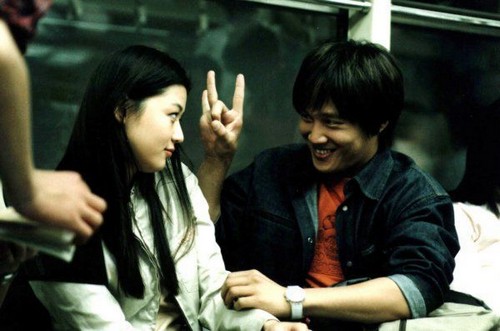
What makes “My Sassy Girl” different from many other romantic dramas/comedies is director Kwak Jae-young’s well-spaced melodrama. He does not force the viewer’s emotion—to cry to his every whim—or overuse sarang he (“I love you”) every five minutes to the point where it loses its meaning. Kwak knows better. While any movie in the genre is expected to have its share of crying, sad moments, and love, he makes sure these themes have meaning. As the main leads become more rounded and deep, the movie becomes more liberal with its serious tones. Since the viewer becomes more attached to the actors, they start caring for them – feeling their pain, excitement, happiness, and loss.
If this film teaches you one new word, it’s “sassy.” The Asian stereotype for women is a reserved, demure, and loving individual. Get ready for a sassy ride, as Gyun-woo goes through the craziest relationship with this nameless girl (yes, she has no name). From the get-go, the viewer will empathize with Gyun-woo; when ordering anything other than coffee gets a “Do you wanna die?”, playing fun games gets Gyun-woo bitch-slapped, and refusing to read horrible movie scripts is returned with a petrifying stare, even the most apathetic of viewers will be moved.

“My Sassy Girl” has plenty of depth, going beyond a one-dimensional story of cute love. For a romantic comedy, “My Sassy Girl” has plenty of depth, an uncharacteristic quality of the genre. The vast majority follows the typical “guy likes girl” formula, where the only focus is “how do the main leads hook up?” This movie, however, goes much deeper than that, presenting sub themes such as: living in the moment, living in the future, contemplating the meaning of love, and, of course, dealing with love’s pain. Blending all these sub themes in this genre well is no easy feat; without a balance, the film goes off too many tangents and loses its identity – such as Kwak’s 2004 follow up, “Windstruck”.
The biggest draw to seeing this film has to be the amazing performances by its leading stars. Jeon Ji-jyun easily steals the show for her role as the girl and single-handedly redefines the meaning of sassy. From her facial expressions: quirky smiles, angry lipped growls, annoyed frowns, and sweet blushes, to bullying her co-star, she plays the unnamed heroine perfectly. Throughout the movie, the audience will see her growth from the drunkard subway female to the aggressive, vicious girl he dates to the Juliet of Korea. Her evolution from drunkard to Shakespearean status comes in the latter half of the movie, where both main characters start to see one another at their worst and their best. Cha Tae-hyun, playing Jeon’s opposite as the comedic Gyun-woo, displays an incredible acting job as the male lead. His counter expressions, when confronted with the girl’s bipolar-induced mood swings, are justified and understandable. Any guy would react that way. But not every guy would stick with the girl. Gyun-woo develops alongside the girl, and although he initially just goes with her antics and adventures, he finds himself slowly wanting to heal her sorrow.
Love or hate it, the 2001 success of “My Sassy Girl” revitalized the romantic comedy genre in Korea. Before its breakout performance in theaters, the genre was largely ignored, as producers would release serious melodramas instead. This film showed skeptics that a love story could be a mixture of lightheartedness, funny, and serious at the same time. Like the infectious Girls Generation“Gee” song that spread like wildfire earlier this year – where singing about the 7th letter in the English alphabet could be so addicting – this movie also spread like an epidemic around Asia. Other Asian countries, intrigued by the sassy concept, also produced their own versions: the 2008 Japanese TV drama” Ryokiteki no Kanojo” and the 2008 Indian movie “Ugly Aur Pagli”. While countless Korean romantic comedies were churned out after 2001 – such as the 2003 “My Tutor Friend” or 2004 “My Little Bride” – few are able to capture the magic that “My Sassy Girl” did.

As with many movies on this list, a “My Sassy Girl” American remake came out last year in 2008. While the movie tries to replicate the sassy feel, unfortunately, the movie is missing the atmosphere and setting; after all, they are different cultures. The chemistry between the US actors Elisha Cuthbert and Jesse Bradford is not the same. Again, watch the original.

It has been 8 long years since this movie came out. As mentioned earlier, for many fans, this film is their “first love.” My Sassy Girl has it all: a charming love story, incredible acting, multi-layered themes, and memorable soundtrack. What a great “first love” indeed. While these fans still consider this Korean classic as their favorite, the POPSEOUL list, like former lovers, has moved on; this film stands as #2 on our list.
Check out the Top 10 to 6 movies
———————————————————————————————-

1) Tae Guk Gi
Director: Kang Je-kyu
Writer: Kang Je-kyu
Genre: War, Drama, Action, Historical
Release Date: February 2004
Quotes from famous people during the Korean War (1950 –1953).
 “The most important thing in our war preparations is to teach all our people to hate U.S. imperialism.”
— Kim Il-sung
North Korean leader

“We will defeat the Reds, the Communists!”
— Syngman Rhee
South Korean leader
 “Never before has this nation been engaged in mortal combat with a hostile power without military objective, without policy other than restrictions governing operations, or indeed without even formally recognizing a state of war.”
—Douglas MacArthur
Supreme Allied Commander of the Pacific

“[Korea is] the wrong war, at the wrong place, at the wrong time, and with the wrong enemy.”
— Omar Bradley
General of the Army, United States

“If we allow the United States to occupy all of Korea, Korean revolutionary power will suffer a fundamental defeat, and the American invaders will run more rampant, and have negative effects for the entire Far East.”
— Mao Zedong
Chairman of the People’s Republic of China
Near the 38th parallel dividing the two Koreas, a big movement towards the south is occurring. Soldiers are heard marching step-by-step, with their rifles swaying and grenades attached to their belts. Rumbling engines echo loudly nearby, as armored tanks slowly drive through narrow roads. Supply trucks are heard going over bumpy tread marks. Grunts and signs of fatigue are heard from mortar teams pushing heavy artillery guns over steep hills. Fighters and bombers are heard from above, flying at incredible speeds in formation. North Korean propaganda is heard from loudspeakers, proclaiming that Communism will prevail over Capitalism. As onlookers see this advancing army approaching from the north, calamity is thrown out the window and panic ensues; the entirety of South Korea is in chaos. Dressed in light brown and red uniforms, the invading army conquers, pillages, and destroys any towns in its wake. Their target: all of Korea – the reunification of the Korean peninsula. The date: June 25th, 1950 – the Korean War has just started.
Fast forward to modern times in 2004; archaeologists are excavating the remains of fallen soldiers in preparation for a Korean memorial. An elderly man receives a phone call from the South Korean army. They claim one body found is Lee Jin-seok, but upon confirming that he is alive, the aged man suspects the body is actually his brother’s. He travels to China in hopes of finding his brother’s remains—no luck—and heads to the excavation site; there, he opens a shoebox containing vanilla colored shoes. As a flood of memories start coming back, tears swell up in his eyes. Fifty-four years ago may sound like an eternity for many, but for the survivors of war, they can relive the struggles like it happened yesterday. The pain, repressed memories, war wounds, bitterness, and brutal experiences are things any former soldier wants to forget. This begs the questions: how did the other brother die? What happened to Lee Jin-seok during the war? The movie shifts back to 1950 and the story of “Taegukgi” begins.

Director Kang Je-kyu’s film follows two brothers – Lee Jin-tae and Lee Jin-seok – and their family during the Korean War. Living in Seoul, life was peaceful for the Lee family following World War II. The older brother, Jin-tae works as a shoeshine boy during the day, foregoing his higher education to support his younger brother’s. Since his father passed away, he has taken the mantle as male figurehead in the family household. His fiancée, Young-shin, helps out at the family noodle shop in the afternoon with his mother. Jin-seok, the younger brother, dutifully studies and excels in academics in hopes of getting into a good university. Yong-seok, the brother’s childhood friend, spends time with the two on the streets of Seoul. With a loving family, food on the table, and clean clothes, the Lee family lived carefree in the newly established South Korea, looking towards a promising future. However, their peaceful world is shattered when the North invades. While the Lee family travels further south to escape the ensuing battles, the South Korean army drafts males between the ages of 18 to 30 in preparation for the South Korean war machine. Both brothers are thus drafted and must survive this hell together.

Shortly after, Jin-tae and Jin-seok find themselves in the muddy trenches with other scared and new recruits. Mortar fire and pounding artillery pepper the recruits’ first battlefield and Jin-seok immediately becomes shell-shocked, unaccustomed to the horrors of real combat. Worrying that his younger brother might not survive another battle, Jin-tae knew he had to do something fast; he had to save his family.
Jin-tae knows that their family’s future lays in Jin-seok and his promising future. If one of them can return home, it has to be his younger brother. Knowing this, he attempts to persuade his commanding officer to discharge his brother from the war. However, it comes with a condition: his superior tells him he has to get an Order of Military Merit medal, South Korea’s highest military honor. Agreeing to this secret deal, he starts volunteering for near suicidal missions, ranging from placing land mines during enemy fire to leading reckless assaults. Jin-seok starts wondering why his older brother is doing this. However, despite Jin-tae’s heroic and insane deeds, the South Korean army is in a terrible bind; they are surrounded and nearly annihilated.
Their regiment has little sleep, food, ammunition, and morale; the soldiers are beginning to go crazy. The sounds of suicide, amputated body parts, and screaming become the lullaby of their camp. Contemplating a last stand, many soldiers write their wills, ready for their inevitable fate. Jin-tae, however, has other plans; he suggests going on the offensive. After all, to him, the more suicidal the odds are, the better. Taking the North Koreans by complete surprise, the South Korean regiment makes rapid headway. Leading a one man charge, Jin-tae begins to braves the danger and lucks through. Eventually, his efforts pay off: he conquers the enemy headquarters on a mountain. As the North Koreans start a full retreat, he returns to see cheers and celebrations; it was the squad’s first victory.
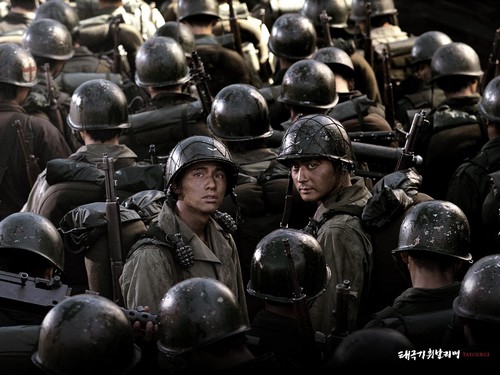
However, as victory after glorious victory continued to pile up, Jin-tae becomes infatuated with the proposition. No longer is it about his brother’s safety; it’s about fame. He receives all the adulteration: promotions, mass cheering, awards, and even an appearance at the United Nations press conference. He sees the world in two shades: Communism and Capitalism. As a result, he becomes desensitized to murder—he becomes the perfect soldier. After another battle, he sees a childhood friend forced to fight for the North …yet, he has no compassion for his life; he sees nothing but an enemy. Soon, he barely recognizes his own younger brother, the very same he promised to protect. As Jin-seok begins to resent his older brother and his motives, their brotherhood starts to fall apart. Can they reconcile their differences? Will they ever see their family again? Does Jin-tae even see a different between Capitalism and Communism?

“Taegukgi” shows that war is hell. Like the critically acclaimed American war movie, “Saving Private Ryan”, this film does not hold back the brutal reality – arms are separated, legs are blown off — blood is used in great amounts. The battle scenes are intense: machines guns, tanks, airplanes, and artillery are all shown; bodies, shattered homes, and dreams ornament this battlefield. There is no peace in hell—no haven even in one’s house. War doesn’t discriminate and battles can be fought anywhere. War crimes, needless to say, were rampant by both sides during the war. Vicious propaganda was used to portray the other side as “evil”, framing the enemy with lies and atrocities. Surrendering to the enemy was frowned upon and even doing so did not guarantee survival. Prisoners weighed down advancing armies, so rather than keep them, commanders ordered captured prisoners to be shot. For every handful that benefits from war, there are millions more that are devastated by it.

With the success of his 1999 movie, “Shiri”, director Kang Je-kyu had the leeway to go for some big name actors for Taegukgi. Kang decided to go for some of the best, enlisting skilled actor Jang Dong-gun as Jin-tae and pretty boy Won Bin as Jin-seok. Jang plays a brilliant Jin-tae that evolves (or devolves) from a protective brother that places family first to a ruthless murderer. From his facial expressions to his dialogue, the audience will see how the rigors of war can change a person. Although slow, his transformation is believable because of his atrocities. His decision to weigh awards over his brother’s safety is, in itself, a result of his transformation. Won’s performance as the younger Jin-seok, however, steals the show. Since his role required the most radical change, his part was incredibly challenging. However, Won does not disappoint at all. This role required a transformation from passive intellectual to rookie soldier to a strong, determined man that opposes his brother’s motives. The audience will empathize with Won’s character and grown alongside with him throughout the war.

Korean beauty, Lee Eun-joo, played the fiancée of Jin-tae admirably in the few scenes she is in. Unfortunately, this was one of her last films she acted in, as she took her life on February 2005. If there is a knock in the film’s cast, it has to be the supporting characters. While the film focuses on the two main leads’ struggles, the supporting cast, compared to war movies like “Welcome to Dongmakgol”, pales in comparison. The movie, sadly, does not spend the time to develop their characters and most of them play extremely minor parts in the brothers’ journey. Although, not to take away from what they did, these characters still played their parts quite well, considering the time.
“Taegukgi” elicits poignant memories for South Koreans. The film name itself – “Taegukgi” – is symbolic; it represents the South Korean national flag. Like the American Civil War or the schism of Western and Eastern Germany after World War II, this film presents the viewer a greater understanding on the turmoil post division. When heartthrob Won Bin was asked to do a movie about the Korean War, he did not hesitate. “How could you not want to act in a movie about the Korean War … I would be honored,” Bin said. Thousands of extras also heeded the call in recreating this bloody conflict; many did their roles for little or no money. The North-South division still hurts to this day for Koreans and this movie provides a glimpse to seeing that very pain.
This film is one not to be missed by movie fans. While one may dismiss the movie as the Korean “Saving Private Ryan” – other than some inspired scenes from the American classic – they are both vastly different story wise. With slick battle cinematography, incredible scripting, deep main leads, a non-biased look at war, and a tale of brotherhood, the film’s scope is breathtaking. Crying “man-tears” during or at the end is acceptable, because the movie’s final message is powerful: family blood runs deeper than any sort of ideology or government. And for that, “Taegukgi” deserves the top slot.
If you have missed it, check out the Top 10 to 6 movies that have made an impact on Korean cinema.
Subscribe to:
Posts (Atom)