Update. Insanity in Korea...
Gi Korea
It really was only a matter of time before Jimmy Carter surfaced again due to the latest North Korean crisis. Carter has surfaced this time in a New York Times editorial which like other editorials from those involved in the failed 1994 Agreed Framework blames Bush for everything going on with North Korea:
Responding to an invitation from President Kim Il-sung of North Korea, and with the approval of President Bill Clinton, I went to Pyongyang and negotiated an agreement under which North Korea would cease its nuclear program at Yongbyon and permit inspectors from the atomic agency to return to the site to assure that the spent fuel was not reprocessed. It was also agreed that direct talks would be held between the two Koreas.
The spent fuel (estimated to be adequate for a half-dozen bombs) continued to be monitored, and extensive bilateral discussions were held. The United States assured the North Koreans that there would be no military threat to them, that it would supply fuel oil to replace the lost nuclear power and that it would help build two modern atomic power plants, with their fuel rods and operation to be monitored by international inspectors. The summit talks resulted in South Korean President Kim Dae-jung earning the 2000 Nobel Peace Prize for his successful efforts to ease tensions on the peninsula.
First of all in June 1994 Carter wrote a letter to Clinton that he was going to Pyongyang with or without Clinton's approval. On the advice of Al Gore, Clinton approved the visit if Carter would agree that he was only going as a private citizen and not a US Ambassador. When Carter visited Pyongyang and cut the deal with then North Korean dictator Kim Il-sung the father of the current leader Kim Jong-il, he informed his contact in the White House of the deal and then proceeded to give a CNN interview announcing the deal.
His White House contact walked into a on going policy meeting with President Clinton and his top advisors to inform Clinton of Carter's call. Clinton was about to give a go ahead on a military force build up in Korea along with increased sanctions that would ultimately lead to possibly a naval blockade if North Korea did not give up their nuclear program. Does this all sound familiar? It should because it is 1994 all over again today, we just need Carter to go to Pyongyang, and hopefully this time he will stay there.
Carter's announcement was a bombshell to the White House because somebody acting as a private citizen had taken control of US foreign policy and the White House appeared to be by standers. People in the meeting actually called Carter's actions of cutting a deal without White House approval as "near traitorous" and Clinton actually put out an order for people in the meeting to not engage in Carter bashing to media despite their private feelings.
Clinton's instincts initially was that the North Koreans could not be trusted and only understood force to get them to quit their nuclear program, however Carter's actions made it politically impossible for him to take action against North Korea when Carter publicly announced on CNN that he had prevented war by cutting a deal with Kim Il-sung. Attacking a country after publicly announcing that you cut a deal with them never goes over to well internationally or domestically for that matter and Clinton knew it and he was forced to deal.
Additionally the deal was cut with Kim Il-sung who Clinton and even I believe may have been acting in good faith at the time when he agreed to end his nuclear program and allow in IAEA inspectors if the US gave him aid and built two light water reactors. Kim Il-sung I think was beloved by his people enough that he would have been able to survive any reforms that would have opened up the country. Thus he saw this deal as opportunity to feed his people and provide them energy, which in turn allowed North Korea to then focus their limited resources on rebuilding a post-Soviet Union economy.
However, Kim Il-sung died a month later after striking the deal with Carter. Was this just coincidence or did Kim Jong-il have something to do with it? I for one wouldn't be surprised if Kim Jong-il and others in the military who wanted the nuclear bomb and resisted opening the country did away with Kim Il-sung and installed Kim Jong-il because he promised to implement the Songun (military first) policy which would ensure the elite status of the North Korean military within North Korean society.
Something else I found disingenuous about Carter's article was his claim that his 1994 deal led to the 2000 inter-Korean Summit between then South Korean President Kim Dae-jung and Kim Jong-il. Carter made no mention of the fact that the summit only happened, not because of Carter's 1994 deal, but because of the $156 million dollar bribe that Kim Dae-jung authorized Hyundai to give to Kim Jong-il in order for the North Koreans to agree to host the summit.
The dishonesty only continues in Carter's editorial:
But beginning in 2002, the United States branded North Korea as part of an axis of evil, threatened military action, ended the shipments of fuel oil and the construction of nuclear power plants and refused to consider further bilateral talks. In their discussions with me at this time, North Korean spokesmen seemed convinced that the American positions posed a serious danger to their country and to its political regime.
Carter makes no mention of the fact that North Korea cheated on the 1994 Agreed Framework deal and continued a covert nuclear program, which the Bush Administration called them on and to everyones surprise, the North Koreans even admitted to.
The dishonesty in this article only gets worse:
Six-nation talks finally concluded in an agreement last September that called for North Korea to abandon all nuclear weapons and existing nuclear programs and for the United States and North Korea to respect each other’s sovereignty, exist peacefully together and take steps to normalize relations. Each side subsequently claimed that the other had violated the agreement. The United States imposed severe financial sanctions and Pyongyang adopted the deeply troubling nuclear option.
Carter leaves out some more critical information by forgetting to mention that the financial sanctions had nothing to do with the six party talks. The financial sanctions were due to North Korea's counterfeiting and money laundering of US currency. Ever wonder why the US$20 dollar bill keeps changing? It because of North Korean counterfeiting which Carter makes no mention of.
So what does Carter suggest to end the current stand off? Well implementing pretty much the 1994 Agreed Framework again:
The other option is to make an effort to put into effect the September denuclearization agreement, which the North Koreans still maintain is feasible. The simple framework for a step-by-step agreement exists, with the United States giving a firm and direct statement of no hostile intent, and moving toward normal relations if North Korea forgoes any further nuclear weapons program and remains at peace with its neighbors. Each element would have to be confirmed by mutual actions combined with unimpeded international inspections.
You have to give Carter credit for one thing, he is persistent in wanting to implement failed policies.
As you can see there were various factors that led to the failed 1994 Agreed Framework. Was it Clinton's fault? Even though the policy failed I don't see it as being Clinton's fault because due to the circumstances he had no choice but to cut the deal. This issue has taken on it's current political context solely because of next months elections. None of this rhetoric is helpful in actually resolving the crisis but since when have politicians cared more about solving issues over protecting their own political power?
So what do I think it going to happen? Kim Jong-il counted on sanctions before he decided to test his nuke and knew that the international community would condemn him including China and South Korea. Even though he would be condemned for the test, Kim Jong-il gambled that China and South Korea would still protect him from sanctions that would lead to the end of his regime like a naval blockade. I would love to see a naval blockade because I doubt the North Korean regime would last a year if a naval blockade is implemented. However, all signs are that the South Koreans and Chinese will not support a blockade and I find it unlikely the US would implement a blockade without a UN Security Council Resolution.
So what does this mean? Well it means that North Korea will get hit by increased sanctions, but China will keep the oil flowing and the South Koreans will keep the food and fertilizer coming in because neither country wants to deal with a collapse North Korea. China doesn't want a possible war or a humanitarian crisis to threaten their hosting of the 2008 Olympics and the South Koreans do not want to pay both the financial and social costs that reunifying with North Korea would cost plus the possibility of war would devestate the peninsula. Plus the North Koreans will be allowed to keep bringing in hard currency through their weapons sales, counterfeiting, and other illicit activities without a naval blockade, which means that the Kim Jong-il regime will survive with more time to develop and perfect their nuclear weapons, while our political leaders aided by the irresponsible US media continue to play politics and blame each other for the crisis, which is just what Kim Jong-il counted on.
Note some great reading on the 1994 Agreed Framework can be read in Don Oberdorfer's book, The Two Koreas.
Playing Politics Over the NK Crisis
Senator John McCain recently came out and criticized former President Clinton's failed 1994 Agreed Framework with North Korea for leading to the current nuclear crisis. In fairness to Clinton I do believe diplomacy should be tried before starting a war and he tried diplomacy and failed due to the untrustworthiness of the North Koreans who went ahead and continued a covert nuclear program while simultaneously moving even more troops and equipment to the DMZ between North and South Korea. Clinton tried diplomacy which I think no one should fault him for and it didn't work. The Democrats accused McCain of playing politics, but what do the Democrats do in response? Continue playing politics themselves of course; with former Clinton Secretary of Defense William Perry writing this blame Bush editorial in the Washington Post:
North Korea's declared nuclear bomb test program will increase the incentives for other nations to go nuclear, will endanger security in the region and could ultimately result in nuclear terrorism. While this test is the culmination of North Korea's long-held aspiration to become a nuclear power, it also demonstrates the total failure of the Bush administration's policy toward that country. For almost six years this policy has been a strange combination of harsh rhetoric and inaction.
President Bush, early in his first term, dubbed North Korea a member of the "axis of evil" and made disparaging remarks about Kim Jong Il.
Continue reading "Playing Politics Over the NK Crisis "
I wonder if Perry prefers that Bush call Kim Jong-il the "Dear Leader" instead of the tyrant that he is?
Some of you may remember that Perry also wrote an editorial before the July NK missile tests in the Washington Post advocating a bombing campaign against the NK Taepodong missile before it could be tested. Perry like many former Clintonites are trying to rewrite history. Their policies were a failure then and their advice is a failure now.
Just think about if the US followed Perry's advice before July's missile test. A bombing campaign against NK would validate the very reason Kim Jong-il proclaims for needing both a ICBM and nuclear programs; to protect the country from US aggression not to mention possibly causing a second Korean War which the US would have clearly been the aggressor. Additionally the US would have never gathered the valuable intelligence of the failed test. The US didn't totally know the NK ICBM capabilities, now the US does. It is the same thing with the nuclear test. The US now knows that the NK nuclear program is not as advanced as the North Koreans would want you to believe. Plus the NK actions have driven a wedge between China and North Korea which a bombing campaign would have never done. If anything it would bring the two allies closer together against US aggression. Now this is not the case after the nuclear test because China is actually seriously considering backing a UN resolution that would allow a US naval blockade of North Korea. Do you think a bombing campaign would have brought this close cooperation with China about?
So what does Perry advocate in the wake of the nuclear test, when his bombing campaign policy would have been an obvious failure? Well I really don't know because the article is all blame Bush with no policy alternatives. Maybe he learned from his last article that blaming Bush is safer politics than actually providing alternative policy ideas.
Naval Blockade Coming to North Korea?
Looks like a UN resolution condemning North Korea is in the works that includes a very provactive naval blockade of North Korea to inspect all ships entering and exiting the country:
The United States circulated a draft resolution Monday to U.N. Security Council nations calling for stiff weapons sanctions and other restrictions on North Korea following its claim to have conducted a nuclear test.
The United States is suggesting international inspections of any cargo going into or out of the reclusive, communist country.
Washington also is proposing a U.N. embargo on any goods or materials that could be used in Pyongyang's missile and nuclear programs.
Security Council members will resume closed-door discussions of the proposals Tuesday.
The council voted unanimously Monday for a statement opposing North Korea's reported test, but it is unclear whether the council will favor economic sanctions.
John Bolton, U.S. ambassador to the United Nations, said he was "strongly encouraged by the mood of the council."
"No one even came close to defending it," Bolton said.
Japan also added its own proposals to deny North Korean ships and planes permission to enter other territories, to ban the import of any North Korean products and to ban travel by high-level North Korean officials.
The U.S. draft calls for an overall arms embargo, prohibitions on any financial transactions that might support missile activities, a freeze on any assets related to North Korea's weapons programs, measures to prevent counterfeiting by North Korea and a ban on luxury goods.
The draft also calls for North Korea to cease any missile and nuclear-related activity and return to the six party talks.
If the resolution passes with the implementation of a naval blockade and a full embargo of the country, both the South Koreans and the US better be prepared for a possible confict. I don't think the North Koreans would wage war from the start of the blockade but I would expect them to conduct smaller scale actions such as DMZ shootouts, West Sea naval clashes, or even terrorist style attacks in South Korea in order to pressure the South Koreans to get the blockade lifted. They will also simultaneously play up the humanitarian crisis of the sanctions to the global media and the global media will probably fall for it, it worked for Hezbollah why not North Korea too?
Over the course of an entire year I don't think the North Korean regime could survive a full embargo. When it reaches the point that the regime is on the verge of collapse what do they have to lose by going to war? If the embargo is implemented the US and it's allies better be prepared for possibly a bloody war. Is the US and South Korean publics ready for a bloody war or would they rather just appease the North Koreans, work out a deal, and get back to the status quo? The coming months will tell.
Another possibility is that a military coup happens in North Korea and Kim Jong-il is replaced. A new leader takes over, works out a face saving deal for all sides, and begins a real process towards reunification. Maybe US and South Korean intelligence knows something that the public doesn't. Then there is always the possibility China could take matters into their own hands and move in and occupy North Korea on their own accord.
Who knows but one thing you can count on is that North Korea will remain very unpredictable and the coming months would be very interesting.
Now Why am I not suprised by this next article at all?
Say What?
South Korean president refuses Abe's request for joint condemnation of North Korea
South Korean President Roh Moo-hyun talked about his views on the history of Japan's wartime atrocities for 40 minutes during talks with Prime Minister Shinzo Abe in Seoul on Monday, forcing them to abandon a joint statement, entourage sources said.
Roh refused Abe's request to issue a joint statement condemning North Korea for its alleged nuclear test, according to the sources. The South Korean leader then talked for 40 minutes about his views on the history of Japan's atrocities during World War II and visits by Japanese politicians to the controversial Yasukuni Shrine.
During the meeting, South Korean Foreign Affairs and Trade Minister Ban Ki-moon handed a memorandum to Roh, urging him to discuss a joint statement with Abe. The sources said this suggested there is a perception gap between the president's office and the ministry over the country's interpretation of history and its North Korea policy.
South Korean officials subsequently suggested that the two countries issue a joint statement on North Korea's alleged nuclear test and interpretation of history, a proposal rejected by Japan.
A Japan-China joint press release was completed one hour prior to its announcement following the summit talks between Abe and Chinese President Hu Jintao on Sunday.
Uri Party Blames US for North Norea
If you also watched the new “South Park” episode last night, you may still be laughing about it. I still am. It dealt with 9-11 conspiracy theories, and naturally, Eric Cartman acted as the surrogate for all that is irrational, prejudiced, and nasty (Kyle was the scapegoat, of course). I won’t spoil any of the plot twists, but there’s a scene in the beginning where Cartman, Kyle, and Stan are talking about 9-11. Stan says that only a retard would believe in the conspiracy theories. Cartman answers that 25% of the American people believe that 9-11 was a conspiracy. Can 25% of the American people really be retards?
Stan: Yes, Cartman, 25% of the American people are retards.
Kyle: Yeah, at least.
It helps you put this into some perspective.
U.S. Ambassador to South Korea Alexander Vershbow said Wednesday it was unfair that his country had been criticized in the wake of North Korea’s nuclear test. On a visit to the Grand National Party, the ambassador said according to a recent press poll, 30 percent of Korean’s believe that the North’s test was the fault of the U.S. But Vershbow insisted the U.S. did everything it could at the six-party talks on the North’s nuclear program. Party spokesman Na Kyung-won quoted Vershbow as voicing disappointment that people did not look at the entire series of events.
How can I possibly describe my reaction to this? Let me find exactly the right word. I am …
relieved.
Yes, relieved. Because if you compare that result to some of these results, we could have the makings of a tourist brochure: “South Korea – Now 20% Less Retarded!“ Unfortunately, there appears to be substantial overlap between that 30% and South Korea’s current government. The foundation of the ruling Uri Party is the idea that appeasing North Korea would improve its behavior. Now that the Sunshine Policy has just suffered the mother of all sunburns, Cartman Uri must find a scapegoat:
[F]ormer president Kim Dae-jung and the ruling Uri Party continued to work out their theory that the U.S. was to blame for the test. During a talk Wednesday at Chonnam National University, Kim said, “Under the Sunshine Policy, was North Korea engaged in nuclear development?
Where does DJ think North Korea got its bomb(s)? Botswana?
With the U.S. refusing to even talk while bullying North Korea, isn’t nuclear development the only option left (to North Korea) to ensure its survival.”
Why, yes, if you exclude instituting meaningful economic reforms, releasing the captive citizens of your neighbors, importing some food, getting out of the counterfeiting and dope rackets, complying with the NPT, letting in some food aid, and moving some of the guns away from the DMZ. Other than that, I suppose that’s your only option. The continuation of Moammar Khaddafy’s life term of office does present some problems for DJ’s theory, of course, but facts are simply inconvenient obstacles.
One Angry South Korean
WaPo describes the “chill” in North-South Korea relations in the aftermath of “The Test“:
“The joy I felt when I first signed up for the reunions was indescribable — such elation at the thought of seeing even one of my children again,” he said, slipping a bony finger under his watchmaker’s monocle to dry his tears. “But the North Koreans have robbed me of my chance. They have tricked us and deceived us, using our hearts to open our wallets. All they wanted was South Korean money, and now they’ve tested this thing, this bomb. They have what they wanted and I’ve lost hope of ever seeing my family again.”
Lee’s views echo the changing sentiments across South Korea in the wake of Monday’s purported test, which was something of a national wake-up call in a country where the perception of a North Korean threat had all but evaporated after years of detente.
One can only hope that this sentiment will persist.
Friday, October 13, 2006


Tuesday, October 10, 2006
Gi Korea
2nd test?
Alook from Japan
wHAT CAN WE DO
This is 4 looks at what the heck is going onin my world now. To say that I am scared would be an understatment. Pay close attention to all 4 and re-read the comment from Japundt about "At the end of World War II, Japan had relinquished its control on Korea and the two dominant victorious super powers, the Soviet Union and United States, swooped in for control." Very Intresting..
Once again a long read but one well worth it..
Most of all some are not even sure if this explosion was even a nuclear blast
“We have assessed that the explosion in North Korea was a sub-kiloton explosion,” said the intelligence official, speaking on condition of anonymity because of the sensitivity of the issue. He added, “We don’t know, in fact, whether it was a nuclear explosion.” He spoke as intelligence analysts in Washington were in the early stages of assessing the explosion.
A one-kiloton blast would be extremely small for a nuclear weapon. But regardless of the size of the blast, the North Korean announcement reverberated throughout the world of diplomacy, and seemed likely to be felt in American domestic politics as well. There were suggestions, moreover, that the Communist state might be preparing a second test.
That's right folks there might be another test either today or in the coming days. Could this be a sign that their first test wasn't as successful as they claim?
France has been even bold enough to say that the test might have failed:
France estimated it as merely the equivalent of about 500 tons of TNT, and did not confirm that it was the result of a nuclear device, The Associated Press reported.
Russia tends to think the test was a success:
Russia’s defense minister, Mr. Ivanov, said that the Russian military had confirmed the test and estimated its force at somewhere between 5 and 15 kilotons — much larger than estimates from South Korea.
Predictably nations around the world have condemned the North Korean nuclear test. Even Venezuela condemned the nuclear test, however one country didn't:
Iran, which is already at odds with the United Nations Security Council over its own nuclear program, stood out from the general mood of condemnation. Its state-run radio today blamed pressure from the United States for North Korea’s decision to test, A.P. reported, calling it “a reaction to America’s threats and humiliations.
Pressure? Like enforcing our counterfeiting laws and allowing North Korea international aid so they can use their scarce resouces to build nuclear weapons? How would Iran like the North Koreans counterfeiting their money? I do think this test is not good for Iran because if quick and decisive action is taken on North Korea the global community may wrap Iran into any resolutions to come in stopping the development of nuclear weapons.
Here is what the US President George Bush had to say:
President Bush on Monday said North Korea's claim that it has tested a nuclear weapon is a threat to international peace and said the world "will respond."
"The transfer of nuclear weapons to states or non-state entities would be considered a grave threat to the United States," Bush said. "And we would hold North Korea fully accountable to the consequences of such action."
Bush said the U.S. was still trying to verify North Korea's claims that it had tested a nuclear weapon on Monday.
Here is what US Democrats had to say:
Senate Democrats quickly condemned North Korea, but they criticized the Bush administration as well.
The Democratic leader, Senator Harry Reid of Nevada, assailed North Korea for its “reckless and counterproductive actions.” But he asserted that the Bush administration has been in a “state of denial” about North Korea, in part because the administration has been “distracted by Iraq and parayzed by internal divisions.” A comprehensive review of American policy toward North Korea is essential, the senator said.
Senator Christopher Dodd of Connecticut said the administration had “wasted the last five-plus years sitting on the sidelines” and must now use its influence with China and South Korea to bring the North to the table. Senator Edward Kennedy of Massachusetts said the administration “must go into diplomatic overdrive” and work with its allies in the region. And Senator Charles Schumer of New York said that, in addition to undertaking a diplomatic offensive, the United States must develop nuclear-detection devices as soon as possible.
“North Korea going nuclear shows how much we need allies to succeed in the war on terror,” Mr. Schumer said.
"State of Denial" is new the Democratic catch phrase after the name of Bob Woodward's new book critical of the Bush Administration. I guess the "Culture of Corruption" catch phrase just wasn't cutting it anymore. So what review of policy do these Democrats want? Give Kim Jong-il his pay day that he has been demanding? That was tried in 1994 and didn't work. Then of course Senator Kennedy uses the other Democratic catch phrase, "work with our allies". If there is any issue that the US government has worked with allies on, it is this one. The US has consistently made it a policy to deal with North Korea in the context of the six party talks so that regional allies in the area were involved in resolving the crisis. Now the Democrats are coming out and saying we need to work with our allies when before they were blasting Bush about not holding bi-lateral talks with Kim Jong-il. Then Schumer talking about developing nuclear detection devices I can only assume he is referring to nuclear detection devices in all of the US ports so North Korea can't send a boat into New York and nuke it as absurd of a scenario that, that is.
So what should the US do? Well you can post your opinion and read many others over at the New York Times Blog The responses are definitely all over the place from people wanting to attack North Korea, which is easy to say when you wouldn't be the person crossing the DMZ to do it, others saying that Bush will nuke North Korea in order to win more votes for the Republicans, more saying that Bush created this nuclear crisis to win votes as well (that Karl Rove sure is clever), and a Korean commenter even complained that the Sea of Japan is really the East Sea. In a time of crisis you can always count on a VANKer to remind us what is really important.
N. Korea preparing second nuke test?
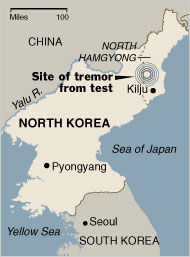
Korea’s National Intelligence Service (NIS) is watching the area around Punggye-ri, Kilju-gun, Hamgyongbuk-do for a possible second North Korean nuclear test, reports Yonhap.
NIS believes this morning’s supposed nuke test took place in Kimchaek-si.
NIS chief Kim Seung-kyu told lawmakers on the National Assembly intelligence committee that his boys were closely watching the Punggye-ri area, where intelligence officials initially believed a test would take place.
One lawmaker said Kim warned that there was sufficient possibility the North would conduct additional tests.
Korea’s chief spook explained that the morning test took place not in Hwadae-gun, as initially reported, but near Sangpyeong-ni, a town some 15 km away from Kimchaek-si. Sangpyeong-ni is 51 km south of Punggye-ri and 48 km west of the North Korean missile base in Hwadae-gun. Or so an Uri Party lawmaker on the intelligence committee said Kim said.
Interestingly, Kim is reported to have said that this morning’s test area was under surveillance up till Sep. 7, but when no unusual signs were detected, NIS decided to concentrate on the Punggye-ri site. Also interesting is that he said the United States still believes this morning’s test took place at Punggye-ri, indicating that Korean and American intelligence officials differ in their analysis. Kim said more minute intelligence analysis was needed.
The NIS chief also noted that with the tremors posting a mere 3.58, the warhead tested this morning was presumed to be under 1 kt (a 1 kt device would cause tremors of over 4.0). He also said it would take 3-5 days to confirm the presence of radiation and, likewise, confirm whether the North actually did what they said they did, namely, successfully test a nuclear device.
From Japundt
It seems that today, Monday October the 9th 2006,Pyongyang has much to celebrate. Reports are coming in that indeed North Korean is now an active nuclear power.
If there is any nation on earth that knows first hand the dangers and effects of nuclear weapons,it certainly is Japan. And tonight, Tokyo has been forced to go back to the table and decide how to deal with the “nuke” kid on the block.
The Korean peninsula and Japan have a long bloody history that dates back to 1592 when Japanese military dictator Toyotomi Hideoshi first drew up plans to attack and tried to subsequently annex Korea which ended in failure for the Samurai lord.
From 1910 to 1945, the Japanese military now modernized and deadly successfully occupied Korea utilizing its resources to fund its budding Asiatic Empire. But once again, the sun would set and Korea would be freed from Japanese rule. At the end of World War II, Japan had relinquished its control on Korea and the two dominant victorious super powers, the Soviet Union and United States, swooped in for control. No agreement could be reached between the two cold war enemies and after a blood three year battle, Korea was split in two.
North Korean boasts the fifth largest army in the world with an estimated 1.8 million standing armed personnel. If ever there was a threat to modern post-war Japan, this would be it.
On May of 2004, The Ministry of Foreign Affairs of Japan released a statement saying “The Government of Japan will aim to normalize the relationship with North Korea in a manner that would contribute to the peace and stability of the Northeast Asian region, in close co-ordination with the United States of America and the Republic of Korea.” On September 17, 2002, Former Prime Minister Koizumi visited North Korea and held a summit meeting with Kim Jong-Il, Chairman of the National Defence Commission of North Korea, and signed the “Japan-DPRK Pyongyang Declaration”.
Today, all has once again changed and a new page of history is to be written. As Japan decides how to proceed with its now nuclear neighbour, it is certain that there will be difficult decisions made that will no doubt affect the world entire.
North Korea tested nuclear device.. and why now? These questions of course assume that North Korea did in fact test a nuclear weapon and didn’t just detonate a large amount of conventional explosives in order to simulate a successful nuclear test. This could be the case considering the well publicized failure of the Taepodong ICBM on 4 July.
However, North Korea had a combination of reasons for testing a nuclear weapon; The timing of it, as author Chuck Downs has pointed out (by phone on an MSNBC broadcast, 0105-0115 am EST 9 Oct), has to do with South Korean Foreign Minister Ban Ki-Moon’s nominated at the new UN Secretary General – North Korea is trying to steal the spotlight and highlight it’s importance and technical acumen. As it is autumn, it is unlikely that fuel and food aid will be cut right before winter sets in. Japanese Prime Minister Abe has also just visited Beijing and arrived in Seoul, which was a bonus.
This is not the first time North Korea has done this. In a failed attempt to upstage the South, Pyongyang hosted an elaborate Arirang Festival over the summer of 2002 and made a point of opening it up to foreigners at the same time South Korea was jointly hosting the World Cup with Japan.
The obvious reason is for deterrence of an attack or invasion from a U.S. seeking regime change. However, military action by the U.S. was already extremely unlikely as any such action would put Seoul, South Korea’s capital, in danger of being hit by the thousands of artillery pieces just north of the border and well within range. That’s aside from the U.S. being overextending in Iraq. So a nuclear deterrent is only another level of deterrence.
The not so obvious reason is that North Korea has been implementing a strategy of disengagement since 4 October 2002, when then U.S. Assistant Secretary of State James Kelly in Pyongyang meeting North Korean Deputy Foreign Minster Kang Seok-Ju. When confronted with U.S. evidence, Kang admitted that North Korea had secretly continued a nuclear-weapons development program.
After that the words “complete, verifiable, and irreversible” became a part of the U.S. negotiating lexicon concerning denuclearization, which caused a shift in North Korean strategy from Regime survival by Extortion of Concessions to Regime survival by Strategic Disengagement.
North Korea cannot accept engagement for two primary reasons. First, invasive inspections would make the regime look weak internally and risk control of the military. Second, inspections on the scale that would be required for any new package deal would likely bring in an unprecedented influx of foreigners, something North Korea does not want.
This is because the legitimacy of the regime is build on a cult mythology that would be in jeopardy if outside information were to reach the isolated and misinformed North Korea population. The exposure of the North Korean people to reality vis-à-vis the cult is an enormous vulnerability for the regime.
What can be done about North Korea now? Excluding military intervention, there are still some options left for applying pressure on North Korea.
U.S.: First, the U.S. could make the world economy choose between itself and North Korea, effectively shutting down all international financial transactions for North Korea. China and South Korea would be most effected. Second, the U.S. could pressure regional powers to enforce the Proliferation Security Initiative (PSI) against North Korea. The PSI prevents proliferation of WMD-related goods and technologies. Third, if the U.S. chose to push for near-term regime change, China’s access to the U.S. marketplace could be threatened if China continues to support the regime. This might include a deal where U.S. forces in Korea remain in South Korean territory below the 38th parallel once Korea reunifies.
Japan: Remittances from Japan are estimated to be in the tens of millions; that’s probably going to stop, and it will hurt the North Korean elite.
South Korea: Condition free aid may come to an end, although it may wait until Roh is out of office.
China: The key is China; only China controls the fuels and aid that literally keeps the North Korean regime from falling. But China will only use this leverage if the U.S. uses its leverage to force China. So not likely that China will be the deciding factor here.
Is This a Failure for the Bush Administration? In a word, no. North Korea had no intention in making a realistic deal from the outset, and has broken every nuclear-related agreement is has made with both the U.S. and South Korea. North Korea has steadfastly refused to come back to the Six-Party Talks since September last year, literally throwing away aid packages that could have helped it’s starving population.
Aside from invading North Korea there is no realistic action any U.S. administration could have done that would have stopped North Korea from producing nuclear weapons. The notion that another deal like the 1994 Agreed Framework could have stopped this is deceptively attractive, but nonetheless incorrect.
The only deal North Korea would accept is one that did not include “complete, verifiable, and irreversible denuclearization,” in other words, another deal where North Korea reaps concessions for stopping nuclear activity, but actually continues such activity, as it did with the 1994 agreement. It’s also worth noting that North Korea likely had nuclear weapons before Bush 43 was even elected.
Do you notice a few people have said that a repeat of 1994 is what(NK) They want and recall when John Kerry went after Bolton with this a few months ago
John Bolton
John Kerry: This has been going on for five years, Mr. Ambassador.
John Bolton: It's the nature of multilateral negotiations, Senator.
John Kerry: Why not engage in a bilateral one and get the job done? That's what the Clinton Administration did.
John Bolton: And, very poorly since the North Koreans violated the agreed framework almost from the time it was signed.
So we cant go back and if we go forward its war. Food for thought for today.
2nd test?
Alook from Japan
wHAT CAN WE DO
This is 4 looks at what the heck is going onin my world now. To say that I am scared would be an understatment. Pay close attention to all 4 and re-read the comment from Japundt about "At the end of World War II, Japan had relinquished its control on Korea and the two dominant victorious super powers, the Soviet Union and United States, swooped in for control." Very Intresting..
Once again a long read but one well worth it..
Most of all some are not even sure if this explosion was even a nuclear blast
“We have assessed that the explosion in North Korea was a sub-kiloton explosion,” said the intelligence official, speaking on condition of anonymity because of the sensitivity of the issue. He added, “We don’t know, in fact, whether it was a nuclear explosion.” He spoke as intelligence analysts in Washington were in the early stages of assessing the explosion.
A one-kiloton blast would be extremely small for a nuclear weapon. But regardless of the size of the blast, the North Korean announcement reverberated throughout the world of diplomacy, and seemed likely to be felt in American domestic politics as well. There were suggestions, moreover, that the Communist state might be preparing a second test.
That's right folks there might be another test either today or in the coming days. Could this be a sign that their first test wasn't as successful as they claim?
France has been even bold enough to say that the test might have failed:
France estimated it as merely the equivalent of about 500 tons of TNT, and did not confirm that it was the result of a nuclear device, The Associated Press reported.
Russia tends to think the test was a success:
Russia’s defense minister, Mr. Ivanov, said that the Russian military had confirmed the test and estimated its force at somewhere between 5 and 15 kilotons — much larger than estimates from South Korea.
Predictably nations around the world have condemned the North Korean nuclear test. Even Venezuela condemned the nuclear test, however one country didn't:
Iran, which is already at odds with the United Nations Security Council over its own nuclear program, stood out from the general mood of condemnation. Its state-run radio today blamed pressure from the United States for North Korea’s decision to test, A.P. reported, calling it “a reaction to America’s threats and humiliations.
Pressure? Like enforcing our counterfeiting laws and allowing North Korea international aid so they can use their scarce resouces to build nuclear weapons? How would Iran like the North Koreans counterfeiting their money? I do think this test is not good for Iran because if quick and decisive action is taken on North Korea the global community may wrap Iran into any resolutions to come in stopping the development of nuclear weapons.
Here is what the US President George Bush had to say:
President Bush on Monday said North Korea's claim that it has tested a nuclear weapon is a threat to international peace and said the world "will respond."
"The transfer of nuclear weapons to states or non-state entities would be considered a grave threat to the United States," Bush said. "And we would hold North Korea fully accountable to the consequences of such action."
Bush said the U.S. was still trying to verify North Korea's claims that it had tested a nuclear weapon on Monday.
Here is what US Democrats had to say:
Senate Democrats quickly condemned North Korea, but they criticized the Bush administration as well.
The Democratic leader, Senator Harry Reid of Nevada, assailed North Korea for its “reckless and counterproductive actions.” But he asserted that the Bush administration has been in a “state of denial” about North Korea, in part because the administration has been “distracted by Iraq and parayzed by internal divisions.” A comprehensive review of American policy toward North Korea is essential, the senator said.
Senator Christopher Dodd of Connecticut said the administration had “wasted the last five-plus years sitting on the sidelines” and must now use its influence with China and South Korea to bring the North to the table. Senator Edward Kennedy of Massachusetts said the administration “must go into diplomatic overdrive” and work with its allies in the region. And Senator Charles Schumer of New York said that, in addition to undertaking a diplomatic offensive, the United States must develop nuclear-detection devices as soon as possible.
“North Korea going nuclear shows how much we need allies to succeed in the war on terror,” Mr. Schumer said.
"State of Denial" is new the Democratic catch phrase after the name of Bob Woodward's new book critical of the Bush Administration. I guess the "Culture of Corruption" catch phrase just wasn't cutting it anymore. So what review of policy do these Democrats want? Give Kim Jong-il his pay day that he has been demanding? That was tried in 1994 and didn't work. Then of course Senator Kennedy uses the other Democratic catch phrase, "work with our allies". If there is any issue that the US government has worked with allies on, it is this one. The US has consistently made it a policy to deal with North Korea in the context of the six party talks so that regional allies in the area were involved in resolving the crisis. Now the Democrats are coming out and saying we need to work with our allies when before they were blasting Bush about not holding bi-lateral talks with Kim Jong-il. Then Schumer talking about developing nuclear detection devices I can only assume he is referring to nuclear detection devices in all of the US ports so North Korea can't send a boat into New York and nuke it as absurd of a scenario that, that is.
So what should the US do? Well you can post your opinion and read many others over at the New York Times Blog The responses are definitely all over the place from people wanting to attack North Korea, which is easy to say when you wouldn't be the person crossing the DMZ to do it, others saying that Bush will nuke North Korea in order to win more votes for the Republicans, more saying that Bush created this nuclear crisis to win votes as well (that Karl Rove sure is clever), and a Korean commenter even complained that the Sea of Japan is really the East Sea. In a time of crisis you can always count on a VANKer to remind us what is really important.
N. Korea preparing second nuke test?
Korea’s National Intelligence Service (NIS) is watching the area around Punggye-ri, Kilju-gun, Hamgyongbuk-do for a possible second North Korean nuclear test, reports Yonhap.
NIS believes this morning’s supposed nuke test took place in Kimchaek-si.
NIS chief Kim Seung-kyu told lawmakers on the National Assembly intelligence committee that his boys were closely watching the Punggye-ri area, where intelligence officials initially believed a test would take place.
One lawmaker said Kim warned that there was sufficient possibility the North would conduct additional tests.
Korea’s chief spook explained that the morning test took place not in Hwadae-gun, as initially reported, but near Sangpyeong-ni, a town some 15 km away from Kimchaek-si. Sangpyeong-ni is 51 km south of Punggye-ri and 48 km west of the North Korean missile base in Hwadae-gun. Or so an Uri Party lawmaker on the intelligence committee said Kim said.
Interestingly, Kim is reported to have said that this morning’s test area was under surveillance up till Sep. 7, but when no unusual signs were detected, NIS decided to concentrate on the Punggye-ri site. Also interesting is that he said the United States still believes this morning’s test took place at Punggye-ri, indicating that Korean and American intelligence officials differ in their analysis. Kim said more minute intelligence analysis was needed.
The NIS chief also noted that with the tremors posting a mere 3.58, the warhead tested this morning was presumed to be under 1 kt (a 1 kt device would cause tremors of over 4.0). He also said it would take 3-5 days to confirm the presence of radiation and, likewise, confirm whether the North actually did what they said they did, namely, successfully test a nuclear device.
From Japundt
It seems that today, Monday October the 9th 2006,Pyongyang has much to celebrate. Reports are coming in that indeed North Korean is now an active nuclear power.
If there is any nation on earth that knows first hand the dangers and effects of nuclear weapons,it certainly is Japan. And tonight, Tokyo has been forced to go back to the table and decide how to deal with the “nuke” kid on the block.
The Korean peninsula and Japan have a long bloody history that dates back to 1592 when Japanese military dictator Toyotomi Hideoshi first drew up plans to attack and tried to subsequently annex Korea which ended in failure for the Samurai lord.
From 1910 to 1945, the Japanese military now modernized and deadly successfully occupied Korea utilizing its resources to fund its budding Asiatic Empire. But once again, the sun would set and Korea would be freed from Japanese rule. At the end of World War II, Japan had relinquished its control on Korea and the two dominant victorious super powers, the Soviet Union and United States, swooped in for control. No agreement could be reached between the two cold war enemies and after a blood three year battle, Korea was split in two.
North Korean boasts the fifth largest army in the world with an estimated 1.8 million standing armed personnel. If ever there was a threat to modern post-war Japan, this would be it.
On May of 2004, The Ministry of Foreign Affairs of Japan released a statement saying “The Government of Japan will aim to normalize the relationship with North Korea in a manner that would contribute to the peace and stability of the Northeast Asian region, in close co-ordination with the United States of America and the Republic of Korea.” On September 17, 2002, Former Prime Minister Koizumi visited North Korea and held a summit meeting with Kim Jong-Il, Chairman of the National Defence Commission of North Korea, and signed the “Japan-DPRK Pyongyang Declaration”.
Today, all has once again changed and a new page of history is to be written. As Japan decides how to proceed with its now nuclear neighbour, it is certain that there will be difficult decisions made that will no doubt affect the world entire.

North Korea tested nuclear device.. and why now? These questions of course assume that North Korea did in fact test a nuclear weapon and didn’t just detonate a large amount of conventional explosives in order to simulate a successful nuclear test. This could be the case considering the well publicized failure of the Taepodong ICBM on 4 July.
However, North Korea had a combination of reasons for testing a nuclear weapon; The timing of it, as author Chuck Downs has pointed out (by phone on an MSNBC broadcast, 0105-0115 am EST 9 Oct), has to do with South Korean Foreign Minister Ban Ki-Moon’s nominated at the new UN Secretary General – North Korea is trying to steal the spotlight and highlight it’s importance and technical acumen. As it is autumn, it is unlikely that fuel and food aid will be cut right before winter sets in. Japanese Prime Minister Abe has also just visited Beijing and arrived in Seoul, which was a bonus.
This is not the first time North Korea has done this. In a failed attempt to upstage the South, Pyongyang hosted an elaborate Arirang Festival over the summer of 2002 and made a point of opening it up to foreigners at the same time South Korea was jointly hosting the World Cup with Japan.
The obvious reason is for deterrence of an attack or invasion from a U.S. seeking regime change. However, military action by the U.S. was already extremely unlikely as any such action would put Seoul, South Korea’s capital, in danger of being hit by the thousands of artillery pieces just north of the border and well within range. That’s aside from the U.S. being overextending in Iraq. So a nuclear deterrent is only another level of deterrence.
The not so obvious reason is that North Korea has been implementing a strategy of disengagement since 4 October 2002, when then U.S. Assistant Secretary of State James Kelly in Pyongyang meeting North Korean Deputy Foreign Minster Kang Seok-Ju. When confronted with U.S. evidence, Kang admitted that North Korea had secretly continued a nuclear-weapons development program.
After that the words “complete, verifiable, and irreversible” became a part of the U.S. negotiating lexicon concerning denuclearization, which caused a shift in North Korean strategy from Regime survival by Extortion of Concessions to Regime survival by Strategic Disengagement.
North Korea cannot accept engagement for two primary reasons. First, invasive inspections would make the regime look weak internally and risk control of the military. Second, inspections on the scale that would be required for any new package deal would likely bring in an unprecedented influx of foreigners, something North Korea does not want.
This is because the legitimacy of the regime is build on a cult mythology that would be in jeopardy if outside information were to reach the isolated and misinformed North Korea population. The exposure of the North Korean people to reality vis-à-vis the cult is an enormous vulnerability for the regime.
What can be done about North Korea now? Excluding military intervention, there are still some options left for applying pressure on North Korea.
U.S.: First, the U.S. could make the world economy choose between itself and North Korea, effectively shutting down all international financial transactions for North Korea. China and South Korea would be most effected. Second, the U.S. could pressure regional powers to enforce the Proliferation Security Initiative (PSI) against North Korea. The PSI prevents proliferation of WMD-related goods and technologies. Third, if the U.S. chose to push for near-term regime change, China’s access to the U.S. marketplace could be threatened if China continues to support the regime. This might include a deal where U.S. forces in Korea remain in South Korean territory below the 38th parallel once Korea reunifies.
Japan: Remittances from Japan are estimated to be in the tens of millions; that’s probably going to stop, and it will hurt the North Korean elite.
South Korea: Condition free aid may come to an end, although it may wait until Roh is out of office.
China: The key is China; only China controls the fuels and aid that literally keeps the North Korean regime from falling. But China will only use this leverage if the U.S. uses its leverage to force China. So not likely that China will be the deciding factor here.
Is This a Failure for the Bush Administration? In a word, no. North Korea had no intention in making a realistic deal from the outset, and has broken every nuclear-related agreement is has made with both the U.S. and South Korea. North Korea has steadfastly refused to come back to the Six-Party Talks since September last year, literally throwing away aid packages that could have helped it’s starving population.
Aside from invading North Korea there is no realistic action any U.S. administration could have done that would have stopped North Korea from producing nuclear weapons. The notion that another deal like the 1994 Agreed Framework could have stopped this is deceptively attractive, but nonetheless incorrect.
The only deal North Korea would accept is one that did not include “complete, verifiable, and irreversible denuclearization,” in other words, another deal where North Korea reaps concessions for stopping nuclear activity, but actually continues such activity, as it did with the 1994 agreement. It’s also worth noting that North Korea likely had nuclear weapons before Bush 43 was even elected.
Do you notice a few people have said that a repeat of 1994 is what(NK) They want and recall when John Kerry went after Bolton with this a few months ago
John Bolton
John Kerry: This has been going on for five years, Mr. Ambassador.
John Bolton: It's the nature of multilateral negotiations, Senator.
John Kerry: Why not engage in a bilateral one and get the job done? That's what the Clinton Administration did.
John Bolton: And, very poorly since the North Koreans violated the agreed framework almost from the time it was signed.
So we cant go back and if we go forward its war. Food for thought for today.
Monday, October 09, 2006
WILL NORTH KOREA BACK DOWN
GI Korea
Not really, they are basically making the same old demands they always do: that they want bi-lateral talks with the US so they can get their pay day for saying they will give up nuclear weapons:
North Korea informed China it may drop its plan to test its first atomic bomb if the United States holds bilateral talks with the communist country, a former South Korean lawmaker said Sunday.
The North also denied speculation that its nuclear test was imminent and said the regime has not raised the alert level of the country's military, said Jang Sung-min, citing a telephone conversation with an unidentified Chinese diplomatic official.
North Korea warned the Chinese official, however, that it would accelerate its preparations for a nuclear test if the United States moves toward imposing sanctions or launching a military attack, Jang said, citing his contact.
The Chinese official was informed of North Korea's stance by North Korean officials Sunday afternoon, Jang said.
While this is going on, North Korea has also turned to their lackeys within South Korea to begin lobbying for the US to hold direct talks. Former President Kim Dae-jung who bribed for $156 million won the Nobel Peace Prize for his failed Sunshine Policy was on CNN's Talk Asia saying the US needs to hold bi-lateral talks:
South Korea's former President Kim Dae-jung said that the United States should give North Korea one more chance even though it is on the brink of a nuclear test.
In an interview with CNN's Talk Asia on Sunday, he urged the U.S. to engage in direct talks with North Korea so that the isolated country could give up its nuclear ambition and come back to the negotiation table.
``Even former U.S. President Ronald Reagan had dialogue with the Soviet Union, which he branded as an `evil empire,''' Kim told the U.S. 24-hour news channel. ``I can hardly understand why the U.S. does not hold talks with North Korea.''
First of all, North Korea is not the equivalent of the Soviet Union. NK is one of the world's poorest countries with a ruthless dictator who is trying to blackmail the US into giving him free aid. The US is treating this as a regional problem that will require a regional solution with the country's in the region. That is what the six party talks are for. What precedent is this going to set if the United States is expected to hold bi-lateral discussions with every two bit dictator in the world? Here is a chance for major powers in the region like China to step up and show the world their global leadership credentials.
This is basically 1994 all over again. North Korea needs a deal soon in order to keep the regime a float, but has no intentions of completely scrapping their nuclear weapons program. Kim Jong-il not only needs the weapons for international prestige, but also for protection from any international attempts at regime removal and to appease the generals in his military that keep him in power. If a deal is reached the North Koreans will just keep the program secret just like after the 1994 deal until they need more money again and 8 years down the road the US will be doing the same old song dance with these guys once again under a new US administration.
Kim Jong-il might also see the time as right now for a favorable deal because the Republicans are hurting at the polls with the elections coming up and major foreign policy success such as appearing striking a deal on the NK nuclear crisis may help the Republicans. I think this is just one of many factors driving this crisis but I would be really surprised if President Bush makes any big policy changes in regards to North Korea even if there are political consequences.
WMD?
North Korea says nuclear test successful
North Korea said Monday it has performed its first-ever nuclear weapons test. U.S. and South Korean officials could not immediately confirm the report.
The South Korean seismic monitoring center confirmed that tremors felt at the time of the alleged test were not natural occurrence. Japanese Prime Minister Shinzo Abe said information still needed to be analyzed to determine whether North Korea truly conducted the test.
The North's official Korean Central News Agency said the underground test was performed successfully and there was no radioactive leakage from the site. South Korean intelligence officials said a seismic wave of magnitude-3.58 had been detected in North Hamkyung province, according to Yonhap. It said the test was conducted at 10:36 a.m. (9:36 p.m. EDT Sunday) in Hwaderi near Kilju city on the northeast coast, citing defense officials.
North Korean scientists "successfully conducted an underground nuclear test under secure conditions," the KCNA report said, adding this was "a stirring time when all the people of the country are making a great leap forward in the building of a great prosperous powerful socialist nation."
The director of South Korea's monitoring center that is watching for a test with sound and seismic detectors declined to immediately comment on the reported test. "We don't know whether it is a nuclear test or not," an official at the earthquake center at the Korea Institute of Geoscience and Mineral Resources said on condition of anonymity, citing the sensitive nature of the issue.
The U.S. Geological Survey said it had detected no seismic activity in North Korea, although it was not clear whether a blast would be strong enough for its sensors. The North said last week it would conduct a test, sparking regional concern and frantic diplomatic efforts aimed at dissuading Pyongyang from such a move. North Korea has long claimed to have nuclear weapons, but had never before performed a known test to prove its arsenal.
"The nuclear test is a historic event that brought happiness to our military and people," KCNA said. "The nuclear test will contribute to maintaining peace and stability in the Korean peninsula and surrounding region."
On Sunday night, U.S. government officials said a wide range of agencies were looking into the report of the nuclear test, which officials were taking seriously. South Korean President Roh Moo-hyun has convened a meeting of security advisers over the issue, Yonhap reported, and intelligence over the test has been exchanged between concerned countries.
Kyodo News agency reported that the Japanese government has set up a taskforce in response to reports of the test. The North has refused for a year to attend international talks aimed at persuading it to disarm. The country pulled out of the Nuclear Nonproliferation Treaty in 2003 after U.S. officials accused it of a secret nuclear program, allegedly violating an earlier nuclear pact between Washington and Pyongyang.
Speculation over a possible North Korean test arose earlier this year after U.S. and Japanese reports cited suspicious activity at a suspected underground test site.
Don’t Panic! (Ok, worry a little bit.)
Here’s a handy-dandy Guide To The End (Or Not):
While generally nothing should happen now that the DPRK has tested an A-bomb (hell, nothing else they’ve done over the years has changed anything) let’s take a brief look at what an expat in Korea should look forward to before they decide to freak out.
Keep tabs on the American media
For many expats (esp. those of us who don’t know the language) Korea can be kind of a cocoon. You never know what the outside world is thinking about what is going on here unless you seek it out. Therefore, the next few days you should probably avail yourself of the American media to see if there is The Great Freakout on the part of the American mass media. There might be a week of hand-wringing that will climax with the Sunday chat shows where a final decision will be imparted by The Powers That Be. Within a week, we should have a sense of where that’s headed. How many talking heads focus on the potential blackmarket value of an a-bomb? How many talk about how Iran and the DPRK might join forces to become a “true” Axis of Evil?
The UN
American President Bush has said he plans to head to the UN if, well, if the DPRK does exactly what it just did. Things could start to get a little hot in these parts if he is able to successfully get sanctions placed on the DPRK in the coming days. Pay close attention to the exact wording of any resolutions. Can the US take proactive steps to enforce the embargo? Does it tacitly allow for a navel blockade?
The US Military & CNN
Another thing to keep an eye on is the US military…or more exactly, how CNN starts to deal with such things. Ever since the first Gulf War, CNN has had a tendency to be the wink & nod of the US military. If suddenly there are lots of prime time specials about starving North Korean children and or torture chambers, then you know that the US government is at least brooding about some sort of military action. This will be doubly so if there are all kinds of odd military movements in the area that CNN mentions in passing in a very casual-yet-threatening way.
Koreans
This is significantly more difficult for someone like me to give anyone any advice on ’cause I’ve only been here two years and I can’t speak the language. But…as all this happens…is there a more obvious security / military presence on the streets? Are there more military copters in the air randomly?
I would suggest that any type of random civil defense practice on the part of the ROK government would definitely be the first concrete sign that somewhere other than Korea might be a good bet (unless, of course, you want to be a stringer for a Western news agency.)
The only military thing I could maybe — just maybe — see happening is some sort of limited middle-of-the-night attack on some DPRK military installations. Then we all would have to collectively hold our breath. But, honestly, I just think we’re in store for a lot of nervousness…then the “new normal” of a ICBM / A-bomb DPRK.
Welcome to the future, bitches!

Yonhap is reporting that it appears North Korea tested a nuclear device sometime Monday morning, and that the nations concerned have exchanged intelligence.
That’s all the report says. Undoubtedly, there will be more.
UPDATE 1: A little more detailed Yonhap report. A high-ranking South Korean intelligence official told Yonhap that it received intel that North Korea carried out a nuke test this morning, and that Seoul was now examining things.
President Roh has apparently called a snap meeting of security-related ministeries to discuss measures. Attending this meeting was UN General Secretary Foreign Minister Ban Ki-moon, Unification Minister Lee Jong-seok, Defense Minister Yoon Kwang-ung and Cheong Wa Dae national security secretary Song Min-soon.
And here I was, thinking a nuke test wasn’t imminent.
BTW, the Grand National Party decided yesterday to call for Roh’s resignation in the event of a North Korean nuke test. Will be interesting to watch if the reports are accurate.
UPDATE 2: OK, I guess it’s official now—the KCNA is reporting a successful underground nuke test. You’ll be happy to know that amidst the chest thumping over this “historic” moment, the KCNA did assure us that no radioactivity leaked from the test site. Oh, and the test was conducted using 100 percent homegrown technology—mansei!
And for a bit more specific info about the earlier intel, it appears a 3.58-scale earthquake was detected around Hwadae, Hamkyongbuk-do at 10:36 a.m. Korea time.
The Korean Liberator
Acording to Fox News (broadcast), North Korea notified China that a test was going to occur, and China passed that warning on to the U.S. 20 minutes beforehand. The website notes that, “U.S. intelligence official cannot confirm what would be North Korea’s first-ever nuclear weapons test.”
A few brief thoughts until we can learn more about what happened.
First, that North Korea tested a nuke is not confirmed. The could have merely detonated a large amount of conventional explosives in deep (est. ~2km) mine to simulate a nuclear test; after all, the Taepodong 2 ICBM was an abject failure. It’s a possibility, but I doubt it as satellites will probably be able to differentiate between the two. Second, militarily I don’t see any action coming soon; Pakistan/India, but with more sanctions. Seoul didn’t even raise the military alert level. Third, mid-to-long term, UN sections are on the way that may finally topple the Kim regime; let’s hope so. Fourth, North Korea once again a) made China look the fool for conveying its offer not to test, and b) showed that it makes such offers in bad faith to begin with.
I think that this will eventually be shown to be an almost incredible FUBAR on the part of Kim Jong-il.
I don’t think that it’s reached the point of being considered ‘common knowledge’, but Kim just isn’t all that smart, really.
I recall Pyongyang’s similar mishandling of another situation - when Kim Jong-il admitted to Prime Minister Koizumi about having North Korean agents kidnap Japanese citizens on Japanese soil (and elsewhere) and smuggle them to North Korea to train North Korean spies on how to better infiltrate and undermine Japan.
Kim’s gameplan was that his admission to Prime Minister Koizumi on 17 Sep 2002 was going to be greeted with hosannas in Tokyo, diplomatic relations would be established, and that $10 billion in WWII reparation moneys would be shortly forthcoming. The operative word here being ‘$10 billion’ and ’shortly’ … like in ‘tomorrow’.
Wrong-o … with a capital ‘W’.
Kim (and his addlebrained advisors) completely misjudged the nature and depth of the feelings of the Japanese populace on this matter and were completely taken aback by the vehemence of their negative response.
I can still recall KCNA’s bitching about Tokyo’s not forking over the big bucks immediately after the ‘two nations’ big bosses had already agreed to it and can’t understand what the problem is’ … which, by the way, certainly seems to imply a clear lack of understanding of how democratic governments actually operate.
My views on the Kim Family Regime’s political sophistication at the international level (as reflected in my thinking then, ‘Geez! These guys are really stoopid!’) haven’t changed all that much since then … and, if nothing else, are certainly being confirmed by this latest antic.
When I know more I WILL POST IT, FOR NOW, WE SIT AND WAIT.
I received this in an Email today and so did GI KOREA
A United States soldier was attending some college courses between
assignments. He had completed missions in Iraq and Afghanistan.
One of the courses had a professor who was an avowed atheist and a
member of the ACLU.
One day the professor shocked the class when he came in. He looked to
the ceiling and flatly stated, "God, if you are real, then I want you to
knock me off this platform. I'll give you exactly 15 minutes." The
lecture room fell silent. You could hear a pin drop.
Ten minutes went by and the professor proclaimed, "Here I am God. I'm
still waiting."
It got down to the last couple of minutes when the soldier got out of
his chair, went up to the professor, and cold-cocked him knocking him
off the platform. The professor was out cold. The soldier went back to
his seat and sat there, silently. The other students were shocked and
stunned and sat there looking on in silence. The professor eventually
came to, noticeably shaken, looked at the soldier and asked, "What the
hell is the matter with you? Why did you do that?"
The soldier calmly replied, "God was too busy today protecting America's
soldiers who are protecting your right to say stupid shit and act like
an asshole. So, He sent me."
Sunday, October 08, 2006
Well today was the best of times and it was the worst of times.
Lets get the bad news out of the way....THE YANKEES LOST.....
I think its time to implode the team and start over again,
Now for the good news I went to the Korean Baseball Playoff here in Daejeon and recored video and posted it on myspace and I wil post it here for everyone to see.
Get this video and more at MySpace.com
Get this video and more at MySpace.com
Get this video and more at MySpace.com
Get this video and more at MySpace.com
well I finally posted homemade videos on myspace
OH DAJEON WON 3-2
Enjoy the videos
Saturday, October 07, 2006
Friday, October 06, 2006
For they last few weeks I have been doing a movie theater review of all of the film places here in Daejeon, Korea. I have listed a video about the insanity of Dokto that shows that nationalism and the pure stupidity of the commercials that I have seen here at the Korean Theaters. Well Thanks to youtube, Here it is.
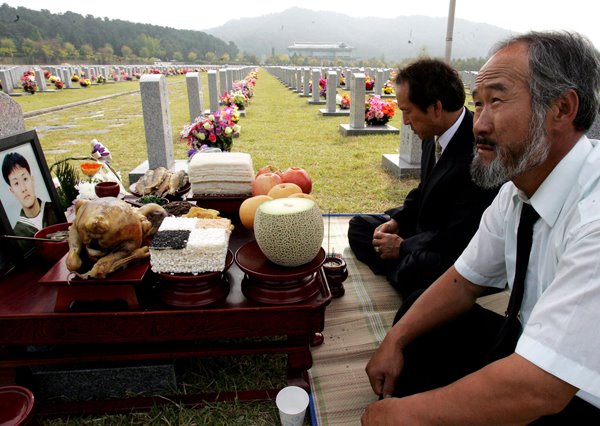
A Sad photo
Park Nam-jun, right, visits the grave of his son, Sergeant Park Dong-hyeok, who died in a June 2002 naval skirmish with North Korean forces, at the National Cemetery in Daejeon on the eve of Chuseok.
Happy Chuseok
Chuseok (Tip to GI Korea)
Chuseok is supposed to be a happy time of year for Korean families but for some families it is a time painful rememberance.
For background information click here.
Buy a T-shirt.
I saw this in Itaewon and just could not believe it. Be very very quiet, I'm hunting Americans. (Tip of the hat to Elmer Fudd)
Alleyway T-shirt vendors in the Itaewon district have a new competitor. The new must-have shirts read “I’m not migook” on the front, and on the back in Korean, “I am not an American.” Since the shirts first turned up at a shop in front of the neighborhood Starbucks in the middle of last month, more than 100 of the shirts have been sold every five days. The man who brought the thoughtful product into the world is a 31-year-old named Michael Kenny who would like to make it clear that he is Canadian.
Kenny hatched the idea of starting up his own business only two months ago. “When I started out, it was just to help make money for a trip my girlfriend and I were taking to South America and Australia,” he recalls. He found an untapped niche market: non-American Caucasians in Korea, with their fears of being thrown in the same pot with U.S. citizens. Kenny’s idea paid off. The going price of W15,000 is a little steep for a T-shirt, but that hasn’t stopped droves of European tourists and Canadian and Australian English instructors -- fed up with the “everything white is an American” attitude -- from snapping up every last one of the shirts. He has already recouped his investment, and from here on out, it’s pure profit for the entrepreneur. His Korean girlfriend says, “We’ve seen for ourselves just how many non-American Caucasians there really are in Korea.”
Michael spends his Fridays and Saturdays out on the Itaewoon sidewalk hawking his goods. A spinoff of his original best-seller -- “I’m waygook” on one side and “Foreigner” on the back -- also sells well. “I’ve been to Korea six times now, and there are always Koreans who assume that I’m an American and come up speaking only English to me,” said one German traveler who bought a shirt the moment he saw it. “What I’ve always wanted to say is written right there.” There are even Americans who see the fun in the shirt and purchase one for themselves. Kenny is only waiting for his first Korean customer.
But though things are going well, he still has two things to fret about. First, he is concerned about knockoffs. The flood of cheap copies inundating outlets in Itaewon is one of the things it is best known for, so Kenny decided to apply for a patent for his T-shirt design with the Korean Intellectual Property Office. But the complicated procedures involved are giving him a headache. Worry no. 2 is that people tend to associate the shirts with anti-Americanism. He says quite a few people have challenged him about the message. But his response is: “Oh, there’s nothing to it. It’s all just good fun. American whites are Caucasians, but that doesn’t mean all Caucasians are Americans. Now, wouldn’t it be nice if Koreans knew that too?”
I have alot of friends from Canada here in Korea so this is not directed at them ,but, as Robert said, "I’m in the market for a “I’m Not a Low-Quality Canadian English Teacher (who hates America and feels sad because they are great and we hate them)" jeogori if anyone’s got ‘em.
Foreign actors in "The Host" deported
Payback (From the Marmot)
The Dong-A Ilbo reports that immigration authorities have handed down deportation orders for actors David Anselmo and Clinton Morgan, both of whom appeared in Bong Joon-ho’s blockbuster “The Host,” for violating Article 20 of Korea’s immigration law, namely, that you must get government permission before engaging in activities other than the ones specified in your sojourn status.
Morgan, an Australian, was on a English teaching visa and employed at a university in Suwon, while Anselmo, a Canadian, was on a 90-day tourist visa.
Good news for the both, however. If they pay a 1 million won fine and leave Korea, they can return anytime they like. If they fail to pay the fine, however, they would be forcefully deported and barred from reentering the Land of the Morning Calm for 3-5 years. Which would suck.
Mr. Morgan, however, was still pretty pissed. He told the Dong-A (warning: retranslating from Korean here), “Restricting activities besides those marked on your visa is a narrow-minded policy… I don’t want to come back to Korea.”
Actually, I feel bad for the guys. I can see how they might have to pay a fine, but a deportation order? For appearing in, what, the highest grossing film in Korean cinema history? You’d figure just for their contributions to Korea’s film industry the authorities would go easy. Guess not. Hope they get some good legal help.
Someone elses remaks...
My favorite part of the sneering disdain many Koreans have for those foreigners who, for whatever reasons, decide to come to Korea instead of some other place, is the self-hatred behind the idea that such people have “nowhere to go but Korea”, or that only “low-quality” expatriates would choose this place.
Anyway, for the two actors, or for Mrs. Vershbow, all of the trouble could have been avoided simply by asking for permission to engage in some activity outside the scope of the original visa. In all cases, provided the foreigner has permission from his/her “owner” (think of yourselves as indentured servants or chattel slaves, and you’ll get the idea of the immigration department’s attitude toward foreigners resident in Korea, and whose rights they ought to be protecting), the immigration department is usually pretty generous about granting additional permission for work.
Free legal advice for the day: If you’re here in Korea on a visa, of whatever kind, ask yourself whether the economic activity you intend is permitted by the visa you currently hold (the answer is usually “no“), then go about getting the additional permission — in the form of an endorsement to your current visa — necessary to do it without getting deported.
THIS JEM ALSO.....
Back in the eighties, when Chun Doo Hwan was having the film industry crank out cautionary tales about dalliances with Itaewon’s foreign devils, there were always some white ninnies willing to play villains in the films. Two Europeans that I know of fell victim to the xenophobia they had helped whip up: immigration deported them. I agree with Hans: poetic justice.
But my guess is the Immigration turned a blind eye to Morgan and Anselmo for a couple years, then decided to boot them out before they turn into bona fide “talents”.
Thursday, September 28, 2006
We are going to the PIFF!
Ok, now what is the PIFF?
11TH Pusan International Film Festival
On October 14th at 1130 and 1430 me and my former co-worker will be watching 2 movies the first one will be 12:08 East of Bucharest this one will start at 1130 and will be playing at the CGV Jangsan 6, it is a film about the fall of Nicolae Ceausescu of Romania and it's a Critic's Choice selection at the Festival.
The second one is Soul Kicking this one will start at 1430 and will be playing at the CGV Jangsan 6, it is a film from Greece/Cyprus and it's in the World Cinema selection. I could not get any tickets and the times just never would work for the one that I really wanted to see. The film is called Days of Glory , I know , another French War film. (The last 2 French films I really went crazy over werethe re-release of Battaglia di Algeri, La in 2004 and Joyeux Noel, the latter I gave the #1 selection on Socious best film of the year.)
I have allready seen some of the films that wil be shown here, The 9th Company, The Host and a few others. I have 2 PIFF books and tickets in hand. What really suprised me was the price of the tickets, they were 5,000 Won ($5.50) each.
It looks like a KTX ride to Pusan and then we will have to take the subway to Jangsan Station. I am so looking forward to this.
Happy Birthday, Claudia
Saturday was my daughters 10th birthday. It was a sad day for me, I still do not have any idea where She and my son, Sean , live at in California. They probably think that I have forgoten about them but I have not and my ex will not let me talk to them. Its just a sad story, that sadly, will continue.
I hope that you had a very nice birthday.
Thursday, September 14, 2006
Am I Famous Here In Korea
Am I famous here in Korea? At times I sure do not understand it. Today I was in Costco, looking at Ipods, when I see this group of High School girls. I bow and say, hello ladies, The girls all start to giggle at me and take my photo with their cell cameras. Later I was eating pizza and I was thinking about what had just happened .
I recalled Bob "The Beast Sapp, talking about how everytime he traveled in Japan, the girls would gigle and always have his picture taken. It sure sounded familiar today.
Now I am not A k-1 fighter, the only think I have going is that I am 6'4. maybe I am the first tall white guy that they have talked do, to be honest I do not understand it but it sure does happen alot.
Tuesday, September 12, 2006






Sunday, September 10, 2006
2996
2,996 is a tribute to the victims of 9/11.
On September 11, 2006, 2,996 volunteer bloggers
will join together for a tribute to the victims of 9/11.
Each person will pay tribute to a single victim.
We will honor them by remembering their lives,
and not by remembering their murderers.
I saw this link and I knew that I had to join this. I really can not tell anybody why. It just seemed like the right thing to do, and that I had to do it.
So When I joined I was sent an Email and I was given a name
The name was Francis X. Deming
What I found out was that he was 47 years old when he died, he worked at the WTC for Oracle and that he loved God and that he loved his family. I can think of no better words than those to honor this man.
Francis X. Deming

Solid Man, Quiet Hero
Francis Xavier Deming was not a peacock. He was not ostentatious, flashy or loud. He was a solid man who bowed to God. "He was the quiet hero," said his sister Rose Deming-Phalon. "He worked hard and he worked a lot. He loved his family and he is missed."
By his sister's account, Mr. Deming, 47, was one of the workaday Americans who is never celebrated. He went to his job as an accountant at the Oracle Corporation and came directly home to Franklin Lakes, N.J. He taught his five children to swim. He was active in his church, Most Blessed Sacrament. He built furniture. He was a man who did not lean on others, but whom others leaned on.
His last day on earth is a good example. There is a record of it in a message he left for his wife on their answering machine. He and a group were fleeing the 99th floor of 1 World Trade Center. "Get down low so you can breathe better," he told the group. And then: "What happened to the people who were behind us?"
Profile published in THE NEW YORK TIMES on November 2, 2001.
Francis X. Deming age 47, of Franklin Lakes, missing from World Trade Center since Sept. 11, 2001. Beloved husband of Brooke (nee Flynn). Devoted and adored father of Brian, Craig and Christopher, and step-father of Jeffrey and Brooke. Loving son of Ann Deming of Pequannock and the late Thomas J. Deming. Frank will be sorely missed by brothers Thomas of Towaco, Patrick of Mine Hill, Michael of Auburn. N.Y, and Robert of Monroe, NY.: and sister Rose Phalon of Pequannock. He also leaves behind many nephews and nieces, aunts and uncles, in-laws, cousins and friends. Frank was a member of Most Blessed Sacrament R.C. Church in Franklin Lakes.
He was employed by Oracle Corp as a practice director, working in the offices of Marsh McClennan on the 99th floor of Tower One of the World Trade Center. Prior to that he was employed as consultant by Exxon, TRW, Price Waterhouse, Coopers & Lybrand and Anderson consulting. He was a 1968 graduate of Holy Spirit Elementary School in Pequnnock and a 1972 graduate of Pequannock Township High School.
He graduated William Patterson College in 1976, and completed his Master's at Business Adminstration degree at Fairleigh Dickinson University in 1979. A strong believer in honest hard work. Frank held a number Jobs, including those of a cook in W.T. Grants' in Pompton Plains and member of the National Ski Patrol, to pay for his education. These will be among the many qualities he will pass along to his family. Frank was an avid sportsman, whose activities always included his family. He was a accomplished skier and boater.
Many of his happiest days were spent aboard his boat, the Good Times, water skiing on Lake Hopatcong or just enjoying a quiet sunset on the water. Although Frank's professional background was in accounting and computer software systems, he was also very good with this hands. Whether plumbing, electric or carpentry, there was rarely a project, repair or improvement in his home he could not handle. And he could always be counted to lend a hand to a family member or friend. When he found time to relax Frank and Brooke could often be found dining at Aldo's in Wyckoff,
Frank's friends and family are invited to Join in celebration of life Saturday, September 29 at 9:45 a.m. at Most Blessed Sacrament Church, 787 Franklin Lakes Road, Franklin Lakes, N.J. 07417. In lieu of flowers contributions in Franks' name may be made to The American Red Cross and The American cancer' Society.
Paid Notice published in THE BOSTON GLOBE on September 27, 2001.
Francis X. Deming, 47, an avid boater
Francis X. Deming of Franklin Lakes named his motorboat Good Times, and not without reason.
"Most of his time was spent on Lake Hopatcong boating with his wife, Brooke, his children and friends," said Robert Vreeland, a longtime friend who shared Mr. Deming's enthusiasm for water sports.
"Frank was an avid sportsman, whose activities always included his family," Vreeland recalled. "He was an accomplished skier and boater. Many of his happiest days were spent aboard his boat, water skiing or just enjoying a quiet sunset on the water."
Mr. Deming, 47, also enjoyed his job as a practice director for the California-headquartered Oracle Corp., a data-based software developer. At the time of the terrorist attack on the World Trade Center, Mr. Deming was at work as an Oracle consultant in the offices of Marsh McClennon on the 99th floor of the North Tower.
Although his professional background was in accounting and computer software systems, he was described as very good with his hands. Whether it was plumbing, electrical work or carpentry, there was rarely a repair or improvement project in his home that he could not handle. Family and friends could always count on him for his skills.
Mr. Deming was a 1968 graduate of Holy Spirit Elementary School in Pequannock and a 1972 graduate of Pequannock High School. He graduated from William Paterson College in 1976 and completed his master's of business administration degree at Fairleigh Dickinson University in 1979.
In addition to his wife, Mr. Deming is survived by his mother, Ann Deming of Pequannock; his children, Brian, Craig and Christopher, and stepchildren, Jeffrey and Brooke; four brothers, Thomas of Towaco, Patrick of Mine Hill, Michael of Auburn, N.Y., and Robert of Monroe, N.Y., and a sister, Rose Phalon of Pequannock.
A celebration of life ceremony will be held at 9:45 a.m. Saturday at the Most Blessed Sacrament Church, 787 Franklin Lakes Road, Franklin Lakes.
In lieu of flowers, contributions in Mr. Deming's name may be made to the American Red Cross and the American Cancer Society.
Profile by William Gordon published in THE STAR-LEDGER.
I have learned something over the years that I was a police officer, "You can tell alot about a man when he has a huge crisis and you see how he reacts to it."
I noticed that on the phone call to his wife, he was heard telling his people to get low to the ground and wondering where the people were that were just behind in his group as they were trying to escape the WTC.
This tells me what kind of a man he was, he was worried about his fellow man. He loved God, His Family, and his fellow man. We should all try and follow this example.
Friday, September 08, 2006
My former co-worker wrote this and I thought that it needed to be stated here in my blog.
I really did not see what was going on until I saw Stephanie say no, then I moved the guy away from Steph in about 2 seconds. I still can not believe that these Korean men try and buy Stephanie like she is a piece of meat. I have always wondered what would happen if I tried to buy a girl at that club, like the Korean men were trying to buy Stephanie. Is was very pathetic to see the guy cry because I removed him from Stephanie but damn it was just sad. I kept my eye on him for the rest of the night. I was in taxi one so I did not see the cab 2 incident, but I would have removed him again if I had been in cab 2.
Here is the rest of the story from her own words.....
For those of you who aren’t foreigners in Korea or familiar with our situation, because I have blonde hair and blue eyes, in Korea it is assumed that I am Russian. The first few times I heard this, I wasn’t surprised or offended by this because I passed for a Russian in Russia both times I went there. Later, I came to understand that by being asked if I am Russian, a Korean man is actually asking me if I am a prostitute (if they just ask where I’m from as an opened ended question, there’s nothing implied). The strange thing about it is that it has nothing to do with what I’m wearing or how I’m behaving, and everything to do with the way that I look naturally. I shrugged the incident off since it happens often enough not to be anything of scandal. After mentioning the event while getting the group together and walking to the North Korean bar, it became a running gag for the night.
Later, I was at a nightclub downtown called "Boobi boobi" which is always a good time. At one point, a young Korean man wanted to dance with me, so I humored him for a minute and then broke away to go dance with my little circle of friends who were nearby on the dance floor. A little while later, he came back and started asking my friend Trey about me. Trey gave me a confused/incredulous look and told the guy “no.” The guy kept asking questions and pointing to me, and Trey kept shaking his head saying “no” and crossing his arms across his chest in the Korean “no” fashion.
The guy wouldn’t let up and decided to talk to me directly. I couldn’t understand a word he was saying until the words “how much” came out of his mouth. I looked at Trey, and he said “I kept telling him that we’re American and that we’re not Russian but he keeps asking.” I was disgusted at this man’s persistence in pursuing me as a product to be bought and sold and told him in Korean to go away. The guy wouldn’t listen to me and continued trying to talk to me, but I wasn’t having it. Luckily, big Mike, my bouncer, saw me yelling at this guy and forcibly removed him from my presence. Good job, Mike! Heather said the guy almost cried when Mike tossed him away.
I was really irritated at being propositioned twice in one night, and especially at the creepy persistence of the second interested party. I needed to step away for a moment and calm down because I could feel my anger rising. I left the dance floor and stood by the lockers, drinking my drink. After about two minutes, another Korean guy came up to me, tried to put his arm around me, and asked me if I was Russian. I angrily replied that I was American, and decided that enough was enough. Three propositions in one night is three strikes and I’m out.
I rounded up my friends that hadn’t gone home already, and we decided to continue the party at my place. I took off in the first taxi with a few people, and the rest packed into the second taxi to follow us. After my taxi had pulled away, the second taxi was preparing for departure when the creepy Korean guy who wanted to buy me tried to hop in the front seat of the second taxi. Its occupants made it very clear that he was not welcome, but he refused to get out of the cab. One of the guys in taxi got out and again, had to physically removed him from the group.
This kind of situation bothers me not only because it’s insulting to be thought of as something that can be bought and sold, but I find it to be especially insulting to all the Russian women that I know (since I’m American, not Russian), most of whom are completely respectable individuals. I know that there are certain individuals and realities that give some Russian women that kind of reputation in Korea, but first of all, I guarantee you there are more Korean prostitutes than any other kind in Korea.
That does not mean that all Korean women are prostitutes, although it kills me how a regular Korean girl can walk around in high heels and a skirt so short you can see her ass cheeks and everything’s cool, but if I am completely covered I must be selling myself since I'm blonde and white. Following that train of thought, I find it appalling that some Korean people assume that all yellow haired females must be for sale. It’s total racism. I’m not comparing this in an exact way to the racism that occurred in America in the earlier part of the twentieth century, but to a certain extent, it is. I’ve had cab drivers pull up, take a look at me and say “Russia no!” before driving off without me. I’ve been approached by businessmen and propositioned in broad daylight while trying to get my groceries in a cab. I guess he thought I’d be quick enough to finish him off and get home before the ice cream melted.
Korea spends a good amount of energy trying to protect what they see as their traditional culture and values, but with that come closed-mindedness, xenophobia, and intolerance. Korea sees a lot of its cultural problems as the influence of outside (read western) culture and foreigners corrupting their food, their clothes, their language, and their general way of life. It’s all well and good to maintain one’s cultural identity, but that does not entitle any culture to hate, avoid, or look down upon another group or ethnicity simply because it is not one’s own. It makes even less sense for a country trying to become more important on the world stage to make generalizations about the people that currently reside in or visit the country.
At the same time, Koreans treat westerners (read English speakers) as something desirable and essential to what they see as their gateway to the rest of the world. I think it’s amazingly ironic that I can get a job anywhere here, and get a job instead of someone more qualified because I’m young, white, and blonde, but if I step out into the street to run some errands, some people will assume that I’m a prostitute.
I find it insulting, especially as someone who prides herself on being a person of substance, to be treated as something that can be bought or sold. It’s not the first time that it’s happened here, it won’t be the last time, I’m sure, but that doesn’t make it right. It’s embarrassing, it’s degrading, and I refuse to put up with it.
Thursday, September 07, 2006
My Socious review for United 93 and World Trade Center
http://www.imdb.com/title/tt0475276/ imdb link United 93
http://www.imdb.com/title/tt0469641/ imdb link for World Trade Center
Release dates in Korea. United 93 9-7-06. World Trade Center Unknown
How I saw both films. Cam VCD
Plot For United 93. On September 11, 2001, America witnessed three terrorist attacks when three planes were hijacked and destroyed the pentagon and the two world trade centers. However, one plane in the mist of the hijacking never reached its target. Instead the passengers fought back to save thousands of lives even if it meant they too, would die. This is their story. The story of United Flight 93.
Plot for World Trade Center. In the aftermath of the World Trade Center disaster, hope is still alive. Refusing to bow down to terrorism, rescuers and family of the victims press forward. Their mission of rescue and recovery is driven by the faith that under each piece of rubble, a co-worker, a friend a family member may be found. This is the true story of John McLoughlin and William J. Jimeno, two of the last survivors extracted from Ground Zero and the rescuers who never gave up. It's a story of the true heroes of that fateful time in the history of the United States when buildings would fall and heroes would rise, literally from the ashes to inspire the entire human race.
Opening Weekend.
United 93 $11,478,360 (USA) (30 April 2006) (1,795 Screens)
World Trade Center $18,730,762 (USA) (13 August 2006)
When I agreed to do the movie reviews, I promised to tell the truth and to call it straight. To be very honest I did not want to see these 2 movies, I knew how I would react to them. I made a promise to always see the good films along with the bad films, so I went into these 2 with a very heavy heart. I have decided to do these 2 reviews together because the both talk about a very sad day that will not be forgotten for a very long time.
When I saw the 2006 film release schedule back in January, I soon realized these 2 films and next years Adam Sandler tackle on the aftermath of this day . I just sighed and dreaded the day that I would have to do these reviews. I was lucky I did not loose anybody that I knew that day, some of my friends were not so luck, they lost loved ones that day.
I have selected 2 cartoons to, in a very simple way, to show what was lost that day.
 alt="" />

You can see what was lost that day, 343 firefighter and many innocent people.
The first review will be for the film “United 93” it will be released on 7 September 2006, here in south Korea.
I have always had a question about my life in the US Army and as a police officer, what would you do when you have to face real evil and its wants you dead. I was lucky, I was always able to skate around this without ever having to answer this decision. The people on flight United 93 has the same decision to make and the film deal with their reaction to insanity.
This will not be an easy film to watch, if you know anybody who lost anybody on this sad day then please do not see the movie, it will be to painful to remember. If you want to see a very good movie then I highly recommend this film. There are no big name stars in this film and some of the actually US Military and FAA people involved in the decision making of that day play themselves in the film. Near the end of the film, when you know what is going to happen, and the passengers and crew call to say goodbye to their loved ones, It will make you very angry and very sad at the same time.
Grade (A+)
Next movie review will be Oliver Stone’s World Trade Center
When I saw Stones name attached to this I was thinking, “Great another JFK film” with his waked out conspiracies and theories.
I was so glad that I was wrong! This is a good film by Stone but it is not a great one like United 93.
I also had another pre-judgment error about this film, I thought that the film would be about Nicolas Cage’s character, Sgt. John McLoughlin. He plays the leader of his small band of brothers but the film really belongs to 2 actors who take you by the hand and shows you what hell was like on that day. Michael Pena plays the role of Officer William Jimeno, who was trapped under the rubble of the WTC. The other stars name is Michael Shannon, who plated Dave Karnes, a former Marine, who put back on his uniform and went to Ground Zero to save lives and to find it.
I was really impressed with the role that Shannon played in the film, he plays a man who knows that he has to do something and in the end he is the one who finds the trapped officers in the WTC rubble. During the films credits you find out that Karnes’ later re-enlisted in the Marine Corps and served two tours of duty in Iraq.
Michael Pena takes the next step, from becoming a part player, as he was in the film “Crash” to actually being able to carry a movie, When you are shown his back story while he is trying to stay alive under the WTC, you see that he pulls it off and you believe it. When his daughter ask when is daddy coming home, it will really strike at you very hard.
I thought the film would cover more of the WTC, but it just covers the collapse, A police officer that feels guilty and makes a very sad decision and their rescue. It just seemed that something was missing, it was the small parts that make a good film into great one.
The film will make you feel very sad about that day and when the dispatcher makes the comment, “A lot more people went to help at the WTC than are coming back, where are they at?” It just left me very sad because a lot of them never did make it back.
Overall, this film had a nice idea but just never seemed to be able to reach it. It’s a good film and needs to be seen but its not a great film and from Oliver Stone I was expecting more than what I received.
Grade B+
Please see both films when you can.
http://www.imdb.com/title/tt0475276/ imdb link United 93
http://www.imdb.com/title/tt0469641/ imdb link for World Trade Center
Release dates in Korea. United 93 9-7-06. World Trade Center Unknown
How I saw both films. Cam VCD
Plot For United 93. On September 11, 2001, America witnessed three terrorist attacks when three planes were hijacked and destroyed the pentagon and the two world trade centers. However, one plane in the mist of the hijacking never reached its target. Instead the passengers fought back to save thousands of lives even if it meant they too, would die. This is their story. The story of United Flight 93.
Plot for World Trade Center. In the aftermath of the World Trade Center disaster, hope is still alive. Refusing to bow down to terrorism, rescuers and family of the victims press forward. Their mission of rescue and recovery is driven by the faith that under each piece of rubble, a co-worker, a friend a family member may be found. This is the true story of John McLoughlin and William J. Jimeno, two of the last survivors extracted from Ground Zero and the rescuers who never gave up. It's a story of the true heroes of that fateful time in the history of the United States when buildings would fall and heroes would rise, literally from the ashes to inspire the entire human race.
Opening Weekend.
United 93 $11,478,360 (USA) (30 April 2006) (1,795 Screens)
World Trade Center $18,730,762 (USA) (13 August 2006)
When I agreed to do the movie reviews, I promised to tell the truth and to call it straight. To be very honest I did not want to see these 2 movies, I knew how I would react to them. I made a promise to always see the good films along with the bad films, so I went into these 2 with a very heavy heart. I have decided to do these 2 reviews together because the both talk about a very sad day that will not be forgotten for a very long time.
When I saw the 2006 film release schedule back in January, I soon realized these 2 films and next years Adam Sandler tackle on the aftermath of this day . I just sighed and dreaded the day that I would have to do these reviews. I was lucky I did not loose anybody that I knew that day, some of my friends were not so luck, they lost loved ones that day.
I have selected 2 cartoons to, in a very simple way, to show what was lost that day.
 alt="" />
You can see what was lost that day, 343 firefighter and many innocent people.
The first review will be for the film “United 93” it will be released on 7 September 2006, here in south Korea.
I have always had a question about my life in the US Army and as a police officer, what would you do when you have to face real evil and its wants you dead. I was lucky, I was always able to skate around this without ever having to answer this decision. The people on flight United 93 has the same decision to make and the film deal with their reaction to insanity.
This will not be an easy film to watch, if you know anybody who lost anybody on this sad day then please do not see the movie, it will be to painful to remember. If you want to see a very good movie then I highly recommend this film. There are no big name stars in this film and some of the actually US Military and FAA people involved in the decision making of that day play themselves in the film. Near the end of the film, when you know what is going to happen, and the passengers and crew call to say goodbye to their loved ones, It will make you very angry and very sad at the same time.
Grade (A+)
Next movie review will be Oliver Stone’s World Trade Center
When I saw Stones name attached to this I was thinking, “Great another JFK film” with his waked out conspiracies and theories.
I was so glad that I was wrong! This is a good film by Stone but it is not a great one like United 93.
I also had another pre-judgment error about this film, I thought that the film would be about Nicolas Cage’s character, Sgt. John McLoughlin. He plays the leader of his small band of brothers but the film really belongs to 2 actors who take you by the hand and shows you what hell was like on that day. Michael Pena plays the role of Officer William Jimeno, who was trapped under the rubble of the WTC. The other stars name is Michael Shannon, who plated Dave Karnes, a former Marine, who put back on his uniform and went to Ground Zero to save lives and to find it.
I was really impressed with the role that Shannon played in the film, he plays a man who knows that he has to do something and in the end he is the one who finds the trapped officers in the WTC rubble. During the films credits you find out that Karnes’ later re-enlisted in the Marine Corps and served two tours of duty in Iraq.
Michael Pena takes the next step, from becoming a part player, as he was in the film “Crash” to actually being able to carry a movie, When you are shown his back story while he is trying to stay alive under the WTC, you see that he pulls it off and you believe it. When his daughter ask when is daddy coming home, it will really strike at you very hard.
I thought the film would cover more of the WTC, but it just covers the collapse, A police officer that feels guilty and makes a very sad decision and their rescue. It just seemed that something was missing, it was the small parts that make a good film into great one.
The film will make you feel very sad about that day and when the dispatcher makes the comment, “A lot more people went to help at the WTC than are coming back, where are they at?” It just left me very sad because a lot of them never did make it back.
Overall, this film had a nice idea but just never seemed to be able to reach it. It’s a good film and needs to be seen but its not a great film and from Oliver Stone I was expecting more than what I received.
Grade B+
Please see both films when you can.
Sunday, September 03, 2006
well a real intresting look at our problem child of the North and he does not pull any punches, its a long read but a good one. thanks to the koreanliberator.org for this one
Chuck Downs is an author, independent consultant, and former Pentagon official who frequently appears on television news programs to discuss North Korea policy. He has held a number of important positions in government during his career, including Deputy Director for Regional Affairs and Congressional Relations in the Pentagon’s East Asia office and Assistant Director of the Office of Foreign Military Rights Affairs, where he was deeply involved in the planning and negotiation of key overseas basing agreements with foreign governments. He later served as Senior Defense and Foreign Policy Advisor to the House Policy Committee of the U.S. House of Representatives. He retired from government service in 2000.
Since his retirement, Mr. Downs has served as a Senior Fellow at the National Institute for Public Policy, where he chaired the North Korea Working Group, as a fellow at the Institute for Corean-American Studies, and the former Associate Director of the Asian Studies Program at the American Enterprise Institute. He currently serves on the board of the U.S. Committee for Human Rights in North Korea and the North Korean Freedom Coalition. He co-wrote Crisis in the Taiwan Strait with Former U.S. Ambassador to Korea and China, James Lilley. He is best known as the author of Over the Line: North Korea’s Negotiating Strategy, which has also been published in Korean and Japanese. This quotation should give you a general idea of how Mr. Downs views his subject:
“North Korea does not enter into negotiations because it seeks agreements. Its objective is to gain concessions and benefits merely as a result of consenting to talk.” He believes not only that the deliberate policies of the Pyongyang government have claimed more than 500,000 lives each year since 1995 [the article was published in 2000], but that in many ways the regime is better off today than it has been at almost any time in the past. “It has obtained political recognition, security assurances and significant economic assistance -even from its former enemies. Through its negotiating strategy, the North Korean leadership has avoided political and economic collapse time and again during the past five decades.” [….] “Contrary to the hopes of the administration, North Korea has used these years to develop a more threatening military posture, not less.”
Our thanks to Mr. Downs for agreeing to this interview. He has also agreed to answer readers’ questions in the comments below. As always, I reserve the right to moderate comments.
============================
Q: There have been some rumors among Korea bloggers that in October, after the next talks on the future of the alliance, that an accelerated downsizing or even a full U.S. withdrawal from Korea could be announced. Have you heard those rumors? Do you think there’s anything to them?
A: I wouldn’t call them rumors. For a long time, there have been discussions between both countries on troop deployments. South Korea has resisted a fast timetable of reductions, but Secretary Rumsfeld wants these things to happen on a faster timetable. That’s what he has always said. I think Rumsfeld and his people still want to proceed on that accelerated path. So this is not a new push by Rumsfeld. Perhaps the reductions have recently become even more desirable from the point of view of the Pentagon.
It’s clear that the SK government wants to give lip service to the alliance, but its point of view is at odds with the basic rationale for the alliance. You can’t have an alliance when one side tries to portray the other as an oppressive presence. When this develops, as it did in the Philippines, there is no alternative but to accelerate the reduction in the American presence. The government in South Korea is now limiting us in ways that reduce our capabilities and change our obligations in a legal sense. In such situations, the U.S. tends to respond extremely quickly. When the host government isn’t stridently calling for us to stay and address a common threat, it’s hard for us to justify continuing the troop presence. No one ever thought we’d leave the Philippines, either, but our presence is always based on how the host country views our forces. If the host country starts doing things like changing the basic command structure, it’s a fundamental shift in the way the alliance works. You will hear the U.S. side say that it will move quickly to do what the host government wants. You can’t do something good for the host government that the host doesn’t recognize as a good thing. We are not the Soviets and this isn’t the Warsaw Pact. We are not a colonial power. If the host country doesn’t want us there, we won’t stay.
Now, I don’t think this means a pull-out from Korea completely, but if we hear the South Korean government say that we are there to work for our own interests, but not theirs, then we can be out in a number of months.
When you are in a foreign country, that country is in charge. We never stay in a foreign country against that country’s will — ever. The Korean pro-U.S. right thinks we should be pushing against the Roh government, for arrangements that favor the U.S. That’s all fine, but it doesn’t work that way. We do what the government in place wants done. It’s the task of the Pro-Americans in South Korea to get their government to promote a strong alliance and arrangements that favor one. We won’t do something against their government’s objectives.
Q: How do you think the North Korean missile tests affected the Administration’s view of the North Korean regime?
A: I think they made the administration realize that – some of this was surprising – how far South Korea’s view had diverged from our view of how to deal with the North Korean threat.
The other thing that happened was it proved how cooperative the Chinese can be in undertaking stringent measures against North Korea when they’re persuaded that it’s in their interests to do so. In spite of some troubling rhetoric from China, they voted for a strong condemnation of North Korea’s program in the the U.N. resolution, and they took strong action to limit North Korean access to the Bank of China. The South Korean view was that pressure and the resolution were not helpful.
The third interesting development from the missile tests was the strong expression of anti-Japanese sentiment by the South Korean government. The U.S. government worked out a clever way to encourage Japan to carry the diplomatic burden at the UN. Although North Korea threatens South Korea more directly, Japan voiced the strongest protest against North Korea. This protected South Korea from having to lead the charge against North Korea. Japan was willing to do that in the interest of protecting itself. Normally, in the past, South Korea would have been in the position of leading the charge. At the time, we welcomed having Japan take the leading role, because we knew that South Korea wanted, on some level, to have relatively cordial relations with North Korea. We tend to assume that in reality, South Korea recognizes the threat from North Korea, and wanted Japan to play a leading role in formulating a strong international response. But the Roh Moo Hyun government turned on Japan, instead of criticizing North Korea. That was a completely unfortunate turn of events.
Q: Do you think the Sunshine Policy is dead?
A: Roh Moo Hyun and his followers are going to continue trying to carry out the Sunshine Policy every chance they have. But I think the South Korean public is beginning to be very tired of funding a country that still wants to annihilate or absorb South Korea. Its followers are still in power and still running the executive branch in South Korea, so the Sunshine Policy is not dead
yet. But it has less popular support, and eventually, I think it will die because of a lack of popular support.
Q: We’ve heard various reports that China has cut off fuel to the North, or reduced aid or trade. How much do you believe those reports?
A: I don’t have any independent way of confirming that. Sometimes, people talk about things that happened ages ago as if they were happening today. In March of 2003, we know that China shut off North Korea’s supply of fuel, supposedly for technical reasons. I don’t know if that has happened again. But a very effective measure taken by China was to deny North Korea access to the Bank of China.
Q: Do you think China’s view of the North Korean regime has changed since the missile tests?
A: The missile tests per se didn’t change their views, but they strengthened the arguments of people who take a more pragmatist view. Various Chinese officials have already staked out their positions on North Korea. You have an older group, sentimentalists, who tend to see “fraternal” North Korea from the perspective of the Korean War and China’s support for North Korea then. Then you have younger technocrats, pragmatists, who realize that what North Korea is doing is dangerous to China’s own interests.
The missile tests strengthened people on the pragmatist side. Chinese attempts to moderate North Korea’s positions, which failed miserably, hardened Chinese Chinese views about North Korea’s actions.
Q: We’ve discussed all of these effects from the missile tests in July. So what would motivate Kim Jong Il to do something that’s damaged his interests so much?
A: He probably thinks it has not damaged his interests. Part of the answer may involve domestic North Korean matters we don’t know anything about. It may have been necessary for Kim Jong Il to provide his military with a type of exercise — something to challenge their loyalty, to keep them busy. He knows that his military cultivates contacts with Chinese military officers. Kim Jong Il was asking his military to do something in open defiance of Chinese interests. They failed on the Taepodong test, and that was an embarrassment. The SCUD and No-Dong launches, on the other hand, were a demonstration of how effectively those missile forces work. They were an impressive show of handling of mid-range missiles from mobile launchers in different parts of country. The entire emphasis was on loyalty of the military to Kim Jong Il. I suspect that this may be followed by executions of some whose loyalty was in doubt. It may also be followed by more tests.
Q: We’re all speculating about whether Kim Jong Il will test a nuclear weapon. Would you care to venture your own guess?
A: It seems as though a nuclear test would be the capstone of a strategy of ratcheting up pressure against the United States. The setback was that the Taepodong was a major failure. Kim Jong Il might hold off to prove that he has good long-range Taepodong capabilities first. Another thing you have to consider, in the context of that embarrassing failure, is what would it be like to suffer the embarrassment of a bad nuclear test? Kim Jong-il has to be considerably concerned about the failure that may result from his bravado.
In terms of traditional strategy, I expect North Korea to go through what appear to be preparations for a nuclear test. I’d expect them to go through the motions of preparing to conduct a nuclear test without actually doing it, perhaps for as long as two years. If he goes through with it within the next few weeks, that might be an indicator that he has something worse in mind down the road. The traditional way for North Korea to serve its interests is to threaten to test without actually testing, so it creates an atmosphere of concern and fear and leverage about the potential test. There can be a lot of back-and-forth discussion about whether they have a right to conduct a test, how they want to join the nuclear powers like India and Pakistan, and about their need for deterrent forces. We’ll also hear their rationalization that this is justified by a fairly small U.S. and ROK military exercise called Ulchi Focus Lens [see Richardson’s link here — Joshua]. They can get lots of play out of the threat of a nuclear test. They can make this go on for many months, maybe a year.
Q: Recently, the South Korean Foreign Minister met with his Chinese counterpart, and the two jointly called on North Korea not to test a nuclear weapon. Would you agree that the South Korean and Chinese positions on North Korea are considerably closer than those of South Korea and the United States?
A: It’s possible, and the South Koreans may see it that way, but I’m not sure the Chinese see it that way. It’s easy to call on North Korea not to test a nuclear weapon. I wouldn’t apply a great deal of significance to that, certainly not as much as South Korean officials do.
Q: To what extent is it really accurate to call South Korea an ally today?
A: Although the current trend seems to be moving very quickly toward a diminishment of the alliance, it has been such a strong alliance over the years that there’s still a significant amount left to it, even despite the approach Roh Moo-Hyun has taken. Roh is certainly aware of other benefits of the alliance, other than deterrence of North Korea, such as regional and global security, and South Korean participation in the Middle East, which is very important. Aspects of that could continue even without the threat from North Korea, even if one party in the alliance thought there was no North Korean threat. Something will be left of this alliance even if the North Korean factor is taken out of the equation.
Q: How much chance do you think there is of us agreeing to CVID with North Korea before this Administration ends?
A: Very close to zero.
Q: Does the Bush Administration, through diplomacy or otherwise, still have time to accomplish anything?
A: Something is accomplished by merely trying to pursue an objective in this kind of international policy. I’m not sure that I’d consider an agreement with North Korea a good accomplishment. A better accomplishment would be cutting all of North Korea’s means of support from outside governments and its banking operations. There is a lot that can be accomplished, even though I think an agreement with North Korea is unlikely.
Q: Do you think there are elements in the Administration so desperate for a deal that they would take one that fails to attain our objectives?
A: Whatever those elements may be, they’re not in the White House. I don’t think this White House would conclude a bad deal with North Korea.
Q: From where I sit, Kim Jong Il is just continuing to build bombs and refuse to negotiate in good faith. One possible explanation for this is that we lack the power to deter him: South Korea won’t go along with us, our Army is fighting two ground wars, and China – at least as I see it – won’t cut off his supplies. Realistically, what military options at our disposal can deter Kim Jong Il from dragging things out forever?
A: I think we are deterring him now from many things. He’d be in Seoul now, with a government much more like his, if we were not already deterring him. We are already succeeding at deterrence. It’s worth remembering that. I wouldn’t give up on the possibility that we will continue to deter with much of the same force we’ve been using for last 60 years. The Bush Administration has constrained his options more on illicit activities and banking—that’s an achievement.
It’s true that we’re deterred from taking certain military actions, but I’m not sure we’d want to take the kind of military action we’ve been kept from taking. After all, we didn’t attack North Korea when South Korean governments wanted a more hostile policy toward North Korea. It’s true that South Korea now tends to stay our hand, but I’m not sure we’d want to pursue hostile action anyway. Iraq also restrains our options, but from doing something we’d prefer not to do anyway.
Q: What, then, should we be doing to influence events in North Korea? I speak here not just of the regime itself and its decisions.
A: We should be trying to influence the regime and its decisions, trying to embarrass the regime with the truth every time we get a change. We should be trying to learn as much as we can about connections between the North Korean military and the Chinese military. We should encourage China to build contacts on a personal or local level to try to influence better behavior by the government in Pyongyang. Success lies in influencing China through the U.S.-China relationship, toward loosening its bonds with the North Korean regime.
Q: To what extend should we be trying to reach out to the North Korean people?
A: I think they listen to our radio broadcasts. Through word of mouth, they probably know more than we suspect. We forget that, throughout history, huge mass movements have happened in countries without loudspeakers or telephones. It’s possible to have mass movements form based on what people hear from their neighbors. We could see a situation develop in North Korea where the people begin to move toward the border, and begin to challenge the military. At that point, the military would have to decide whether it wanted to maintain its loyalty to the people of North Korea, or to Kim Jong Il. This is the scenario that Kim Jong Il finds the most frightening.
=========================
A few notes on how this interview was conducted. I interviewed Mr. Downs telephonically, typed notes of the conversation, and later reworked those notes into grammatical sentences that were as faithful as possible to Mr. Downs’s own words. I then forwarded that text to Mr. Downs for his approval and adoption, at which time he had the opportunity to edit his responses for accuracy. Newspapers don’t ordinarily do this, but having had the experience of being misquoted by newspapers, and given the reluctance of most people to allow themselves to be recorded, this is the format both the interviewees and I tend to prefer. In this case, Mr. Downs’s edits did not significantly change the meanings of his responses and were primarily edits for clarity and flow.
Subscribe to:
Posts (Atom)