


"A Little Pond"
Based on the harrowing true story of the Nogun-ri massacre that shook the nation, "A Little Pond," chronicles the tragic event in a fictitious account. On July of the year 1950, the country is being ravaged from the on-going Korean War.
In the small village of Bawigol - a rural village in the mountainous region of Yongdong County in North Chungcheong Province - life for its resident go on as normal.

But as the tide of war turns against the south and its allies, the people of Bawigol are forced to evacuate and seek refuge as legions of platoons surge into their tiny village. In the midst of confusion and paranoia, retreating American soldiers massacre villagers trying to escape advancing North Korean forces by crossing U.S. military lines.

The American soldiers, under the command of General Hobart R. Gray, fear they are North Korean soldiers in disguise, and open fire, killing 400 South Korean refugees.

After seven years of production made of four years alone spent interviewing the survivors and investigating the facts, three months of pre-production, three months of shooting and a painstakingly long two years of post-production, it seems like we'll finally get to see this one soon enough.And how many
Taejon's turn is coming soon and everybody here seems to know it. Here a gallant general and five thousand men are trying to stem the Red tide from the north: fifteen divisions, four hundred tanks, thousands of 75-mm. howitzers, armoured cars, anti-tank rifles. It is a flood tide of Communist soldiers, well-led, Russian-equipped, confident and victorious, overwhelmingly superior in arms and numbers, that is faced by the gallant general and five thousand men from a far-off land. Men? Many of the G.I.s in Major-General William F. Dean's 24th American Infantry Division are mere kids of seventeen and eighteen who have gone straight from school into the army [.]He records a conversation between two US officers in early July, 1950:
Then a burst of anger. 'It's a goddam shame. Not a tank yet, not a three-inch Bazooka, no mines. Sending those kids up the line like that's as good as issuing them with a death sentence!'Later, he rides in a jeep with a major to Gongju:
The major is watching the refugees pouring past us along the road. There are old men and women, some carrying babies, but there are also thousands of strapping young Koreans marching along in their midst, heads held high, arms swinging. They are the only ones with smiles on their faces.As for whether this context is provided, there are a few reviews out there. One says that
'We should shoot them all,' the major says. 'I'll bet there's at least a pistol in every pack. They're the ones who shoot our boys in the back at night. We let them through in front of our eyes, and to-night we shall hear that the Communists have infiltrated our lines again. It's sheer suicide!'
[A Little Pond], which is based on the Nogunri incident follows how ‘ignorant’ people who did not know anything about the realities of war were sacrificed. Rather than dealing this situation from a set ideological viewpoint, Lee captures the people as a whole, within a community in the big picture.Another review:
Once you are drawn into their daily lives the atrocities occur leaving the audience to witness air raids and shooting rampages that are clearly unnecessary and end up really shaking your emotions. Of course, like all war movies this too is one-sided; it's the Korean side of the situation[.]Twitch provides more information about the director:
Lee [Sang-woo] is one of the most influential stage producers in Korea, with a past as a screenwriter in Chungmuro [...] and managed to put together a pretty strong cast (although the subject was probably another big factor), including Moon Sung-Geun, Moon So-Ri, Park Won-Sang, Jeong Suk-Yong, Kim Roi-Ha, the late Park Gwang-Jung, Lee Dae-Yeon, Kang Shin-Il, and even cameos by Song Kang-Ho and Yoo Hae-Jin. To reflect the ensemble cast feeling of the production, whose motto from day one has been that of faithfully recreating the event, even the new poster has been produced that way.Here's the new poster:


“Writing the scenario, I asked myself what story I have to tell. This is not going to be about the incident, not the event, but it’s going to be about the people. It is going to tell the relationships that people had in the small community and how intimate and beautiful they were, and ask them (the U.S. military) if they knew what they were doing. They were destroying these beautiful human beings,” Lee said after shooting the film’s last scene in Sunchang, South Jeolla Province, early this week.I think the North Korean poster is a little more succinct:
By HOWIE RUMBERG, AP Sports Writer
Photographing the Yankees captain from below to make him look more regal seemed beside the point. Jeter already has an image that is larger than life.
Jeter was back at Yankee Stadium a couple of weeks after winning his fifth World Series title, capping a stellar season with a photo shoot for his latest achievement: Sports Illustrated’s sportsman of the year.

The magazine made the announcement Monday.
“It’s unbelievable. It was completely unexpected. It came out of the blue,” Jeter told The Associated Press during a break in the photo shoot. “When I heard it, what can you say? It’s one of the greatest honors you can achieve in sports.”
The 35-year-old Jeter is the first Bronx Bomber to be tapped for the award that has been given out since 1954. Swimmer Michael Phelps was last year’s recipient.
“That’s even harder considering all the great Yankee players that have played for this organization,” said Jeter, standing under the banners depicting Yankees greats that hang in the Great Hall of the new stadium. “So I hope I’ve done them proud.”
Sports Illustrated Group editor Terry McDonell certainly thinks he has.
“This verifies my idea that he is on the level of Ruth and Gehrig,” McDonell said. “He’s the greatest shortstop in the history of the game.”
Some other baseball players to win the award are Sandy Koufax (1965), Tom Seaver (1969), Cal Ripken Jr. (1995); and the recent nemeses of Jeter’s teams, Randy Johnson and Curt Schilling (2001), and the Boston Red Sox (2004).
All business between the lines, Jeter has become one of the untarnished ambassadors in the steroids era of baseball through steady play and quiet leadership on and off the field.
“He’s so classy,” McDonell said. “He brings a dignity and elegance to the game.”
Jeter’s 2009 season was remarkable.
He batted .334 with 18 homers and 66 RBIs with 30 steals to help lead the Yankees to their first World Series title in nine years—a frustrating drought for the player who won four championships in his first five seasons.
And as calls swelled for Jeter to switch positions after his contract expires in 2010, the 10-time All-Star went out and had one of his best defensive seasons: He made a career-low eight errors in winning his fourth Gold Glove.
He also passed Yankees icon Lou Gehrig’s club record for hits, won the Hank Aaron Award as the AL’s top hitter, and was given the Roberto Clemente Award for excellence on and off the field.
The World Series victory might have been Jeter’s most cherished accomplishment this year, but what clinched the sportsman award for him was his philanthropic work. Jeter’s Turn 2 Foundation has doled out over $10 million in grants since 1996 to organizations that help keep young people away from alcohol and drugs.
“It’s about the manner of the striving and the quality of the effort, too,” McDonell said. “Off the field he has grown so much as a member of the community.”
Coming 15 seasons into a career full of honors, the award could be seen as a lifetime achievement, but both McDonell and Jeter dismissed the idea.
McDonell was impressed by Jeter’s leadership, how he “stepped in and molded a team” this spring with the arrival of three expensive free agents, and Alex Rodriguez’s admission to using steroids from 2001-03 and then having hip surgery that kept him out until May.
For Jeter, who only looks as far ahead as the next game, he’s nowhere near the end of an illustrious career that could culminate with 4,000 hits.
“I’ll take it one hit at a time. That’s a long way in the future,” said Jeter, who has 2,747 hits. “I’m going to play as long as I’m having fun. Right now I’m having a blast.”


NEW YORK (AP)—Hundreds of Yankees fans poured into the streets of New York early Thursday to celebrate the team’s 27th World Series championship, a party that extended uptown and began building hours earlier when the crowd at Yankee Stadium danced and sang to the music even before the first pitch.
Fans in Yankees jerseys and hats who watched the 7-3 victory over Philadelphia at sports bar Stout spilled out onto 33rd Street between Sixth and Seventh avenues early Thursday in Manhattan. Greeted by an NYPD van, several patrol cars with lights flashing and officers standing on street corners, they remained well-behaved.
New York City police said there were no early reports of disturbances related to the Yankees victory.
A ticker-tape parade and ceremony to honor the team has been scheduled for Friday, the mayor’s office said.

Outside the team’s $1.5 billion ballpark in the Bronx, 16-year-old Ryan Wessel of Somers, N.Y., bought two Yankees hat right after the game. He reveled in the team’s win, underscored by Hideki Matsui’s record-tying six RBIs. Matsui was named World Series MVP.
“He definitely should have gotten it,” Wessel said. “He’s my favorite player.”
The Yankees “have a great attitude, a lot of hard work, really superb performances by clutch players at the right time,” said fan Bob Matsuok of New York, who wore a Matsui jersey as he watched the game in northern Manhattan.
Fans at Stout yelled, “MVP! MVP! MVP!” every time Matsui came to bat.
The three-level bar was packed most of Wednesday evening with fans from as far away as San Diego hanging on every pitch as they watched Game 6 on flat-screen televisions.
“It’s phenomenal,” said Robert Christiansen, 41, of Malverne, N.Y. “It’s all you can ask for.”
When Yankees left-hander Damaso Marte struck out Phillies second baseman Chase Utley on three pitches with two runners on to end the top of the seventh inning, a sense of relief overcame the packed house at Stout.
The crowd responded to the strikeout by chanting: “Yankees! Yankees! Yankees!”
Gabriel Ortega, 28, a credit card executive from San Diego, called it “an extraordinary game; it’s keeping us on our toes.”
“We love Matsui,” said Ortega.
In Manhattan’s Chelsea neighborhood, a whoop went out from bars and restaurants every time the Yankees recorded an out in the late innings.
Fans high-fived each other at the Westside Tavern on 23rd Street when the game ended.
“Matsui should be the MVP,” said Tom Murphy, an investor.
Cynthia Lang finished work on a party cruise boat and watched the last two innings at a Mexican restaurant next door.
“The season started off kind of slow,” she said, adding that the Yankees performed best when it counted—in the playoffs.
Fans had waited nine years since the team’s last World Series win, a Subway Series against their crosstown rivals, the Mets, in 2000.
Some were quick to note that before the series began, Phillies shortstop Jimmy Rollins had predicted a Philadelphia victory in five games.
But it was a quiet night on Broad Street in Philadelphia, where thousands of fans partied when the Phillies won the National League championship.
There were no postgame troubles in the city early Thursday, Philadelphia police spokesman Officer Stephen Malen said.
At Yankee Stadium, the stands trembled after each key hit.
A television blimp circled above the stadium during the entire game, and at one point the electronic lettering on the side beamed “Lisa, will you marry me? Love John.”
The blimp circled the stadium again, and on the next round it brought the answer: She said “yes.”

Score and situation: Yankees 7, Phillies 3 Yankees win Series 4-2
Leading lads: Stone-faced Hideki Matsui went 3-for-4 with a homer and six RBIs to almost single-handledly (or double-handedly, since we're talking swinging) make the Yankees offense go in Game 6. He made the most of his limited plate appearances, clubbing three homers and driving in eight runs in just 13 at-bats to win Series MVP. He also might have played in his final game with the Yankees; he will be a free agent.
Mariano Rivera was the Yankees' rock at the end of the game as usual, going the final 1 2/3 innings to close it out for a save — in spirit.
 Head hangers: The Phillies went 0-for-6 with runners in scoring position and most of it hangs around the neck of Pedro Feliz(notes), who left five runners stranded.
Key play: The Phillies' best threat of the night came with them down four runs in the seventh, but left-hander Damaso Marte(notes) struck out Chase Utley(notes) with two men aboard to sink the rally. Marte had an awful, injury plagued regular season, but he was unscored-upon in eight playoff appearances.
Key stat: Pedro Martinez threw 77 pitches but 31 were outside of the strike zone. His inability to command, plus a lack of zip made it amazing the Yankees didn't score more.
What they're talking about: The Yankees won their first title since 2000, which seems like a couple of lifetimes for the Bronx Bombers.
What they're saying: "You never know where you're going to get back here." — Jorge Posada
What's next: A parade for the Yankees. Then spring training in about 3 1/2 months.
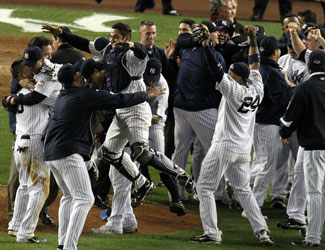
The Yankees won their 27th World Series title and first in the new Yankee Stadium by beating the Philadelphia Phillies 7-3 Wednesday night to take the 105th World Series in six games.
They christened their new $1.5 billion home in the same style as the original back in 1923, when the heroes were a left-handed slugger named Babe Ruth and a left-handed pitcher named Herb Pennock. Ruth hit three home runs, including one in the World Series clincher, and Pennock won twice, including the finale.
Eighty-six years later, only the names changed. Left-handed slugger Hideki Matsui(notes), in possibly his last game in a Yankee uniform, tied a Series record by driving in six runs and hit his third home run of the Series, a two-run blast in the second that was the Yankees’ first shot across the bow against Phillies starter Pedro Martinez.
Matsui, whose aching knees limited him to a pinch-hitting role in the three games in Philadelphia, had hit a tie-breaking home run off Martinez in the Yankees’ Game 2 win and demonstrated anew that if Martinez wanted to discuss his ancestry, his Yankee “daddy” was the venerable Japanese star.
Matsui hit a two-run single in the third off Martinez, then doubled in two more against Phillies’ rookie J.A. Happ(notes) in the fifth to earn Series MVP honors.
Left-handed pitcher Andy Pettitte(notes), pitching on three days’ rest, won the duel of old goats, as it was called by Martinez, holding the Phillies to a single run while the Yankees built a 7-1 lead against the 38-year-old Martinez and relievers Chad Durbin(notes) and Happ.
Pettitte, a sellout crowd of 50,315 creating chills independent of the 47-degree temperatures by thunderously chanting his name, came out in the sixth after giving up a two-run home run to Ryan Howard(notes), the strikeout-ridden Phillies slugger, and a two-out double to Raul Ibanez(notes).
Despite walking five batters, a number he has exceeded just once in 40 postseason starts, the 37-year-old Pettitte won for the second time in the Series and joined Boston’s Derek Lowe(notes) (2004) and Chicago’s Freddy Garcia(notes) (2005) as the only pitchers to win the clinching game in all three rounds of the playoffs: the division series, the LCS and the World Series.
Pettitte has won 18 postseason games, the most of any pitcher in history, including four this season. He also was the winner in a clinching game for the sixth time in his career, the most of any pitcher.
The last 10 outs were recorded by the Yankees bullpen, the final five by Mariano Rivera(notes), who with Pettitte, catcher Jorge Posada(notes) and shortstop Derek Jeter(notes) are the only players left from the last Yankees team to win it all, in 2000. Joe Girardi, in his second season as Yankees manager, was with the team as a reserve catcher for World Series titles in 1996, 1998 and 1999 but left as a free agent before the 2000 season.
With their bookend Series titles, the Yankees now can make a compelling case that they are the team of the decade, having won more regular-season games (965) and playoff series (10) than any other team, and joining the Boston Red Sox as the only teams to win two Series titles.
The Yankees had four 100-win seasons in the decade, including 103 in 2009 after new owner Hal Steinbrenner, taking over for his ailing father, George, gave general manager Brian Cashman the green light to spend over $243 million on three players – starting pitchers CC Sabathia(notes) and A.J. Burnett(notes) and first baseman Mark Teixeira(notes).
Sabathia and Burnett each won a game in the Series while Teixeira, who came into Wednesday night batting just .105 in the World Series and .172 in the postseason, singled home a run in the Yankees’ three-run fifth.
And, of course, the Yankees are the most successful franchise of all time. Their 27 titles are 17 more than that of the St. Louis Cardinals, who have won the second-most in baseball.
The Phillies fell short in their quest to become the first National League team since the 1975-76 Cincinnati Reds to win back-to-back Series titles.
Martinez, the self-styled “old goat” who didn’t join the Phillies until August, had counted upon “experience and survival” and his “frog’s blood” to carry him in a quest to add a triumphant coda to his rich history against the Yankees.
But Martinez lasted just four innings, succumbing to the master strokes of Matsui.


