Thursday, June 26, 2008

June 26th, 2008 at 12:05 pm

Looking for the Next Spike in Anti-US Activity

» by USinKorea

GI Korea asked me if I’d like to do some posts here at his blog and I was honored. He runs a top flight K-blog, and it is a little daunting to prepare to write at a level to do the blog justice.

I admire GI Korea and One Free Korea for doing the difficult day jobs they have - yet also - finding time to write out long, detailed, sourced posts for their blogs.

I avoid that kind of writing for the most part on my blog. I spent too many years in college and grad school writing research papers. Blogging was a way to release some of that stress by just typing as I thought. I did long posts for the www.usinkorea.org website, but that only required a few days of intense work combing the media archives, collecting notes, then writing then going back to being lazy the rest of the year.

But, in posting here at GI Korea’s, I plan to beef up my typical posts.

With that introduction stated —- on to the current post — which concerns what might happen on the anti-US front in the near future now that Cows Gone Wild!! Hysteria has died down:

It is safe to believe Korean society feels strong after pushing President Lee around for a month - and that the society feels good about feeling strong.

That is not a good combination for the US in Korea…

In 2000, Korea put on months and months of anti-US activity over a variety of issues — The Great Water Dump was the most memorable one (GI Korea’s Review). But, the Koon-ni/Maehyang-ri Bombing Range Saga was also finally picked up by average Koreans. And there were other much smaller issues brought up during this period as well.

Both the water pollution and training range issues were as frivolous as the beef issue: The pollution case involved a small amount of formaldehyde dumped in the Yongsan base sewer system. It had no potential whatsoever to harm a single Korean - but this editorial illustrates how far Korean society was willing to freak out about it:

These toxic chemicals are widely known to cause cancer and birth defects. The Han river supplies drinking water for over 10 million citizens residing in metropolitan Seoul and its satellite cities. Are Koreans disposable people?

The news is ethically repulsive. Environmentally, the act is destruction-friendly. In psychiatric terms, it comes close to an act of quasi-murder [oh my!]. For, what matters here is the sick mind and attitude that made possible the dumping of the cancer-causing substance. Whether or not the quantity of the discarded was enough to cause cancer is not the issue here.

Korea Times Editorial

The myth that was created during the Maehyang-ri incident was that a USFK plane dropped a bomb that missed the range and landed “in the heart of the town.” But, in reality, the initial spark was simply that the plane dropped the bomb, on the range, unannounced:

No pilot training was scheduled that day, because the plane that dropped the bombs was heading for another range when it developed engine trouble and was diverted to Koon-ni to drop its load before returning to base.

The fact that villagers weren’t notified ahead of time was the original cause celeb for the protests — but when the media and average Koreans jumped on board — they quickly altered the truth to justify the level of anger put on display by claiming that the bombs had hit outside the range and hurt people and did “much” damage to houses in the area.

This shifting of “root cause” is typical in anti-US culture — and we saw it in the Cows Gone Wild!! Hysteria too: when it became obvious that Korea might look stupid in the world’s eye due to the irrational “fear” of US beef, they shifted to the idea it was about President Lee’s arrogance…

The main point here —- however —- is that Korean society does not need a solid reason for even large spikes in anti-US activity to occur.

So - Anything might set off the next spike after Cows Gone Wild!!

But the Korea Times editorial above also demonstrated another factor we need to include in guessing about future activity:

Frankly, some Koreans are also scared of the idea of a defense by those who commanded to dump the toxic substance; who murdered many Korean hostesses, the poor souls, who had to sell sex to earn their subsistence; and, who care little about those Koreans suffering from constant bombing exercises like the one in Maehyang-ri. Why are they reluctant to fully disclose the facts about Nogun-ri massacres? Is the SOFA really a fair arrangement?

“Are they here to defend us? Thanks but from whom?” The answer to the question is in a sense becoming more and more ambiguous and ambivalent in the post inter-Korean summit detente.
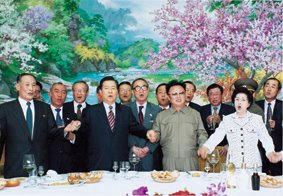
See. 2000 was the year of the Great NK-SK Summit.

For a few months back then, even many die-hard Korean conservatives really believed peace in our time might be at hand.

Korean society as a whole was drunk with the idea North Korea was really going to change.

That made Koreans feel really, really good - and proud -

- and that feeling was easily transferred into venting long-held anger at the US in Korea — especially with the summit making it seem USFK was no longer needed…

Pent up and long held are perfect ways to describe the phenomenon. Look back at the last quote from the Korea Times editor: he throws in all the big ticket anti-US/USFK issues - pollution, GI crimes, Maehyang-ri, the SOFA, and so on. Economic bullying is absent, but he hit most of the others.

And that is how it goes. We witnessed it again with Cows Gone Wild!! Of course other issues were quickly mixed together in the street demonstrations — that is simply how the process works.

All of these issues peculate in the society, with periodic reminders spaced throughout the year - every year - waiting for the right time to activate. And when one item scores a direct hit, the others are usually brought along.

And one thing that activates them is Korean pride.

In 2002, what made Korean society feel strong and prideful wasn’t another summit with North Korea —– it was their impressive showing in the World Cup - coupled with pride in hosting the games on Korean soil.

My Korean language skills are weak — but I believe in this video from 2002 - the Korean student demonstrates the link between World Cup fever, Korean pride, and anti-US activity.

In 1997-98, Korean pride was the primary factor in the IMF bailout short spike in anti-US activity: In that case, Korean pride was badly damaged as their Miracle on the Han economy, the greatest source of their national pride, tanked. In Nov. and Dec. of 1997, within about a week’s space in time, Korea’s president both stated Korea would not ask for an emergency bailout, talking as if such a thing would be too dishonorable to even consider, then asked one. Korean society felt great humiliation.

And - they decide to release some tension about that by — going nuts over how the IMF chief sat on a couch in a media photo op with the Korean president when the IMF team was in town discussing the bailout. You see — the IMF chief, who wasn’t American, sat back on the cushion and even dared to cross his legs - looking comfortable, while Korea’s president was forced to sit ramrod style on the edge of his chair kowtowing to the foreigner.

The US government, through the IMF, was providing billions of dollars in an emergency loan to stabilize the Korean economy that was in a rapid downfall, and this is how Korean society chose to respond — with hurt pride and anti-Americanism. (thus showing that the pride factor is at play whenever Korea’s sense of national pride is too low or too high)

So what does this mean for us today?

Korean society most likely feels strong and proud of itself with what they accomplished through their hysteria over US beef imports.

President Lee is supposed to be arrogant and a bulldozer.

His mandate after the last election was very strong. The GNP/conservatives were given a very strong hand in the National Assembly and they controlled the Blue House. The liberals were crushed…

…But Korean society, through massive protests, brought the conservatives to their knees immediately after handing them so much power. Pres. Lee even went several times on TV in front of the nation and kowtowed - begging for forgiveness.

That only validates the society’s sense of pride and strength…

So, I do not think we will have to wait two or three years for the next anti-US spike to occur.

In the 1990s, my rule of thumb said that an anti-US spike in activity occurred about every 8 to 16 months — or about once a year.

I don’t think we’ll have to wait 16 months.

I can’t give a good guess about what might spark it.

We’ve seen clearly - anything can.

I don’t know what stage the Pyongtaek base expansion is in. One of the big hurdles was crossed a year or two ago when the moved off the squatters. If that was something that needed to be done this year, I’d put my money on it, but it has already passed.

USFK base pollution is an issue always ready on hand.

This recent Korea Times article said pollution is becoming a bigger issue for Korean society. The cost of decontamination of US bases has been in the news. Maehyang-ri was in the news on the pollution angle this past January.

Pyongtaek could finally be the spark - much like with Maehyang-ri.

In both issues, The Priest had been trying to generate a society-wide outrage for years before such an outrage finally arrived. He just hasn’t been successful with Pyongtaek, yet.

Don’t be surprised to see him and his people repeating the violence of 2005.

That video is just one of several from 2005. You can see the others via this page.

The objective in most of those violent protests was to rip down the fence line at the USFK base. The Priest did the same thing at Maehyang-ri in 2000 to grab the society’s attention.

It didn’t work in 2005. In fact, the media didn’t report it at all. I just happened to catch it on a routine review of video postings at the leading anti-US/USFK website www.voiceofpeople.org that I do every 4 to 6 months or so.

Those multiple riots were large and very violent. They were staged by both the usual shock troops - university students + union members. But, because they had the potential to harm the US-SK relationship and possibly motivate Roh to “do something” — when they couldn’t trust what the hell Roh might do — the media decided to bury them.

With President Lee in the Blue House, The Priest might be much more successful if he makes this play again.

The cost of relocating USFK bases off the DMZ and out of Seoul could be the spark itself — especially because Korean society has long opposed the perceived “weakening” of the US commitment to defend Korea such a move implies. This link is to a Korea Times archive search for “bases” in which you can see the costs have been in the news.

A crime by a US soldier could be the spark - but I wouldn’t put my money on that…

GI Crimes and The SOFA are two bedrocks of anti-US culture in Korea, but oddly enough, they don’t directly inspire that much street protest activity. (GI Korea’s SOFA Review + GI Crimes and GI Crimes again)

Technically speaking, the 2002 armored vehicle accident and the 2000 water contamination cases were about crimes and the SOFA, but I have seen murders and rapes pass without significant street protests.

Those events do help solidify anti-US ideas in the society through the media and schooling. But, the 1995 subway brawl and the early 1990s Markle murder case are the only two I can think of that caused significant street activity.

Given the society’s mood, the militant labor unions might also strike gold sometime this year over things like the FTA that it wasn’t able to generate support for with President Roh in the Blue House.

Even North Korea could help start the next spike:

Things are looking bad in the North — as One Free Korea has been showing repeatedly the last few months.

South Korea under President Lee is also unlikely to give Pyongyang as much as it has been used to getting since 1998 when President Kim started the Sunshine Policy.

So, we could see North Korea do some very provocative things this year.

And when tensions rise on the peninsula, South Korean society often transfers that tension onto the US-SK alliance.

This article noted by GI Korea and others in the K-blogsphere says that 28% of Koreans believe the US is the biggest security threat to South Korea. That number rises dramatically when tensions with the North go up, because Koreans take it as a given the North will not attack as long as USFK in is Korea, because it would be suicide, but they have MUCH less faith that the US will not bomb the North - thus potentially starting a war.

So, if Kim Jong Il decides to act up this year in a big way, it could directly lead to another anti-US spike in South Korea.

Who knows?

Time will tell what the next spark will be - and how long of a wait until it comes - but my money is on the idea that it will take place within 8 months.

Winter break for the universities might be a time to watch….

June 26th, 2008 at 9:00 am

Remembering the Korean War in Pictures

» by GI Korea

With the success of the Incheon Landing Operation US and ROK forces on the Pusan Perimeter moved north to recapture land previously occupied by the North Koreans. Along the way bodies of captured US soldiers massacred in Daejon are discovered:

kwpic6.JPG

Besides executed US soldiers many South Korean civilians were also killed by the retreating North Koreans though Charles Hanley and the Korean Truth & Reconciliation Committee would probably agree that US soldiers are really responsible:
kwpic29.JPG

A month later and bodies of massacred South Korean civilians in Daejon are still being discovered:

kwpic43.JPG

As the allies moved north they found themselves with more and more North Korean POWs:

kwpic30.JPG

General MacArthur makes the decision to cross the 38th parallel and reunite Korea by force:
kwpic1.JPG

While advancing into North Korea an Australian soldier found time to use portraits of Kim Il-sung for target practice:

kwpic2.JPG

British troops also participated in the offensive into North Korea most notably during the Battle of Kunu-ri which saw the Chinese enter the war:

kwpic7.JPG

The US Air Force conducts a bombing operation against a North Korean freight train:

kwpic42.JPG

This picture of the North Korean masses cheering the allies entering Pyongyang is probably one that Kim Il-sung was none too happy to see:

kwpic3.JPG

Here is a picture for all you airborne types out there:

kwpic4.JPG

General Milburn confers with ROK 1st Division Commander General Paik Sun-yup:

kwpic41.JPG

The casualties against civilians during the war was just as deadly north of the 38th parallel as it was in the south:
kwpic5.JPG

With the Chinese entry into the war the Marines and the 7th Infantry Division fought a desperate battle to escape a Chinese trap in brutal winter weather at the Chosin Reservoir:
kwpic8.JPG

This bridge was destroyed to delay the Chinese advance on Hamhung:

kwpic40.JPG

After the Marines and the 7th Infantry Division escaped the Chinese trap, they conducted an amphibious withdrawal which included many North Korean civilians from the port city of Hungnam:

kwpic9.JPG

If you read most popular histories of the Chosun Reservoir campaign you would have no idea the Army was just as critical in the operation as the Marines, but receive little credit for their part in the campaign. The Army fought just as hard and withdrew just as orderly as the Marine Corps:

kwpic10.JPG

After the withdrawal from Hungnam the port city was completely destroyed:

kwpic11.JPG

As the Chinese forces advanced south more young conscripted ROK soldiers were committed to the front lines:

kwpic39.JPG

Captured Chinese soldiers pleading to a South Korean soldier:

kwpic12.JPG

South Korean civilians once again flee Seoul as refugees as the Chinese army prepares to capture the city in January 1951:

kwpic88.JPG

ROK soldiers cross the Han River to recapture Seoul as part of an allied offensive in March 1951:

kwpic86.JPG

Seoul destroyed even further after the battle to retake the city from the Chinese:

kwpic66.JPG

US & ROK soldiers battle to retake the city of Munsan north of Seoul:

kwpic68.JPG

Korean Service Corps personnel transport ammunition for the allies:

kwpic67.JPG

ROK Army soldiers advance into Hwachon in March 1951:
kwpic87.JPG

MBC’s excuse maddens translator

A translator who worked on a controversial Munhwa Broadcasting Corporation program about mad cow disease in April lashed out at the company’s claim that mistakes in the show were errors in translation.

Jeong Ji-min, who said she did translation work on the April 29 episode, reacted furiously yesterday when MBC’s investigative report program “PD Diary” blamed translators for the errors.

Jeong claimed she had warned the producers of the program about possible translation errors, but she said her comments had been ignored.

PD Diary spent 20 minutes of its program on Tuesday night defending itself against allegations that its producers intentionally distorted interviews and documents to exaggerate the risk of mad cow disease in the April 29 program.

“So, MBC is now blaming translators?” Jeong wrote yesterday afternoon in one of her postings.

“While I was checking the translation, I told the producers repeatedly and strongly that linking a downer cow and mad cow disease is a distortion. Those controversial parts [were not my translation] but later selected by the producers.”

Jeong said the problems are not translation issues but reflect deliberate editorial intent.

“The producers should have excused themselves by saying they wanted to emphasize the risk of mad cow disease. Why are they blaming the translation?”

However, the production team behind the show stuck to its translation line of defense. “We regret that we left room for misunderstanding because we didn’t provide word-by-word translation,” the program makers said.

The government, though, is not convinced. The Seoul Central District Prosecutors’ Office launched an investigation earlier this week into accusations put forward by the Agriculture Ministry that MBC had aired a false report on mad cow disease.

The ministry claimed PD Diary had exaggerated the risk of mad cow disease from U.S. beef, defaming the minister and beef deal negotiators.

Meanwhile, PD Diary’s Internet message board was bombarded with thousands of postings yesterday, including a series of messages from Jeong, following the program Tuesday. Many accused MBC of irresponsible behavior as the program had sparked angry protests against the decision by Lee Myung-bak’s administration to resume beef imports.

The program’s April 29 episode included an interview with the mother of Aretha Vinson from Virginia.

The report’s subtitles showed her mother as saying that “human mad cow disease” had caused the American patient’s death.

The term the mother had actually used was CJD or Creutzfeldt-Jakob disease, not vCJD.

Variant Creutzfeldt-Jakob disease is commonly known as the human form of mad cow disease.

PD Diary said Tuesday that “we thought Vinson’s mother, who had no professional medical knowledge, was confused about the two terms,”

explaining why it went ahead and broadcast the translation.

On its Internet page on June 12, the U.S. Centers for Disease Control and Prevention said the National Prion Disease Pathology Surveillance Center had resolved the issue.

It had “ruled out the possibility of vCJD as the cause of death of a young Virginia woman who died earlier this year,” it said.

Although this suspected case received international media attention, NPDPSC said it concluded the cause of death was not due to vCJD, it continued.

PD Diary also claimed Tuesday that the host of the show made a simple slip of tongue when he called a downer cow “a cow suspected of being infected with mad cow disease.”

Its earlier translation of “dairy cow” as “mad cow disease-infected cow” was not a poor translation, but a translation with interpretation, the program argued.

“[Conservative media] are not looking into the substance, and they are just picking on our translation to criticize us,” PD Diary said Tuesday.

“We regret we could not produce a perfect program ... But we cannot agree with the criticism that the entire report was distortion and instigation.”


By Ser Myo-ja Staff Reporter [myoja@joongang.co.kr]
Is Military Intervention Needed In Zimbabwe?
» by GI Korea

With the withdrawal of Zimbabwe opposition leader Morgan Tsvangirai from elections scheduled this week, it looks like Zimbabwe strongman Robert Mugabe will once again steal an election and remain in power. Mugabe was able to use tactics that would make his North Korean idol Kim Il-sung proud by torturing, kidnapping, and murdering his opposition to stay in power.


Robert Mugabe meeting with his North Korean idol Kim Il-sung.

However, he hasn’t been as successful as Kim Il-sung was over the years just by the sheer fact that an opposition even exists in Zimbabwe unlike in North Korea where they died long ago. With that I do find it interesting that there are now voices in the media advocating for an invasion of Zimbabwe to remove Mugabe from power:

Military intervention in Zimbabwe would be justified to stop the violence there deteriorating into mass slaughter, Paddy Ashdown told The Times last night.

Lord Ashdown of Norton-sub-Hamdon said: “The situation in Zimbabwe could deteriorate to a point where genocide could be a possible outcome - something that looks like [another] Rwanda.”

In that case, international military action, with Britain playing a “delicate role”, would have to be considered, said the former European Union High Representative for Bosnia and Herzegovina. Britain and the United States became the first countries to refuse to recognise Robert Mugabe as President of Zimbabwe yesterday after Morgan Tsvangirai, leader of the opposition Movement for Democratic Change (MDC), sought refuge at the Dutch Embassy.

The Dutch Government said that Mr Tsvangirai had been granted sanctuary soon after announcing he was withdrawing from the run-off presidential election on Friday because of mounting violence that has killed more than 85 supporters, left hundreds wounded and tens of thousands displaced. Yesterday Zimbabwean police raided the MDC’s headquarters, seizing 60 of its supporters. [The Times Online]

More calls to invade Zimbabwe can be read here, here, here and here as well. I also love how these pundits believe how easy an intervention will be:

The Zimbabwe military is beatable; economic factors have severely weakened loyalties. Only the special forces are competent. With more than half the population now in support of Morgan Tsvangirai’s MDC, many soldiers may refuse to fight to keep Zanu-PF in power.

Unlike Iraq, there’s little danger of sectarian splits. Before Mugabe decimated the Ndebele tribe on political grounds, there was little history of ethnic antagonism.

No tribalism in Africa? A military that is armed by China and trained by North Korea will not fight back? If you say so.

All these calls of military interventions in Zimbabwe seems very similar to recent calls for military intervention in Burma to overthrow the regime there. I do just find all these calls to remove dictators quite interesting considering all the bashing of the United States intervention in Iraq where Saddam had far more blood on his hands and was a far greater global security threat then Burma or Zimbabwe.

Then you have the North Korean regime which is even worse then the Saddam Hussein regime and is also helping to prop up Mugabe, which the international community appears to show little concern or care about.

You have to love the selective outrage.

I believe the UN should sort this out and write Mugabe a nasty letter as Zimbabweans continue to be tortured and murdered instead of launching a war of choice not authorized by the UN. Just think if the US goes in there to remove Mugabe civilians will die and Lancet and George Soros funded groups will release a study saying millions of civilians were killed by Bush’s War. Better to let them be tortured and killed instead by Mugabe thugs. Plus our military will commit all of these war crimes and our soldiers will return to America with PTSD, become alcoholics, and wander the streets killing helpless civilians.

This is all too much to bare. Instead I think we should all just buy “Free Zimbabwe” bumper stickers to put next to our “Free Tibet” stickers which is much easier and will make us all feel better.

DAMNED IF WE DO SOMETHING AND DAMED IF WE DO NOTHING. LOVE THE CATCH-22.


Far East Economic Review On Korea’s Misinformation Age
» by GI Korea

Courtesy of a reader tip comes this article from Korean born US citizen Hancho Kim who is a retired businessman who has lived in Seoul for 27 years:

Welcome to the Misinformation Age. The premise behind this entire issue and its ensuing paralysis is a remarkable demonstration of the power of a lie today. Right now, South Korea is still battling the Avian Flu, while it simultaneously stares down the barrel of its belligerent, uncooperative and now, nuclearized, neighbor to the north. Despite these very immediate dangers, South Korea’s population is fixated on the threat posed by 42 million perfectly healthy cows in the United States. It defies logic. [Far East Economic Review]

Yes it does defy logic, but so does fan death. Mr. Kim continues on:

Seoul’s descent into madness didn’t come out of thin air. It was exploited—perhaps even manufactured—by political opponents who saw an opportunity in the perception that the new president was more businessman than statesman. His CEO-style presidency combined with his immediate coziness with Washington gave opponents the opportunity to depict U.S. beef imports as favoring U.S. interests over South Korea’s. Never mind the fact that U.S. beef meets an international standard for safety that exceeds South Korean standards.

The fact that this story is helping revive the fortunes of the recently ousted liberal party in Seoul while drawing attention away from their favorite charity in Pyongyang is likely no coincidence. Recent local by-elections handed them resounding wins and Pyongyang isn’t in the headlines for once, so it’s a strategy that’s working—for now.

As ROK Drop readers have long known that the anti-US groups and their media allies were behind the misinformation campaign that mobilized the protests. Once the protests were in full force the anti-US groups used them to initially to politically neuter Lee Myung-bak before shifting the attention of the protests towards these groups’ real agendas which are anti-US and pro-Pyongyang. However, this strategy may have backfired because since the shift in message attendance at the protests has fallen and there are signs average Koreans are not buying the leftist anti-US agenda being brought forward now.

Also ROK Drop readers also have long known that US beef is safer then domestic Korean beef since Korea refuses to meet global safety standards for beef set forth by the OIE. It is good to see these facts getting spread in the mainstream media. Mr. Kim then goes on to provide some good advice for Lee Myung-bak in regards to moving forward on this issue now which I recommend everyone read.

However, I do wish Mr. Kim would have addressed the undertone of anti-Americanism in Korean society that made these protests possible in the first place. Just the fact that the Korean public could actually believe that the US government is out to poison and kill them with imported beef is a perfect example of how bad the underlying anti-Americanism is in Korea. I continue to see this on going tendency to make excuses or ignore this fact, and ignoring it doesn’t make it go away and only sets conditions to justify the next big anti-US flare up in Korea.


AND SOME OF MY FRIENDS STIL SAY ITS NOT ANTI-USA...ARE YOU FRACKING KIDDING ME?

Tuesday, June 24, 2008

WHY I HATE THE KOREAN JUDICIAL SYSTEM


Another Classic Example that Justice for GIs is Hard to Find in Korea

This comment by DMZ Dave provides a perfect example that justice for American servicemembers in Korea remains little changed over the years:

As a new contributor to this blog, I apologize for this long post but believe I can provide some additional perspective.

Although I had spent years in Korea and speak Korean fluently having graduated from the Korean Army College, it wasn’t until I entered the “Twilight Zone” of a false accusation and in police custody at the Itaewon Police Box that I received my post-graduate education in Korean justice.

The year was 1989, on this particular evening, I had just left the UN Compound and was about to pull out from some apartments near Itaewon heading up the hill to the main road at the Burger King intersection. As I sat in my car waiting to make a left turn onto the street, I observed two young girls holding hands and preparing to run across the busy street and I thought it looked like a bad situation. As I watched, to my horror, the girls suddenly dashed into the street, were struck by a taxi and thrown to the side of the road. The taxi sped on without looking back.

I jumped out of my car, ran to the girls, checked them for injuries (I started my military career as a Navy Corpsman) picked one up, checked her for serious injuries and moved her to the sidewalk, consoled the other and began shouting directions in Korean to the those standing by to call an ambulance. I asked if anyone knew the children and asked someone to call their parents. Soon an ambulance arrived and one child left for the hospital and the other less injured child was taken to her home. I then returned to my car and drove toward the main drag in Itaewon where I had been headed when this all took place. As I stopped at the light in front of the Burger King, a small mob suddenly surrounded my car and began slapping and pounding on it. I recall thinking “what the hell?” I had no idea what was going on but some policeman appeared and literally dragged me from my car and hustled me off to the Itaewon Police Box where I was told to sit and wait. This was the time you would expect Rod Sterling voice to announce “you have just entered the Twilight Zone.” It was that unreal.

I protested that I had done nothing except try to aid the children who had been struck by a taxi. “If you were not at fault, why would you have stopped” I was asked by one incredulous policeman? I explained what had happened and he took me roughly by the arm and suggested we both go to the “scene of the crime.”

Make sure to read the rest of the story because it is incredible, but not surprising to those of us who are familiar with justice for GIs in Korea.

This incident happened in 1989 and it is interesting to compare it with later incidents involving US servicemembers such as the 1995 subway brawl:

It all began when an American soldier put his hand on a Korean woman’s rump.

The version that has captured the local imagination is that a group of drunken American soldiers were rampaging through the subway, molesting Korean women, and that the soldiers then attacked good citizens who dared protest the errant hand.

The American understanding of events starts with a fact that the Koreans tend to leave out: The American soldier and the Korean woman whose behind he patted were in fact a married couple.

The Americans say the problems arose when some angry young Koreans on the subway accused the American of sexually harassing the Korean woman. When the Korean woman explained that she was the American’s wife, the Korean men allegedly spat at her and slapped her — leading the woman’s husband to punch the man who slapped her.

In any case, the result that evening in May was a huge brawl in the subway. It has reverberated through the country and underscored the delicacy of the mission of the 37,000 American military personnel in bases in South Korea.

Now fast forward to 2002 when three US soldiers were kidnapped from the subway, beaten, and forced to make coerced statements in front of a large stadium audience and televised on national television:

3 US soldiers and a group of university student activists (and one elder leader) promoting a large anti-US/USFK rally were involved in a big brawl on the subway in Seoul.

1 GI was held captive by the students and forced to participate in the rally and write out a “confession” against himself for the subway incident and write statements against USFK concerning the recent tank accident.

Guess who was charged with assault? The GIs of course.

Fast forward once again, this time to 2006 where in two separate incidents GIs were assaulted by Korean mobs and since the soldiers retaliated they were convicted of crimes while the Koreans received no punishment:

So one kid who got the crap beaten out of him by a mob including get hit across the face with a pipe has paid $9,000 in compensation money and is looking at 18 months in Korean jail, while another GI whose sole crime was pushing a bar owner after being grabbed first by the bar owner, and he then proceeded to get the crap beaten out him by a Korean mob and the GI has since paid $18,000 in compensation money and is looking at a year in Korean jail for that push.

The latest example comes just last year where a GI was jailed for months before finely being released on appeal because the conviction against him was so dubious:

PFC Feldman was clearly innocent when he was originally convicted. Feldman claimed he was trying to hail a taxi while SGT Basel went to use the restroom. This alibi is highly likely since the victim did not remember seeing Feldman in the restroom. Also the Korean restaurant owner who heard the woman yell in the bathroom originally wrote on a sworn statement after the incident that he saw only one man in the restroom. Then days later after the police got a hold of him he changed his statement to say he saw Feldman in the restroom. Additionally the Korean prosecutors were linked to trying to coerce Basel into writing a statement saying that Feldman was in the restroom for a lighter sentence.

The evidence against Feldmann was so dubious that when he was convicted the chief judge encouraged Feldmann to appeal the sentence which is what he did. Finally, on appeal Feldmann was found not guilty and when look at the evidence he should have never had any charges brought against him in the first place.

It is pretty bad when you are convicted of a crime and the chief justice pretty much admits the conviction is dubious but goes ahead and convicts you anyway. These are just a small sampling of how GIs have not been receiving fair treatment in the Korean justice system and is something that has obviously been going on for quite some time. It makes you wonder who is really getting unequal treatment in the US-ROK Status of Forces Agreement?

The important thing to remember is that one of the things all these incidents have in common is that Korean witnesses lie and often encouraged to do so by the police. Also keep in mind the lies and travesties of justice are not just limited to GIs either but foreigners as well.

Despite USFK having an extremely low crime rate when compared to the surrounding civilian population, clearly justice for GIs will continue to be hard to find in Korea.

Obama Gets Another Unwanted Endorsement

[Update: Well, that didn’t take long. Welcome from Little Green Footballs, Michelle Maklin, the Jawa Report, the unlinkable Memeorandum, and my good friend at Gateway Pundit. Regulars here know that I’m completely disgusted with Bush’s own appeasement of Kim Jong Il, but while you’re here, don’t miss the story of Esther Kim, an Obama constituent whose husband was kidnapped and killed by the North Koreans. Obama inspired her Hope, then crushed it with Change.]

The Chosun Sinbo, the mouthpiece of North Korea’s Japanese front organization Chongryon and often for the North Korean regime itself, has announced its preference for Obama over McCain, whom it calls “a variant of Bush” and “nothing better than a scarecrow of neoconservatives,” which is a bit odd considering that the Bush Administration’s giveaway diplomacy is better for Kim Jong Il than even Clinton’s awful performance.

[Update 2: Original Korean here:

조선반도와의 관계에서 본다면 부쉬정권의 잘못을 엄하게 비판하고 조선의 지도자와 조건없이 만나겠다고 공언해온 오바마가 《부쉬의 아류》이자 네오콘의 허수아비나 다름없는 매케인보다 낫기는 낫다. [Chosun Shinbo]

I’m sure someone can improve on this translation:

We will see a better relationship between the U.S. and the Korean Peninsula with Obama, who sternly criticizes Bush and who would meet the leader of Chosun without pre-conditions, than with the “Bush clone” and scarecrow of the neocons McCain.

Somehow I had neglected to put the World Tribune link in there before. I’ve fixed that.]

It’s worth pausing to consider the disturbing rhetorical similarity between the Chosun Sinbo and Daily Kos, although the sheer incoherence of Bush’s North Korea policy makes any comparison to it questionable.

Bush’s North Korea policy may be a poor baseline for comparison, but the candidates themselves have given the North Koreans plenty to judge them by. Both Obama and McCain have told us how they’d deal with the North Koreans. McCain has expressed his distaste for the latest variation of Bush’s policy and emphasized his willingness to raise uncomfortable topics, including human rights. Obama has already shown a disappointing lack of consistency in holding North Korea accountable for its intolerable behavior. If I understand Obama’s policy to consist of direct summit talks, aid, and trying to coax North Korea into opening itself up, that same policy was tried for years, without success, by the South Koreans, and it’s now being tried without success by President Bush. If I understand McCain’s policy to consist of tightening sanctions until North Korea verifiably disarms, that was tried briefly by the Bush Administration and showed signs of considerable success until its inexplicable and premature abandonment.

(Bear in mind that the sanctions the Bush Administration applied for just 17 months were a pale shadow of the power we could potentially apply but did succeed in driving Kim Jong Il back to the bargaining table. When we lifted the pressure, the North Koreans resorted to form and balked at full disclosure or disarmament. And as we’ve since learned, they weren’t dealing in good faith to begin with. The key to any successful negotiation with the North Koreans is showing them that you’re fully capable and prepared to hasten and accept the collapse of the regime as an alternative.)

North Korea’s endorsement of Obama will probably draw comparisons to the unwanted Hamas endorsement of Obama. Hamas withdrew the endorsement after Obama spoke at AIPAC’s convention. Fidel Castro, by contrast, took a more sophisticated and self-aware approach:

[O]n Monday [Castro] gave Senator Barack Obama an endorsement of sorts, calling him “the most progressive candidate to the U.S. presidency” while also berating him for his plan to continue the trade embargo against Cuba. “Were I to defend him, I would do his adversaries an enormous favor,” Mr. Castro said. “I have therefore no reservations about criticizing him.” [N.Y. Times, The Caucus]

Which Castro then proceeded to do, on Obama’s stated support for trade sanctions during a campaign speech to Cuban exiles in Miami.

The Republicans’ efforts to capitalize on the Hamas endorsement made me slightly squeamish, because there are separate issues here that shouldn’t be mixed. It isn’t fair for anyone to imply, based on an unwanted endorsement, that a candidate in any way supports the endorsing entity’s ideology or actions. It is fair to ask whether the endorsement suggests that the endorsing entity knows something about the candidate. Why would Hamas or Kim Jong Il both believe that if Obama is elected, his policies would mean boom times for evildoers? Are they wrong?

Finally, as with Ron Paul’s refusal to return contributions from white supremacists, it’s reasonable to demand that a candidate unambiguously disavow the endorsement and denounce the endorser. In the case of Hamas, Obama rightly did this. Given that North Korea’s human rights atrocities are as repellent as any since the Khmer Rouge was driven from Phnom Penh 30 years ago, Obama has both the duty to speak out about the evils happening in North Korea today and an opportunity to refute those who say he would merely appease tyrants.

Update 3: Now I’m been linked by the Hillary Clinton forum:

One of the reasons he supports Obama is that he knows he’s a fool and Obama flip flopped on removing N. Korea (de-listing) from the terrorist nation list. He NOW says he would remove them even though they haven’t divulged the whereabouts of Rev. Kim (a legal US citizen living in N. Korea). See my post about compiling a list of Obama’s broken promises.

This needs to be blogged and sent everywhere!! Obama is a very dangerous man! Fearing him is not paranoia. It is rational thought!

Update 4: Thanks to Ace, Neal Boortz, and the Freepers for linking.

And we have dredged a swamp. Pandagon, which will forever be remembered (by most of those who do at all, at least) as an embarrassment to the John Edwards campaign, offers a characteristically incoherent and foul rant. Your thirteen minutes are over, ladies. I can say “ladies,” can’t I? See your doctor if any of that seems coherent to you. I didn’t think we could set a lower bar, but Kos diarist “Gramarye” links with this fatwa calling for prayers for Michelle Malkin’s death. No, seriously:

According to her blog,

Take me now, Lord. My life as a blogger is complete.

[….]

So let’s all help Michelle’s request along and say a little prayer to the Lord. [….] But I have HOPE for Michelle’s plea. [Daily Kos]
Hey, they have standards to uphold over there. Yes, I kept screenshots. To be fair, even most of the Kos commenters are aghast.

Well, At Least They Knew the War Happened. I Think.

Your ROK-US Alliance warm-and-fuzzy moment of the week, courtesy the Korea Times:

The Ministry of Public Administration and Security said Monday that a survey of 1,016 middle and high school students showed nearly 57 percent didn’t know the war started on June 25, 1950.

Moreover, 51 percent did not know that the war started with North Korea’s invasion of the South. About 14 percent picked Japan as the nation responsible for the war; 13.4 percent, the United States, and 11 percent Russia. About 2 percent even said it was the South invading the North.

While the United States is regarded as the main ally of the country, 28 percent said it was the key “threat” for national security, 4 percentage points higher than North Korea.

Only 56 percent said they felt threatened by the North’s nuclear weapons development, adding that the chance of another Korean War taking place was very low.

I bet 99% knew the latitude and longitude of Dokdo, though. And all were PhD’s about Mad Cow Disease.

Still, I guess one can only be so upset about this. At least they’re not making packs to get knocked up.

THE FOLLOW UP BY THE METOPOLITICIAN

Told Ya So (Again)
Jeez. I don't know what's more disappointing -- the fact that I and other thinking humans figured out from the day PD Notebook aired that their claims were specious-to-false while everyone took their word as gospel, or the fact that everyone's acting as if they were snookered when they should not have been.

If the con artist at the bus stop says they need a 10,000 won bill to get home and they lost their wallet and will promptly pay you back by wiring the money to your account as soon as they arrive, you're an idiot. But hey, it's a learning experience.

If you get fooled twice, you're a maroon.

Three times, and you're a fucking moron.

Hmm -- PD Notebook's track record of being sensationalistic and reporting false claims or going unethical routes to gather information is well known to the Korean public. So why is the government and the people acting so shocked and surprised at the fact that their claims about "genetic susceptibility", out-of-context use of "downer cow" footage, and the report of the "woman who died of mad cow disease" that was mistranslated -- I knew all those things from day 1.

And I'm not a frickin' genius -- so did other members of the media, and so should have many members of the population.

If you're snookered by the same character in the same way several times, who's really at fauly? PD Notebook does what it does, and sometimes they're wrong (like now) and sometimes they're right (like with Hwang Woo Suk); but this ain't nothin' new.

The Korean public is just pissed and angry for being snookered, but this time it was much more embarrassing. But, even if PD Notebook is taken off the air or whatever (it was before, after all), it'll be back up again and nothing will have changed.

This, from the same public that still thinks you can die from sleeping in front of a fan. The problem's much bigger than PD Notebook.

Friday, June 20, 2008

Told Ya So, Or Why Memories of the Panic Is All Is Going Down the Memory Hole Again

GREAT POST BY THE METROPOLITICIAN

On the day when protest numbers peaked, I said that the beef protests would be dead within 4-6 weeks, especially after getting wind that the two middle school girls incident was planning to be inserted into the mix, as well as other issues.

I was more right than I could have hoped.

Of course, things could flare up again, and you might get more people back out there in response to new decisions made here and there, but I think the large protests are indeed over, and things will go back to normal, since this wasn't a "movement" so much as public venting.

Still, I don't buy the whole revisionist thinking that many Koreans have, that this was "never about anti-Americanism" and people trying to act like this was a peaceful, thoughtful expression of public will, akin to a people's referendum on the president's decision-making style.

It was what it was. At first, it was pure, irrational panic over the story that broke on PD Notebook, the Korean equivalent of the American show 60 Minutes, except that the former is a piece of sensationalist yellow journalism, whereas the latter is generally seen as setting the standard for in-depth, professional journalism.

Koreans not only failed to see the ridiculousness of many claims on their face, but also instantly forgot the history of the show itself, including its reputation for questionable ethics and having received intense criticism from the KOREAN PUBLIC for its previous reporting, which was perceived to have been done more for ratings than for the public good. It had actually been taken off the air because of the intensity of public demands -- yet Koreans were for some reason looking at the obviously specious claims and stringing together of flimsy evidence as gospel.

That is and was disturbing, and no attempt to spin this all as some rational reaction to the president's policies will work, since anyone here at the time should be able to tell you that that is NOT what this was about. Now that the beef thing has become embarrassing, as more and more information has come out, people are rationalizing this away as actually having been about something else, but it wasn't -- it simply wasn't.

I and many other foreign observers with some distance from the issue saw this in terms of other public panics to which we had also been witness -- it's just that the recent one was shown to be bullshit quickly, whereas the Ohno or middle school girls incidents didn't have such a clear and simple way of debunking: the genetic susceptibility argument was shown to be ridiculous (why that was even news is still shocking to me), the downer cows shown had nothing to do with CJD (a fact that was also obvious at the time, yet that didn't seem to make any difference), the woman the show claimed to have died from mad cow in fact didn't (a fact readily available from any of the Korean journalists who have the same access to foreign news media as I do), combined with the fact that the Korean beef industry actually has lower standards than every point for which the American beef industry was being taken to task.

Eventually, the bullshit's gotta float to the surface.

And now, as people shift their initial anger into the rationalizations that take place after one realizes that they've overreacted, or that they are even wrong, now the media is getting a lot of criticism for having "deceived" the people. Hey -- I was saying all this from day ONE, back at the beginning of May (see here and here). So why am I OK today, but I was an asshole at the beginning of June? My position hasn't changed one iota, yet everything I said then is now socially acceptable all of a sudden. To all those people who were nearly rabid with fury at possibly getting mad cow, how they might get it from using everything from maxi-pads to makeup, but now are suddenly possessed of omsbudsman-like media criticism skills and are jumping down the throats of the newspapers, I do have to allow myself an uncensored moment:

Give me a fucking break.

This is why Korean public discourse is counterproductive and embarrassing, in that is mercurial and irrational. When PD Notebook aired its "expose", people around me were parroting those pieces of evidence, to which I replied exactly as I did in the paragraph above. People accused me of being an apologist for American empire, which I wasn't, or simply being defensive, which I wasn't. And PD Notebook isn't doing anything they haven't ALWAYS been doing, nor the newspapers.

Yet, now when people are coming around, instead of using the realization that they were simply overreacting to think more deeply about WHY they were so overreacting and why they were so easily snookered and manipulated in the first place, people have just decided to throw what happened down the memory hole and simply remember events as something they weren't at that time.

That is what continues to frustrate me about this and the inevitable future protests to come. At the same time, the cycle of overreaction, mass demonstration, and petering out seems to be much shorter than I anticipated -- but again, I wonder if that was because this issue has such a relatively easier "right answer" that would eventually see the light of day, more than a sign of popular patience for this sort of thing having gotten shorter, i.e. people have "learned something" from all this.

2002 Tank Incident and Aftermath


Students and other participants stage a candlelight vigil to commemorate the 2002 death of two middle schoolgirls in central Seoul, June 13. The girls ― Shim Mi-son and Shin Hyo-sun ― were accidentally struck and killed by a U.S. armored vehicle north of Seoul six years ago. The commemoration was part of the ongoing demonstrations against U.S. beef imports. / Korea Times

By Brian Deutsch

Since the beginning of the anti-beef protests, the media has been drawing cautious parallels between these demonstrations and the anti-American rallies that swept the nation in 2002 and 2003.

Those came after two middle schoolgirls were accidentally killed by an American military vehicle. Conservative newspapers were, last month, expressing concern that these latest protests might equal the level of anti-Americanism on display back then.

We have certainly been reminded of those 2002 demonstrations these past few weeks. Newspapers often mention them in articles on the anti-beef protests, because for a lot of cities and towns, the last time the citizenry got together for a candlelight protest was to rally against the American military.

We saw anti-Americanism on display in Gwangju during commemorative festivities for the Gwangju Massacre, where paintings of shredded American flags, tanks and corpses, grieving mothers, and ``F* USA" were prominently exhibited next to information booths on mad cow disease.

And, now that the sixth anniversary of those girls' deaths is upon us, we see some groups have decided, as expected, to incorporate them into these latest rallies to inject even more emotion into an already hysterical public.

But now that we're six years on from the incident, it's time for some reflection. In the aftermath of the accident, after the U.S. genuinely and sincerely apologized numerous times, paid damages, and followed all protocol dictated by culture and by treaty, we witnessed a display of anti-Americanism and plain old xenophobic hatred that perhaps may never be rivaled here again.

Soldiers were stabbed, kidnapped, beaten up, and showered with rocks and aggression. There were numerous cases of assaults against foreigners, and countless cases of intimidation and discrimination against foreigners and Korean women in the company of foreign-looking men.

Restaurants and businesses prohibited foreigners from entering, with signs that said ``Americans not welcome here'' and ``USFK You are all guilty.''

And the netizens and mainstream media, then as now, distorted facts, fabricated accounts and intentionally mislead the public into taking to the streets with a wild-eyed fervor usually reserved for democratic movements and soccer games.

As with the anti-beef protests of today, when it comes to this incident, opinions seem to be divided according to nationality.

Koreans, in general, still firmly believe the U.S. military committed a grievous error and still contend the incident represented U.S. arrogance and carelessness.

On the other hand, Americans look at the events of 2002 and see that, though the deaths were a tragedy, the public outrage was far too aggressive for such an accident.

Yes, no amount of money can bring those two girls back, but is it not hypocritical to be so outraged in a country ranked the most-dangerous in the world for pedestrians? Is it not hypocritical to protest the Status of Forces Agreement (SOFA) when South Korea has them with countries that quarter the ROK military?

Is it not hypocritical to bemoan the U.S. military in this case when vehicular homicides involving South Koreans go unnoticed every day? And is it not hypocritical to profess to want to internationalize and welcome foreigners, while at the same time attacking them, blaming them, and forcing them away?

Thus, in order to properly normalize relations between cultures, it is proper that South Korea and its level-headed citizens apologize for the ugly behavior exhibited in the aftermath of this accident.

Apologize for attacking foreigners indiscriminately, and for holding all military members accountable for the actions of a few. Apologize for assaulting and discriminating against foreigners who were no more related to the accident than Koreans in the U.S. were to Cho Seung-hui and his massacre on the campus of Virginia Tech.

And apologize for fostering an environment of irrational hate and reckless journalism that still can be seen today and which still threaten its foreign residents.

If South Korea is a nation that truly wishes to accept foreigners, foreign culture, and perhaps most importantly foreign investment, it cannot let its crimes of hate and anger be unaccounted for.

And, if South Korea is a mature, dignified, modern nation, it will not let itself be associated with thuggery and discrimination on par with some of the worst campaigns in recent memory.

As a gesture of good faith in these trying times, South Koreans need to recognize the ugliness and irresponsibility of their actions and make atonement.

Brian Deutsch is an English teacher in Suncheon, South Jeolla Province. He can be reached at deutsch.brian@gmail.com. The views expressed in the above article are those of the author and do not necessarily reflect the editorial policy of The Korea Times.


The 2002 Accident Myth
To be honest, I had no real hopes for this film. I was wrong in my judgment, it was actually worse than I thought it was going to be. Welcome to the film Get Smart

I used to watch the Tv show and it always made me laugh. While watching this film the only thing I did was shake my head and ask, "Why"?

The film is hopelessly mismatched as Steve Carell and Anne Hathaway try and have some on screen chemistry. The mismatch worked on the tv show but fails miserably in the film.

It was so bad, I just guess,after 7 minutes in to the movie, that the double-agent will be..... and I was correct. It was a huge set up and a huge failure.

The only thing I really liked about the film was the end credit where it said, For Don Adams" then it added and Edward Platt. I thought that it was a nice touch.

If you like Steve Carell, then please see this film. If you are a fan of the TV show, then please pass on this turd,at all cost.

Grade D-

Opened in Korea on 19 June 2008

How I saw it CGV Theater.

Extra scene at the end of the movie. No

Thursday, June 19, 2008

Wednesday, June 18, 2008

It's whitey season again in Daejeon.

A Korea Times reporter accompanied some Daejeon police as they went around trying to bust foreigners teaching illegally.
Hur Chang-goo, a veteran immigration police officer, hopped in a car with his partner, a female interpreter. Their mission: To catch a foreign national illegally teaching English at a kindergarten.

Tipped off that a Canadian teacher was hired to teach at the private institute, they needed to check it out. On their way, they discussed ways to block any possible attempt by the teacher to flee. The Korea Times accompanied them.

You'll recall that Daejeon was where the local Foreign Language School association (sic) advertised on buses last year that "you are watched," that "private tutoring of English is a legal offense" (lol), and that informants would be rewarded for leading to the capture and deportation of illegal foreign teachers. Well, you might not recall that bullshit anymore, but you should.


Anyway, take a few minutes to read the KT piece. It's ridiculous and infurating, as usual, and I'm definitely tempted to pull out my overworked "Go fuck yourself" stamp for the piece's topic and its "just another day in the neighborhood" tone. But for the time being I just wanted to point out the sequence highlighted by "Ya-ta Boy" on Dave's:
The police officer did not go into the classroom

. . .
The officer failed to secure any concrete evidence that immigration law had been violated.

Busting Illegal Foreign Workers Elusive

By Park Si-soo
Staff Reporter

DAEJEON ㅡ Hur Chang-goo, a veteran immigration police officer, hopped in a car with his partner, a female interpreter. Their mission: To catch a foreign national illegally teaching English at a kindergarten.

Tipped off that a Canadian teacher was hired to teach at the private institute, they needed to check it out. On their way, they discussed ways to block any possible attempt by the teacher to flee. The Korea Times accompanied them.

It's illegal for any foreign national, even those with an E-2 visa, to work at an institute registered as kindergarten. Under Korean law, kindergartens are banned from providing English classes.

Upon arrival, the officer silently walked into the kindergarten's porch, the noise of kids filtering down from upstairs.

``We are from Daejeon Immigration Office. Please call the foreign teacher,'' Hur declared. Caught off guard by the uninvited, abrupt ``guests,'' the chief rushed to the building's upper floor and soon came down with a Canadian instructor.

The officer asked a couple of questions. What are you doing here? Did this institute hire you? Are you teaching kids? The teacher, 28, refused to answer any of the questions.

On behalf of the teacher, the institute's president claimed the person ``happened to be at the institute by chance to eat snacks, not to teach kids,'' adding that he works at a nearby language institute.

The two presidents were ordered to appear at the immigration office the following week for additional questions.

The police officer did not go into the classroom where the person might have possibly been teaching kids, taking into consideration the possible negative impact it might have had on the children.

He called the two school presidents days later for further questioning. They strongly denied that the teacher was teaching kids at the kindergarten.

The officer failed to secure any concrete evidence that immigration law had been violated.

``Nobody admits their wrongdoing from the beginning,'' Hur said returning to his office. ``The two presidents' statements were a bit conflicting and did not fit well. But, as the kindergarten president did not admit hiring the foreign teacher, we couldn't prove anything.''

The officer said that the case illustrates how hard it is to nab illegal foreign workers, with the difficulty compounded by a lack of manpower at the immigration office.
``We have lots of work to do, causing most immigration officers to work late at the office almost everyday. This case apparently imposed another burden on us,'' he said with a bitter smile.

Chronic Hurdle

His office covers not only Daejeon, where the headquarters are located, but also South Chungcheong Province.

The office estimates there are more than 58,000 foreign nationals, including roughly 12,000 illegal foreign workers, in the area. The number has jumped in recent years.

Even if they wanted to catch all the illegal foreign workers, there are only nine investigators at the office.

``It is basically impossible to put the whole area under our control with the current manpower,'' said Son Jong-ha, chief officer of Daejeon Immigration Office. ``We sometimes fail to react immediately to tip-offs on illegal foreign workers.''

He said an increase of manpower was the only way to get back on track.

``We need at least 40 to 50 more investigators,'' Son said. ``Any administrative reform without additional staff would be meaningless.''

The immigration office focuses on catching those working illegally at private language institutes, and kindergartens.

There are two foreigner-only prisons in the Daejeon area _ Daejeon Correction Center and Cheonan Correction Center. They hold approximately 60 percent of foreign lawbreakers sentenced to three months or longer in jail.

Son expressed concerns over civic groups that denounce the immigration offices' crackdown on illegal foreign workers.

``Whenever our raids hit the headlines, civic groups attack us. They say illegal foreign laborers are here with the pure purpose of making money and supporting their family members in their home countries,'' he said. ``If any foreigner is injured during the raid, they condemn us. But weeding out illegal foreign workers is important to protect them from being abused by employers.''

Noting that the government's inconsistent policies on illegal foreign labor have created sympathetic feelings toward illegal foreigners, he said ``In the past, foreigners had limited access to work here. Nowadays, however, the government offers diverse opportunities to would-be foreign laborers, ensuring their legal status.''
US Beef Protests Dwindle as Anti-US Groups Show Their True Colors
» by GI Korea

It looks like since the real forces behind the US beef protests are beginning to show their true colors, more and more of the Korean public is being turned off by them:

Over the weekend, the coalition plans to hold another relay rally, and will decide Friday whether to go ahead with a full-fledged campaign to bring down Lee if his government fails to relieve public worries on various policies.

But its official Web site has started to receive criticism over “too many political issues” during the candlelit protests and many demand the rally should focus on the beef issue.

“The original theme should be protected. I hope everyone knows that,” an Internet user with the ID ‘marin’ said on the Web site.

Professor Bak Hee-je from Kyunghee University said that various political issues dealt with in the protests are some of the reasons that citizens have turned away from the rally.

“It is a transition period, definitely,” Bak said. “Those who don’t want to deal with political issues may have left the scene. They’re now waiting to see what the government will offer. But if the government comes up with a lukewarm stance again, they will come back to the streets.” [Korea Times]

I think the most disgusting example of the political nature of these protests is when the anti-US groups set up a memorial tent outside City Hall in Seoul that has blatantly linked the US beef protests with the 2002 USFK armored vehicle accident:

green-korea-pic3.jpg

If you look closely at the below image you can see how propaganda images of crazy cows has been intermingled with pictures of the two girls tragically killed in the accident:

green-korea-pic1.jpg

The fact that these anti-US groups did this is made even more disgusting by the fact that the families of the two girls killed in the accident clearly said they did not want these protesters to link the two girls to the US beef protests which they went ahead and did anyway.

Something else that bothers me is that an art department went to the Highway 56 Memorial for the two girls built by USFK and began painting images on it that link the memorial to the candlelight protests going on now:

2008061300339_1.jpg

It is pretty easy to see where this artist received his inspiration for the image from considering it looks just like the image on the Korean Internet site the Candlegirls which has been attacking fellow K-blogger Brian Deutsch for daring to write about the absurdity of the US beef protests:

candlelight-girls.gif

The defacing of the Highway 56 Memorial for political purposes by these anti-US groups is nothing new and something I have written about before and I see no signs of stopping anytime soon.

The anti-US groups also made sure to bring out the kids and indoctrinate them in anti-US hate as well during the beef protests:

green-korea-pic2.jpg

Bringing kids to protests is an often used tactic by the Korean left to include even having them participate in violent protests such as what everyone saw at Camp Humphreys:

For those that don’t know many of the same groups behind the US beef protests were the same ones behind the violent Camp Humphrey's expansion protests that featured epic Braveheart style battles:

When you see video like this of the beef protesters attacking the police it is easy to see many of the same people are involved.

Interestingly enough the images of the two girls memorial by the beef protesters come from none other then the Green Korea site out protesting US beef. Even though this organization has nothing to do with US beef they were out dressed in their own crazy cow outfits protesting Korean President Lee Myung-bak’s grand canal project:

green-korea-pic4.jpg

The sign she is holding roughly says stop the canal, which is something I could sympathize with except from these people who have been key in spreading propaganda about the US camp pollution issue in their attempts to stop the USFK transformation plan. These people care little about the environment and like many other of the groups involved in these protests are nothing more then front groups for anti-US activity in Korea. This was made quite evident when many of these groups to include Green Korea were linked to a North Korean spy scandal.

These people are predictable as well as disgusting and I hope the fact that protests numbers are dwindling has more to do with average Koreans finally seeing through the fraud these groups represent and not just simple fatigue.